Rome, the Eternal City, can be genuinely complex for tourists to navigate. The main challenge is that its major attractions are often spread across considerable distances, and with limited time, you’ll need to make the most of your schedule by choosing somewhere strategic to stay in relation to the main sights. For those with little time, we often recommend concentrating on a single neighbourhood to avoid wasting hours travelling. This is why understanding where to stay in Rome is absolutely crucial.
For instance, you might consider staying near Termini Station if you’re arriving by train, so you won’t have to carry luggage across the city before reaching your hotel. Alternatively, you could choose a location near a cluster of monuments to minimise your reliance on public transport. Or you could opt for somewhere further out to avoid parking worries, then explore Rome using public transport. This approach works well if there’s a train, bus or metro stop near your hotel or apartment.
Here, then, are the best neighbourhoods to stay in Rome, based on major monuments and attractions, neighbourhood character and accommodation options.
Historic Centre
Rome’s historic centre, whilst administratively covering 22 districts within the Aurelian and Gianicolen walls, can be described for tourism purposes as the area bounded by Piazza Venezia to the south, Barberini metro station to the east, Piazza del Popolo to the north and the Tiber to the west. It’s quite a large area, but with a good pace and a willingness to walk, it’s perfectly manageable on foot.
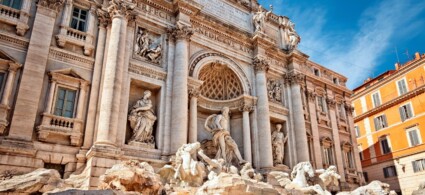
This part of Rome is home to some of the city’s finest attractions, starting with the Trevi Fountain, Piazza di Spagna with its Spanish Steps, the Pantheon and Piazza Navona. Many of the streets connecting these monuments are pedestrianised and highly pleasant to stroll along, with plenty of shops ranging from small independent boutiques to major international brands.
Staying in Rome’s historic centre means you can visit a substantial number of monuments without relying on public transport, whilst also enjoying wonderful walks through the city’s main shopping streets.
On the flipside, accommodation in the historic centre is definitely pricier than average, and there’s a higher risk of tourist traps—both in hotels and restaurants. Bear in mind that you’ll still need public transport to visit other unmissable areas like the Colosseum area or the Vatican.
Recommended accommodation in Rome’s Historic Centre
1 Memorable Jacuzzi Suite Navona
Rome - Via dell'Orso 80 int. 2
8.6Fabulous 34 reviews
Right in the centre of Rome, situated within a short distance of Piazza Navona and Castel Sant'Angelo, Memorable Jacuzzi Suite Navona - Top Collection offers free WiFi, air conditioning and household amenities such as a microwave and coffee machine.
Book now
2 Charming Vittorio by 101 Flats
Rome - Corso Vittorio Emanuele II 337
10.0Exceptional 4 reviews
Right in the heart of Rome, situated within a short distance of Campo de' Fiori and Largo di Torre Argentina, Charming Vittorio by 101 Flats offers free WiFi, air conditioning and household amenities such as a fridge and coffee machine.
Book now
3 Chapter Roma
Rome - Via Santa Maria Dè Calderari 47
9.1Superb 957 reviews
Set in a 19th-century building in Rome’s centre, Chapter Roma is a 5-minute walk from Campo de' Fiori square, and just 900 metres from the Pantheon and Piazza Navona square.
Book now
4 Hotel Sant'Angelo
Rome - Via M. Dionigi 16
7.2Good 7.204 reviews
Set on the right bank of Rome's Tiber River, Hotel Sant'Angelo is set in a historic building, just 1 km from the Spanish Steps.
Book now
5 Cloud 7 Roma Hotel
Rome - Via di Pietra 82
9.2Superb 474 reviews
Set in the centre of Rome, Cloud 7 Roma Hotel is situated 800 metres from Piazza Navona and less than 1 km from Largo di Torre Argentina.
Book now
Termini Station
If you’re arriving in Rome by train, you’ll most likely pull into Termini Station, the city’s main station and arguably Italy’s most important railway hub. This is where high-speed trains from across the country terminate, and once you step off the train, you’ll find yourself in the large Piazza dei Cinquecento, largely serving as a bus terminus for multiple bus routes.
So the main advantage of staying near Termini is having a wide range of public transport at your fingertips to reach almost any part of the city. The red M1 metro line passes through here (Termini stop), numerous bus routes run through Piazza dei Cinquecento, and from the station you can catch regional trains to other parts of the capital, such as Ostiense, Tiburtina, Tuscolana and Fiumicino airport.
Speaking of airports, most buses from both Ciampino and Fiumicino stop at Termini, along with the Leonardo Express train from Fiumicino and a regional train to Ciampino town centre.
Clearly, staying near Termini means you can minimise travel time once you arrive in Rome by train or plane, avoiding the hassle of lugging luggage across the city or taking uncomfortable bus rides to your hotel.
The choice of hotels near Termini is extensive, particularly along Via Marsala and Via Giolitti, the two streets flanking the station on the north and south respectively. Often these are small, unpretentious hotels perfect for a night or two, but you’ll also find excellent 4 and 5-star properties.
As with many Italian cities, the atmosphere around the station at night isn’t ideal, and dining options are mostly fast food, much of it ethnic. Factor this in if you’re planning a Rome holiday with Termini Station as your base.
Recommended accommodation near Termini Station
Trastevere
For many people familiar with Rome, Trastevere represents authentic Rome just steps from the historic centre, whilst others simply see it as another trendy, hipster tourist neighbourhood. Regardless of your view, the fact remains that Trastevere is unlike anything else you’d imagine Rome to be, yet it will feel oddly familiar because the neighbourhood has featured so often in photographs, postcards and films that defined Italian cinema.
Wandering Trastevere’s winding streets, you won’t find grand monuments like the Colosseum or Trevi Fountain—you’ll need public transport for those. But the neighbourhood’s real charm lies in its hidden piazzas, the little alleys that evoke 1960s Rome, and some genuinely fascinating monuments and museums, including the Basilica of Santa Maria in Trastevere, the Basilica of Santa Cecilia in Trastevere, Villa Farnesina, the Corsini Villa Museum and much more.
From Trastevere, it’s also easy to visit Tiber Island, which sits in a bend of the Tiber. Finally, if you want to connect with Rome from sunrise, take an early morning stroll up the Gianicolo, from which the city’s panorama at dawn is truly spectacular.
Accommodation in Trastevere is mostly small apartments and bed-and-breakfasts, but don’t worry about the lack of board options! Trastevere has an incredibly high concentration of traditional restaurants and trattorie where you can enjoy authentic Roman cuisine at reasonable prices.
Recommended accommodation in Trastevere
Colosseum
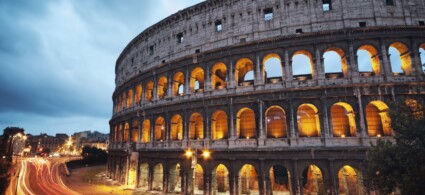
The Colosseum area is roughly 2-3 kilometres south of Termini Station, positioned slightly away from the main tourist drag. However, this part of the city contains an extraordinary concentration of ancient Rome monuments—essential stops for any visitor to the capital. Staying near the Colosseum makes strategic sense if your vision of a Rome trip revolves around discovering ruins, archaeological remains and history museums: this zone alone contains six unmissable attractions.
They are the Colosseum, the Roman Forum, Palatine Hill, the Circus Maximus, the Caracalla Baths and the Domus Aurea. If you want to visit them all and choose to stay in this area, you won’t need public transport—the distances between sites never exceed a kilometre. Plus, the neighbourhood is quite green with several parks and cycling paths.
However, there are some drawbacks: firstly, staying near the Colosseum places you outside the historic centre but in an area packed with tourists, which affects hotel and restaurant quality. Secondly, if you want an evening stroll, there’s not much to do, especially if you’re near Circus Maximus or the Caracalla Baths, unless you head north towards the Pantheon and into central Rome.
Recommended accommodation near the Colosseum
Vatican
Vatican City is the world’s smallest state, entirely contained within Rome. Located west of the historic centre on the far side of the Tiber in a rather remote position, it nonetheless attracts millions of visitors annually due to its extraordinary tourist appeal.
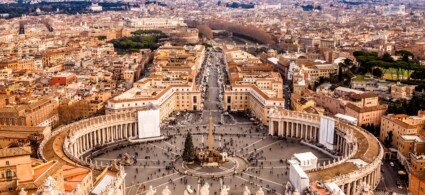
Staying near the Vatican means you can wake up and find yourself steps away from the magnificent St Peter’s Square, behind which rises the imposing St Peter’s Basilica. A visit to the Vatican Museums is essential, and staying nearby lets you be at the entrance when it opens, dodging the worst of the midday tourist crowds.
Between viewing the Sistine Chapel with Michelangelo’s magnificent frescoes and strolling through the Vatican Gardens, your time in Rome will centre on the treasures of the Church and the splendid sacred artworks in the various museums.
However, staying near the Vatican brings considerable drawbacks. Firstly, as mentioned, the area is quite remote, so visiting the rest of Rome requires a series of public transport journeys that aren’t always straightforward: the nearest metro stop is Ottaviano, which is about 15 minutes’ walk from St Peter’s Square.
Additionally, the Vatican area is notorious for tourist traps, with restaurants serving poor-quality meals and bars often inflating customer bills unjustifiably. Finally, if you’re arriving by train or plane, reaching the Vatican could mean an extra hour of travel juggling buses, metros and connections, which can be tedious when carrying heavy luggage.
Recommended accommodation near the Vatican
Ostiense
Ostiense is a neighbourhood south of central Rome, whose main tourist attraction is the Basilica of St Paul Outside the Walls, dating from the 4th century. But you don’t choose Ostiense for cultural sightseeing; rather, to experience authentic Rome, populated by university students frequenting the bars and clubs of Garbatella, and numerous spots where you can eat well cheaply. Ostiense’s strength is its railway station, where regional trains stop running to Tiburtina and especially Termini, plus two stops on the metro Line B—specifically Garbatella and Basilica S.Paolo—that quickly connect you to Circus Maximus, the Colosseum and Termini, where you can interchange to Line A.
Ostiense also offers a range of essential services that bring people to Rome for non-tourist reasons: the Bambino Gesù Children’s Hospital and Roma Tre University.
The disadvantages of staying in Ostiense naturally relate to distances for reaching Rome’s main tourist landmarks: it takes roughly 45 minutes on public transport to reach the Vatican, and about half an hour to many of Rome’s iconic monuments and squares, such as Piazza di Spagna, Trevi Fountain or Piazza del Popolo.
Recommended accommodation in Ostiense
Nomentano
The Nomentano district in Rome stretches east of the historic centre, from Porta Pia to Roma Tiburtina station. It’s a sprawling area, so deciding where to stay in Nomentano is quite the challenge in itself. The neighbourhood is home to numerous high-quality hotels, including several from major international chains. It’s a residential district served by Line 2 of the metro, thanks to the Bologna stop, which sits roughly in its geographical heart.
To the east of Nomentano lies Roma Tiburtina railway station, where numerous high-speed trains also stop before continuing to Roma Termini. You could take advantage of this if you’re arriving in Rome by train and want somewhere more peaceful and less touristy to stay than the chaos around Termini, with prices below city-centre rates and a more local feel.
The downside, of course, is that there isn’t a great deal to see, apart from the lovely Villa Torlonia with its elegant interiors and museums, plus its magnificent gardens. If you choose Nomentano for accommodation in Rome, be prepared to spend considerable time on public transport getting to the capital’s main attractions and monuments.
Recommended accommodation in Nomentano
Testaccio
Testaccio is a district in central Rome situated south of Trastevere but on the opposite bank of the river, not far from the Circus Maximus. It strikes an excellent balance, offering relative proximity to some of Rome’s main tourist attractions whilst being in a non-touristy area; indeed, Testaccio is historically one of the neighbourhoods where Roman authenticity runs strongest.
If you want to experience Rome as locals do, visit the celebrated Testaccio market, for instance, and savour the Roman cuisine at the many restaurants in the area. Testaccio is also close to Roma Porta San Paolo railway station, which is also home to the Piramide metro stop. For this reason, staying in Testaccio makes it fairly easy to get around by public transport.
That said, Testaccio is roughly 20 minutes by metro from Termini, around 25 minutes from the Vatican and approximately 35-40 minutes from Piazza del Popolo. So whilst you’ll be in a semi-central neighbourhood, you’ll need to factor in daily travel by public transport to see everything Rome has to offer.
Recommended accommodation in Testaccio
 Hotel
Hotel  Budget accommodations
  Apartments
  Family Hotel
  Luxury Hotel
  Resorts