Roma Pass: Official City Card with Transportation
Unlock Rome's treasures with priority access to 45+ iconic sites. Enjoy unlimited public transport for 72 hours and save up to 40% compared to individual tickets.
From 55,57 €
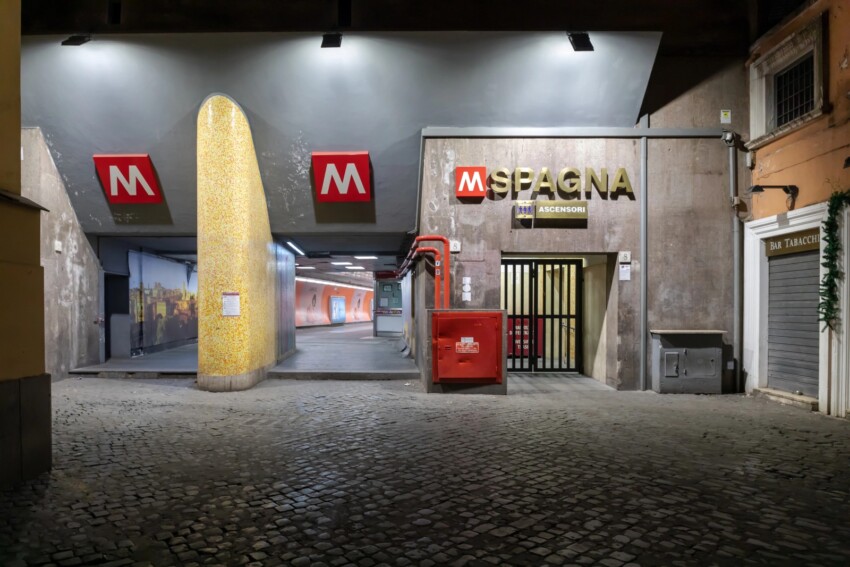
Rome’s underground railway is the rapid transit network of Italy’s capital, comprising three lines — A, B and C — that connect the historic centre with outlying districts and major interchange hubs. Although it lacks an IATA identification code by definition (it’s an urban system, not an airport facility), Rome’s metro is nonetheless the quickest way to get around between UNESCO World Heritage sites and some of the world’s most visited monuments. Operated by ATAC, the network extends for approximately 60 km of track and serves over 300 million passengers annually.
Rome is a complicated city to navigate at ground level due to heavy traffic and numerous limited traffic zones. The underground therefore represents a strategic solution, particularly for reaching the Colosseum, the Vatican Museums or Termini Station reliably and without surprises. However, the network still has significant gaps due to historical excavation difficulties in a city that conceals archaeological treasures at every metre of depth.
In this guide you’ll find everything you need to know: the three lines in detail, the most useful stations for tourists, how to buy tickets, opening hours, fares and practical tips for getting around efficiently during your stay in Rome.
The Roman underground system comprises three lines distinguished by the colours orange (A), green (B/B1) and dark green (C). Each line serves different areas of the city and connects with various tourist attractions and services. Understanding the characteristics of each is essential for planning your journeys effectively.
Line A is the most important for tourists visiting Rome. Opened in 1980, it connects the Battistini district in the west with Anagnina in the south-east, running through the heart of the city. With 27 stations and a length of approximately 18 km, this line serves some of the most strategic stops on the entire network.
Ottaviano station is the main access point for the Vatican: from here the Vatican Museums and St Peter’s Basilica are within a ten-minute walk. Spagna station, beneath Piazza di Spagna, is one of Italy’s most photographed stations: the tracks literally run beneath the Spanish Steps. From Barberini you can reach the Trevi Fountain on foot in five minutes. Flaminio station corresponds to Piazza del Popolo and the entrance to Villa Borghese.
It’s worth noting that Repubblica station, designed by architect Paolo Tognini, features elegant glass panels on the platforms that give glimpses of Roman bath ruins as the train passes — a detail many visitors don’t expect.
Line B, opened in 1955 and extended several times over the decades, is the oldest line on the Roman network. It connects Jonio in the north-east with Laurentina in the south, with a crucial interchange hub at Termini station. The B1 branch splits off from Bologna towards the Conca d’Oro district, serving the university area of La Sapienza.
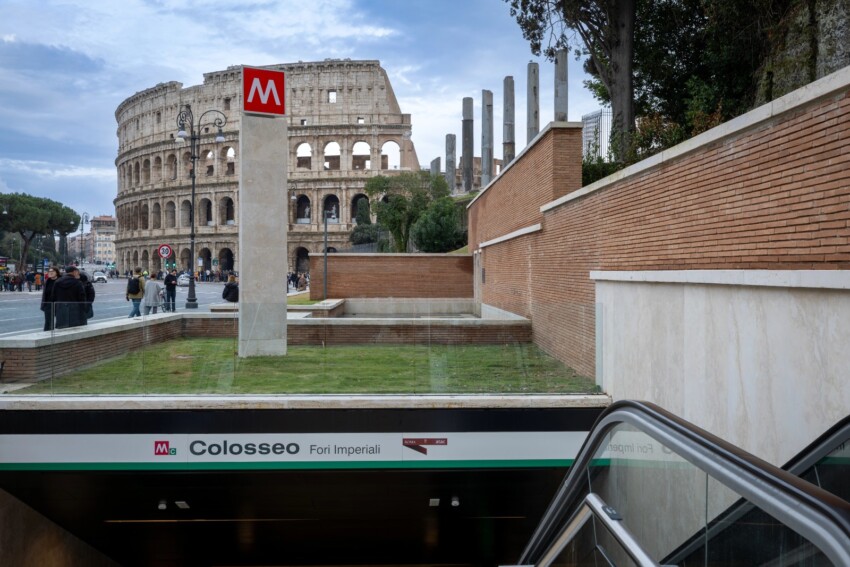
The most important stop for tourists on Line B is undoubtedly Colosseum, which opens directly opposite the Flavian amphitheatre. Exiting from the main exit, the Colosseum is less than 100 metres away — a visual impact that surprises you even after seeing it a thousand times in photographs. From here, the Roman Forum is accessible on foot in just a few minutes.
Circus Maximus station allows you to reach the ancient site itself and the Palatine Hill, while EUR Fermi and EUR Palasport take you to the rationalist district designed for the 1942 Universal Exposition, which was never held.
Line C is the most recent and technologically advanced line on the Roman network: it is fully automated, driver-less, and uses new-generation trains manufactured by Hitachi Rail. Opened in phases from 2014 onwards, it currently connects Monte Compatri-Pantano in the east with San Giovanni, where you can interchange with Line A.
The extension towards the centre has been underway for years and is subject to continuous archaeological discoveries that slow its progress. Excavation for Amba Aradam/Ipponio station revealed in 2016 a Roman barracks from the 2nd-3rd century AD with 39 rooms, mosaics and personal objects belonging to legionaries — a discovery of extraordinary importance that necessitated a complete project revision. When the extension reaches Piazza Venezia and subsequently the Prati district and Vatican, Line C will become essential for tourists too.
The stations already open along the eastern stretch are interesting from an architectural standpoint as well: some, such as Lodi and Malatesta, feature permanent art installations and underground exhibition spaces worth observing.
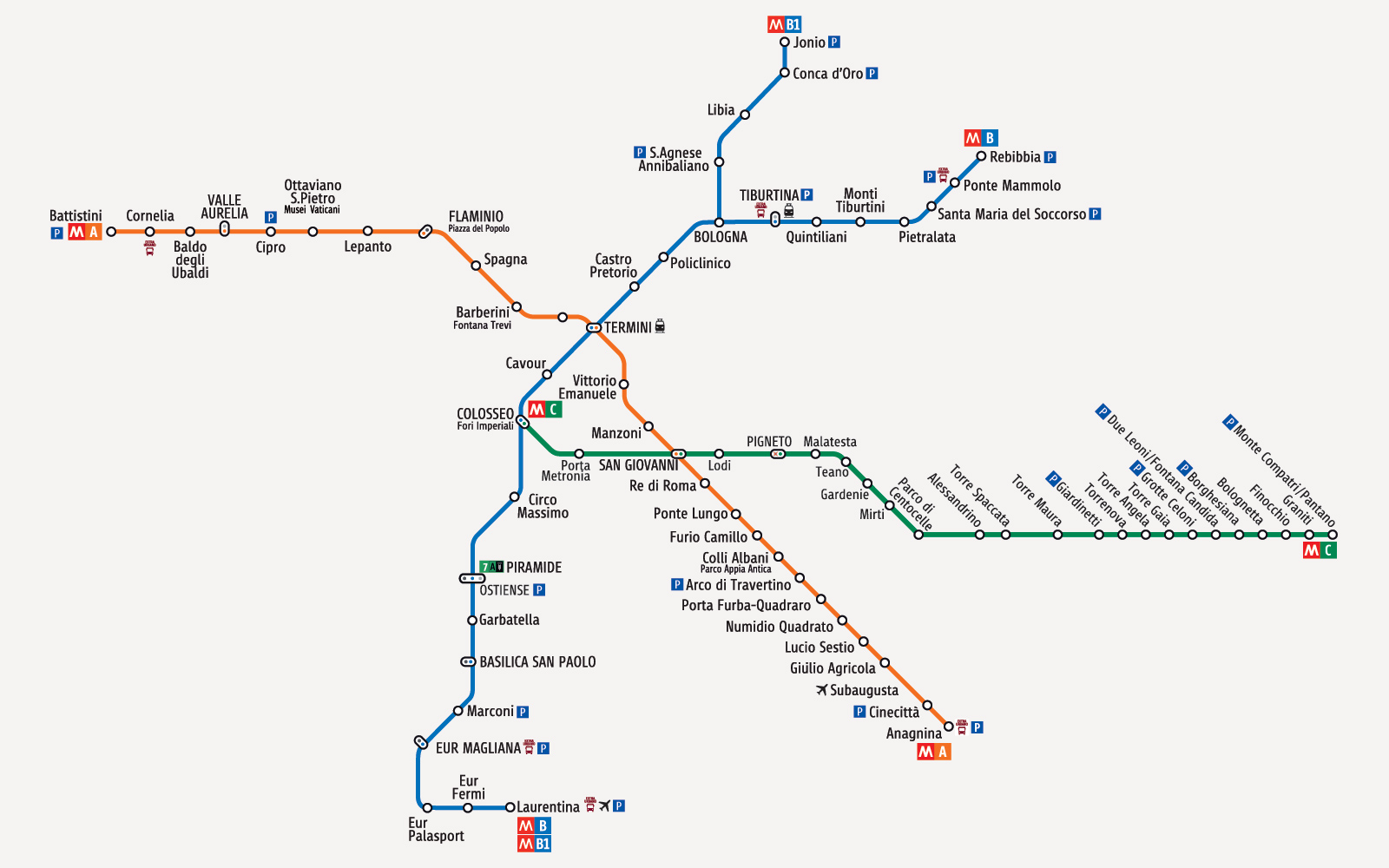
Before you leave or as soon as you arrive in the city, download the official Rome metro map in PDF format: having it on your phone allows you to consult it offline without using data and without needing to search for information panels in stations. The map shows all stations on Lines A, B, B1 and C with connections, termini and the main points of interest reachable from each stop. It’s an indispensable tool for planning your journeys in advance and getting your bearings quickly during your visit.
Metro Map in PDFRome’s underground ticketing system is integrated with the entire ATAC network, which includes buses, trolleybuses and trams. A single ticket is valid for all modes of transport during its validity period.
The standard ticket is the BIT (Integrated Time Ticket), which costs €1.50 and allows travel on any ATAC service for 100 minutes from validation, with one metro journey included. You cannot re-enter the metro with the same ticket after exiting the barrier.
For those staying several days, temporary passes offer better value: the 24-hour ticket costs €7, the 48-hour ticket costs €12.50, the 72-hour ticket costs €18 and the weekly CIS ticket costs €24. Residents have access to monthly and annual passes, but these are tied to residency.
Those purchasing the Roma Pass in the 48 or 72-hour version get unlimited travel included on the entire ATAC network, plus free entry to some museums: it’s an advantageous solution if you plan to use the metro frequently during your visit.
Tickets are purchased from the automatic ticket machines present in all metro stations, at participating bars and tobacconists (identifiable by the ATAC logo), and through the official MyCicero app or other apps such as Moovit. Staffed ticket offices are only available at the largest stations (Termini, Ottaviano, Spagna) and have limited hours.
It’s essential to validate your ticket before passing through the barrier or, in the case of buses, in the appropriate machine on board. Checks are frequent and the fine for travelling without a valid ticket is €100, reduced to €50 if paid within 5 days. Keep your ticket with you throughout your journey.
Rome’s underground operates with hours that vary slightly depending on the day of the week. From Monday to Thursday and on Sunday, the service runs from 5:30 to 23:30. On Friday and Saturday the closing time extends to 1:30 in the morning, to meet increased weekend demand.
For special events — concerts at the Stadio Olimpico, museum nights, New Year’s Eve — the service may be extended until 3:00 or even all night. ATAC announces these exceptions in advance on its official website. On public holidays the hours are similar to those on Sundays.
Train frequency during peak hours (7:30-9:30 and 17:00-19:30) is approximately 3-4 minutes on Line A, 4-5 minutes on Line B and 4 minutes on Line C. During lighter evening periods frequency drops to 7-10 minutes, so it’s worth keeping this in mind when planning your return from dinner.
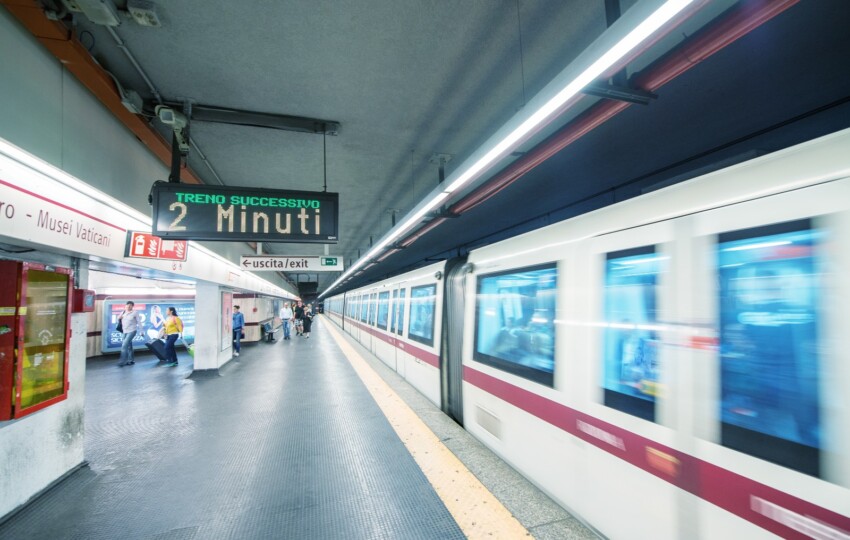
Not all stations on Rome’s metro are equally useful for visitors to the city. These are the stops worth getting to know well, with the main attractions within walking distance of each.
Termini station is the nerve centre of the entire network: this is where Lines A and B intersect, dozens of bus routes converge, regional and national Trenitalia and Italo trains arrive, and the Leonardo Express departs for Fiumicino Airport. If you’re arriving from the airport, Termini will almost certainly be your first contact with Rome.
In the station’s surroundings you’ll find the National Roman Museum at the Baths of Diocletian, the Basilica of Santa Maria Maggiore (a 5-minute walk away) and Piazza della Repubblica. The area is very busy and requires the normal pickpocket awareness typical of any major European railway hub.
Spagna station is a little gem: on exiting, you find yourself right at the foot of the Spanish Steps. The station itself, designed in the 1970s, is considered a successful example of underground architecture integrated into the urban landscape. From here you can reach Via Condotti (luxury shopping), Villa Borghese and the Galleria Borghese on foot.
Ottaviano station on Line A is the ideal starting point for visiting the Vatican. Exiting from the main exit and following Via Cola di Rienzo or Viale delle Milizie, you can reach the entrance to the Vatican Museums in approximately 10-12 minutes. The alternative Lepanto station, two stops towards the east, is instead more convenient for reaching St Peter’s Square directly. Castel Sant’Angelo is approximately 15 minutes’ walk from both exits.
Exiting Colosseum station on Line B is an experience that stays with you: the monumental Flavian amphitheatre appears suddenly just a few steps from the exit barrier. It’s probably the station with the most spectacular urban setting on the entire network. From here you also have access to the Victor Emmanuel II Monument (approximately 20 minutes’ walk along Via dei Fori Imperiali) and the Roman Forum.
The underground covers a significant portion of Rome’s attractions, but not all of them. Here’s a practical map of the most common journeys for visitors.
For the Vatican the recommended stop is Ottaviano (Line A). For the Colosseum and Roman Forum get off at Colosseum (Line B). For the Trevi Fountain the nearest stop is Barberini (Line A), from where it’s about a 5-minute walk. For Piazza Navona and the Pantheon the metro doesn’t reach: the nearest stops are Spagna or Barberini (Line A), both about 20-25 minutes’ walk away, or you’re better off using a surface bus. For Villa Borghese get off at Spagna (Line A) and walk uphill along the steps towards the Prati di Castello.
Trastevere, Campo de’ Fiori and most of the historic centre are not served by the underground: for these areas the recommendation is to rely on the bus network or reach the nearest points by metro and complete the journey on foot. Check our guide on how to get around Rome for a complete overview of all available transport options.
Rome’s underground, particularly the A Line during peak hours, is unfortunately well-known for pickpocketing. The stations at greatest risk are Termini, Spagna and Repubblica, where trains are crowded and tourists with backpacks and cameras are frequent targets. The practical advice is to keep your backpack and bag in front of your body, not in your back trouser pockets, and stay alert when the carriage is particularly packed — often the overcrowding is deliberate.
Groups of people approaching suddenly near the turnstiles or train exit are a warning sign. It’s not uncommon for small organised groups to operate in coordination, especially at the busier tourist stations.
Not all Rome Metro stations are accessible for people with mobility disabilities or those travelling with pushchairs. The situation has improved in recent years but remains inconsistent: many stations on Lines A and B have lifts, but frequent breakdowns make them unreliable. The C Line, being the most recent, is fully accessible.
Before you travel, it’s worth checking the ATAC website for the status of lifts at the stations you plan to use. Alternatively, many stops have working escalators even when lifts are out of service.
The BIT ticket and temporary passes are also valid across the entire ATAC bus network, including night buses. This means you can get off the metro at Termini and board a bus to Trastevere without buying a second ticket, provided you’re within 100 minutes of your initial validation.
If you’re arriving by car, the most convenient option is to park at one of the park-and-ride facilities near the outer metro stations — such as Anagnina (A Line), Laurentina (B Line) or the eastern stations on the C Line — and continue by underground. This avoids city-centre traffic and central car park fees. For advice on where to leave your car, consult our page on car parks and driving to Rome.
The history of Rome’s underground is inseparable from the history of the city itself. The first metro project dates back to 1925, but real construction work only began in the 1930s under the Fascist regime. The B Line was opened in 1955 as the first operational line, with a route that partly followed the ancient Roman consular roads.
The A Line opened in 1980 after decades of work slowed by the continuous discovery of archaeological remains. Between Ottaviano and Termini alone, the building sites had uncovered hundreds of artefacts dating from the Republican and Imperial periods. Many of these finds are now displayed in the Museo della Repubblica Romana e della Memoria Garibaldina and other city museums.
The C Line, the most ambitious and troubled project, has been under construction for over twenty years. The estimated total cost exceeds 3 billion euros and completion to Piazza Venezia is expected — according to the latest projections — no earlier than 2030. Every metre of excavation is preceded by preventive archaeological surveys, a process that slows construction but has yielded extraordinary discoveries, including the aforementioned Roman barracks beneath Amba Aradam.
No, the underground doesn’t reach the airports directly. For Fiumicino Airport the most direct connection is the Leonardo Express, which departs from Termini every 30 minutes and takes about 32 minutes. Termini is accessible by both the A Line and the B Line.
Monday to Thursday and Sunday the metro closes at 23:30. On Friday and Saturday service runs until 1:30 in the morning. On special occasions the service may be extended.
Yes, the Roma Pass in its 48 and 72-hour versions includes unlimited travel across the entire ATAC network, including the underground. It’s a cost-effective solution if you plan to use public transport several times a day.
From Colosseo station (B Line) go to Termini, change onto the A Line towards Battistini and get off at Ottaviano. The total journey time is around 25-30 minutes, including the change. This is one of the most frequent journeys among tourists.
On the whole, yes, but it’s advisable to be vigilant about pickpocketing, particularly on the A Line at tourist stations like Termini, Spagna and Repubblica. Keeping your luggage in front of your body and not displaying valuables significantly reduces the risk.
Children under 10 years old travel free. Teenagers aged 10 to 18 pay the full ticket price. There are no generalised reduced fares for elderly tourists unless they are registered residents of Rome. Some reductions are available for specific categories (disabled passengers with appropriate certification).
Folding bicycles are permitted on all ATAC services without restriction. Standard bicycles are allowed on the B and C Lines, on public holidays and weekends only, not during peak hours. On the A Line, ordinary bicycles are not permitted.
An optimal itinerary involves using the metro as your backbone and completing journeys on foot. Consult our guide on what to see in Rome in 3 days for a detailed programme that makes the best of the Metro network.
City Card allow you to save on public transport and / or on the entrances to the main tourist attractions.
 Hotel
Hotel  Budget accommodations
  Apartments
  Family Hotel
  Luxury Hotel
  Resorts