Book now
1 Garage Centrale Roma Valle Aurelia
41 reviews
Garage Central is situated just outside the centre which is easily accessible on foot. The car park is indoors and can accommodate all vehicles.
Transfer by shuttle 5 min
Rome is a city with a historical, architectural and cultural heritage that the world envies, attracting millions of visitors from different countries each year. Since the time of the ancient Romans, who made this city the heart of their empire, important infrastructure has been built in Rome, along with roads and communication routes that served for the transport of goods and people. Now Italy’s capital has managed to preserve a centre rich in sites of interest and remains well connected to the rest of the country, partly thanks to some road links conceived thousands of years ago.
To discover all the attractions that Rome’s centre has to offer, it’s recommended to explore the city on foot and with the support of public transport, as the city’s roads are very busy and chaotic. There are also many restricted traffic zones (ZTL), which often make it complicated to navigate for those unfamiliar with the city’s traffic system, as well as numerous car parks reserved for residents that make parking difficult. For those arriving in the capital by car, it’s advisable to find a car park and leave your car there for your entire stay in Rome. However, it should be noted that it’s not particularly easy to find parking in the city centre, and not all hotels have car parks for their guests.
Street parking in central Rome is usually charged (marked with blue lines) with rates varying depending on the area and time of day. There are also a few free spaces marked with white lines, but disc parking is required almost everywhere. Street parking in Rome isn’t easy, and there’s also the risk of accidentally entering a ZTL zone while searching for a space. However, if your car is the most practical way for you to travel, don’t worry – here you’ll find a mini-guide with plenty of useful tips on where to park in Rome. Learning about the different options available in the city will help you not only avoid fines but also save time and money.
As already mentioned, Rome is a very busy city and finding parking, especially in the centre, can require time, patience and a considerable knowledge of city streets and roads. The choice of car park depends on several factors, including where you’re arriving from, how many days you’re staying in the city and how often you need to move your car. Those staying in the central area can choose a hotel with parking available for guests or one that has an agreement with a local garage. In the vicinity of the centre, there are indeed garages and car parks with agreements with hotels and restaurants, which can be covered or uncovered, with charges by the hour or by the day.
Another option is to choose one of the car parks further away from the centre, which are connected to the central area by bus lines and are therefore definitely more competitively priced. There’s also the option of driving to locations near the centre and using so-called “park-and-ride facilities“, which allow you to park and then take public transport into the capital at a reduced price. In particular, park-and-ride facilities are located near the stations of lines A, B and C of the Metro (for example Conca d’Oro, Libia or Battistini) and at the terminals of urban and inter-urban buses.
Below is a selection of private car parks of proven reliability in each area.
Parking near Termini Station can be the right choice for those looking for a solution not too far from the centre at fairly reasonable prices. In the Termini area, there are several garages, car parks and attended and/or video-monitored parking facilities considered excellent solutions as they represent a good compromise between price and proximity to the centre. From here, you can reach the Colosseum on foot with a 20-30 minute walk.
Practically all facilities in the area are paid parking, and it’s always best to check the conditions of each car park, as some are ideal for extended stays of several days while others are only for daily parking. Once you’ve parked your car, you can move around on foot or by metro (lines A and B) or via the various bus lines that allow you to reach the central areas.
Moreover, it can be convenient to park near Termini if you intend to use Rome as a base for day trips to nearby locations. Rome Termini railway station is indeed well connected to several other cities in the area such as Ostia or Civitavecchia. In the area you can also find car spaces (some marked with blue lines, others with white lines) along nearby wider and smoother roads such as Viale dell’Università or Via Principe Eugenio.
Generally, areas near railway stations are always characterised by the presence of parking along nearby streets and paid car parks near the station. For example, near Rome Tiburtina, Ostiense and Valle Aurelia railway stations there are several garage and car park alternatives or spaces along the road. Station car parks are usually video-monitored, open 24/7 and have very competitive rates.
At Rome Ostiense there are several car parks a short distance from the station such as Ostiense Parking, Piramide car park and San Paolo car park. Near Gemelli Station you’ll also find several garages and car spaces at reasonable prices and, although these are further from the city centre, they’re well served by public transport. In this case too, it’s advisable to book your parking in advance online to save money and guarantee your preferred space.
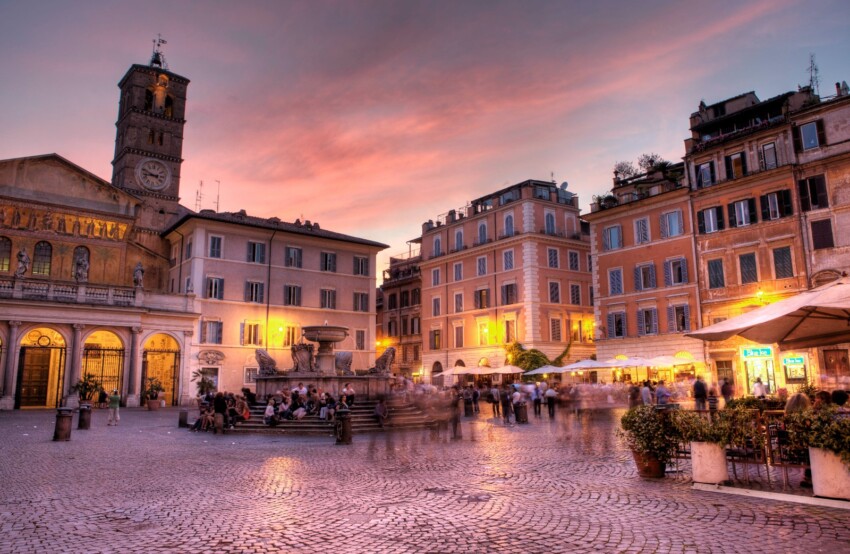
Trastevere is undoubtedly one of Rome’s most charming neighbourhoods, but like other parts of the historic centre it has restricted traffic zones (ZTL) where vehicle circulation is limited or prohibited. One of the few free car parks in Rome is the one in Trastevere, located near the railway station close to Piazzale della Radio. This car park boasts free spaces with no time limit for parking, so you don’t need a disc. Obviously, finding a free space here isn’t easy, and the advice is to arrive early in the morning to see if you’re lucky. It’s very difficult to find a space at weekends, especially on Sundays when the Porta Portese market takes place. From this area, it’s possible to reach Piazza del Colosseo with a walk of about 40 minutes or in 20 minutes using public transport.
There are also other paid car parks in Trastevere, several with reasonable rates for parking your car for one or more days, but you need to be careful as some are open 24/7 while others only during daytime hours or from 7:00 to 24:00. One tip to avoid wasting time searching for a car park could be to book your space in advance online. There are also open and covered multi-storey car parks in the station area where you’ll find reasonable prices, while in the Ponte Testaccio area or near Isola Tiberina the rates are significantly higher.
Another very central area where you can park is Vatican City, which allows you to be close not only to the Basilica of St. Peter but also to Bambino Gesù hospital and the centre. Here you’ll find several facilities where you can park cars, campers, motorcycles and coaches, some of which are covered garages but only open during daytime hours. Given the central location, rates can be quite high: from €2.50 to €4.00 per hour. One of the largest is Terminal Vaticano car park, located just a stone’s throw from the Holy See and spread over five floors offering a wide range of discounts and agreements.
Parking near Villa Borghese is ideal if you want to be just a short walk from the villa itself, as well as from Piazza di Spagna, Villa dei Medici and Trinità dei Monti. There are several car parks here open 24/7, both uncovered and covered, some of which are attended and others video-monitored. The largest facility is undoubtedly SABA Villa Borghese car park, where it’s usually easy to find a space. Prices in this area are certainly higher than in other areas, but you can find several solutions with a good balance between location and cost.
EUR (Esposizione Universale Roma) is a district in the south-west of Rome that was built in the early 20th century to host the 1942 EXPO, which never took place due to the outbreak of war. Although the district is a bit outside the central area of Rome, it’s well connected by metro line B and is therefore practical for those arriving in the capital by car but then want to use public transport. In particular, at EUR-Laurentina metro station there’s a large multi-storey car park, as well as at the EUR palasport stop where you’ll find spaces at competitive prices for both daily and multi-day parking.
For those arriving in Rome by air, it can be really convenient to hire a car directly at the airport, whether at Fiumicino or Ciampino, where the choice of available vehicles is often very wide and rates are advantageous. In the areas around Rome, there are indeed numerous sites to see, and having a car at your disposal is really worthwhile because you can plan an itinerary and move around with complete freedom. As already mentioned, hiring a car at the airport (Fiumicino or Ciampino) is always the best choice, but if you intend to stay in Rome for a few days, you won’t need the car.
At this point, on arrival you can take a hire car at the airport and park it for a couple of days in one of the capital’s car parks, or you can reach the city centre by public transport or by a convenient taxi. Then, once you’ve finished visiting the city, you can reach the airport car hire agency by bus or train and, having picked up the vehicle, you can set off on your itinerary. Later, at the end of your stay you can return the car at the airport before taking your return flight. Of course, you can also hire a car in other cities in the Lazio region, but it’s certainly more convenient to pick up and return the vehicle at the same agency to avoid paying additional costs.
Rome is a destination that can be easily reached by train, by plane or by car from various locations both in Italy and abroad. If you’ve chosen to reach the capital by car and you’re arriving from north or south, the best route is the A1 Milan – Naples motorway. In general, all motorways to Rome intersect with the Great Ring Road (GRA), which surrounds the capital, and where you’ll find the various exits for the centre and the outskirts of Rome.
The main motorways connecting the capital to the rest of the peninsula are:










 Hotel
Hotel  Budget accommodations
  Apartments
  Family Hotel
  Luxury Hotel
  Resorts