Fiumicino Airport (FCO): Bus Transfer from/to Rome Termini
33.222 reviews
Buy now
From 7,00€ per person
That Rome’s traffic is chaotic is something everyone knows. Therefore, if you’re planning a holiday in the capital, consider leaving your car at home and getting around by public transport. Of course, the best way to explore the city centre is to walk around, with your eyes raised to avoid missing a single detail among elegant palaces, Baroque fountains and archaeological remains. But Rome is undoubtedly a vast city, and often walking isn’t practical due to time and distance constraints.
This is where you’ll need to rely on public transport, managed by the public company ATAC. Although it often gets bad press, Rome’s public transport is extensive, frequent and reasonably efficient. Admittedly, a metro system with only three lines is insufficient for a capital of this size and population, but the buses and trams do their job very well, connecting numerous areas of the city. Added to these are taxis and tourist buses, as well as regional and suburban trains that shuttle between the city’s main railway stations.
More recently, Rome’s public transport has been joined by the now ubiquitous bike-sharing and electric scooter services.
Here’s a brief guide on how to get around Rome, which public transport to choose depending on your route, and information on tickets and passes. Of course, the advice to avoid using a car during your holiday remains valid – you’ll face difficulties navigating the city due to traffic and finding parking.
As mentioned, if you want to get around Rome using public transport, you’re spoilt for choice. Here are the main options available to tourists and residents.
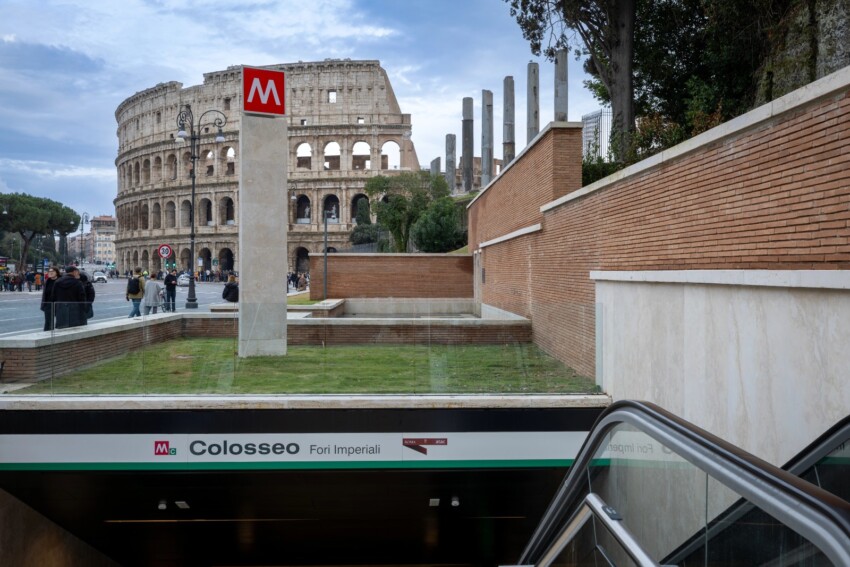
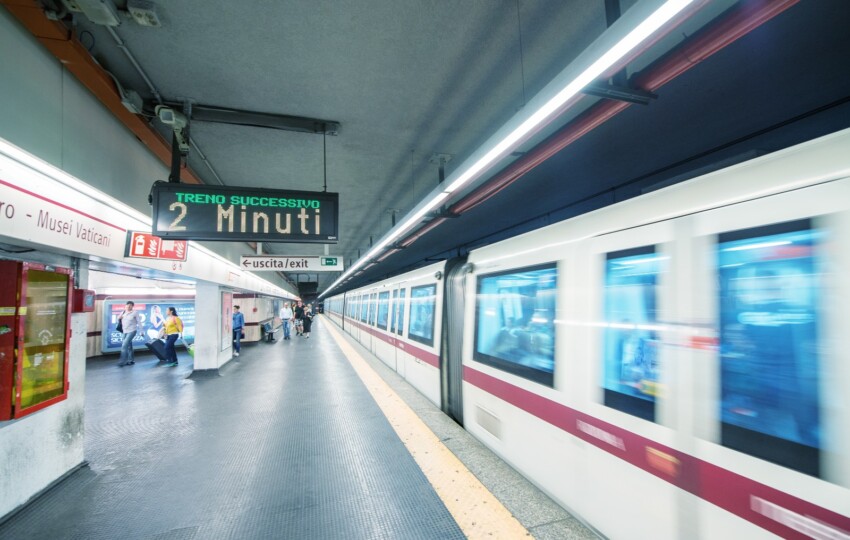
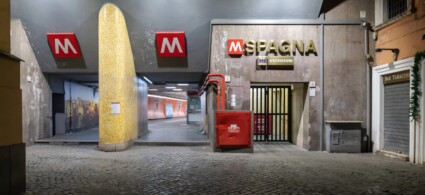
The Rome metro comprises three lines: the orange Line A, the blue Line B and the green Line C, all managed by ATAC. Opened in 1955, Rome’s metro is Italy’s oldest and the second longest after Milan’s.
In total it spans 62.5 kilometres, with three interchanges between lines: A↔B at Termini, A↔C at San Giovanni and B↔C at Colosseo, which opened in December 2025. Of the three lines, the green Line C is the newest, having only opened in 2014 and still expanding. Here are Rome’s metro lines:
As for times, the first departure from each line’s terminus is at 5:30am. From Sunday to Thursday the last service departs at 11:30pm on all three lines. On Friday and Saturday the last departure from the termini is delayed until 1:30am.
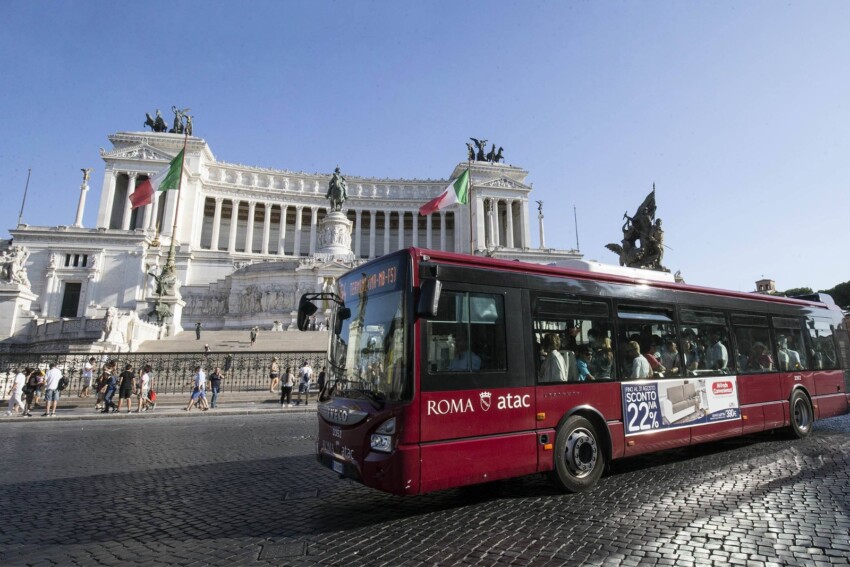
Approximately 350 bus routes run through Rome, managed by both ATAC and the private consortium Roma TPL on behalf of Roma Capitale. The bus network runs mainly within Rome’s city limits, but some routes extend into neighbouring municipalities of Ciampino, Fiumicino, Frascati or Pomezia. In addition to the dense network of urban lines in Rome, there are also some intercity buses operated by Cotral, which connect the capital to nearby cities.
Most of Rome’s routes are urban lines, which generally run between 4:00am and midnight, although some vary slightly. They’re marked with the letter U and the colour blue. They’re divided into high-frequency lines (waiting time less than 10 minutes during peak hours), medium-frequency (waiting time between 10 and 20 minutes) and low-frequency (waiting time over 20 minutes).
In addition to urban lines, some Rome buses run the so-called exact lines, marked with the letter E and amaranth colour, which serve the city’s main cemeteries.
There are also 12 express lines, high-frequency fast lines with spaced-out stops, marked with the letter X and green colour, with numbers 20, 30, 40, 50, 51, 60, 80, 90, 120F, 150F, 180F and 190F.
During the summer season there is also a seafront line marked with the letter m1 in aqua colour, dedicated to the Ostia seafront, and finally there are 31 night lines, which replace some daytime buses during the 11:30pm-5:00am time slot. They’re marked with the letter n and dark blue colour.
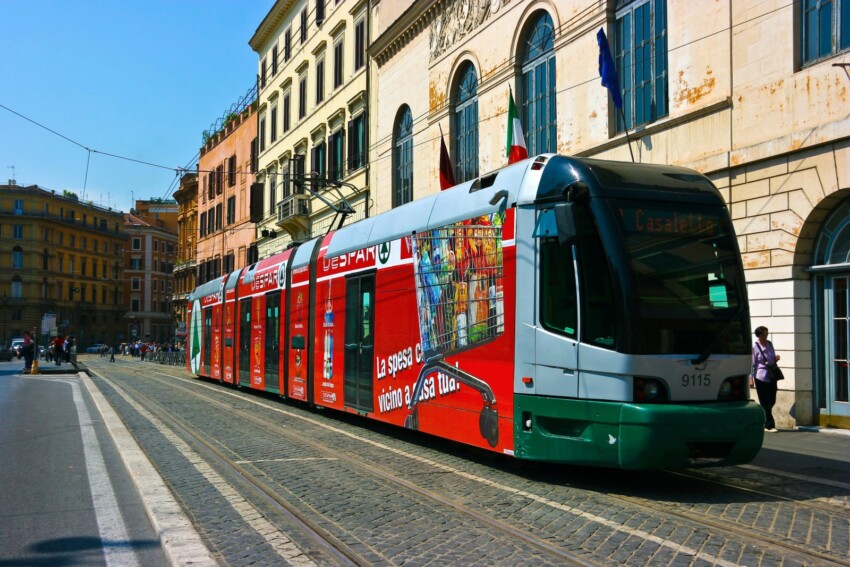
Rome has 6 tram lines, also managed by ATAC. This transport is the oldest still in operation in the city, dating back to 1877. In total, trams operate over approximately 36 kilometres of track. The lines are:
Rome’s tram lines are generally ignored by tourists as they cover areas mostly outside the historic centre. The Line 8 from Trastevere, heading north to return to the centre near Teatro Argentina – Piazza Venezia is convenient, as is Line 3 which passes the Colosseum and Circus Maximus.
Trams operate during the same hours as buses; at night they’re replaced by night buses.
Rome’s suburban trains consist of three lines: Roma-Lido, Roma-Viterbo and Roma-Giardinetti (currently limited to the Termini-Centocelle section). They operate from 5:30am to 10:30pm, whilst the Roma-Lido line remains open until 11:30pm. Trains pass every 10-20 minutes depending on the time of day, and for tourists the most interesting line is undoubtedly Roma-Lido, which also stops at Ostia Antica.
The Roma-Giardinetti railway is still active but scheduled for closure by the end of 2026, when work will begin on transforming it into the new Line G, a tram line that will connect Termini to Tor Vergata University.
There’s nothing stopping you from using regular regional trains to get around the city: from Termini you can reach Ostiense in 10 minutes, Tiburtina in 7 minutes and Tuscolana in 5 minutes.
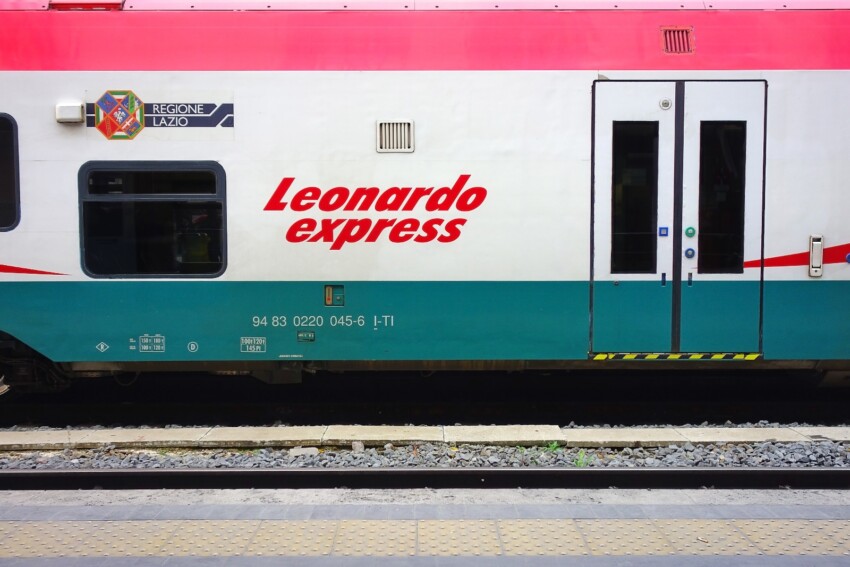
On the pages dedicated to Rome’s airports you’ll find all the detailed information on how to reach the city centre from the two terminals at Fiumicino and Ciampino.
Briefly, we remind you that Rome Ciampino is the airport closest to the centre, being just over 10 kilometres away; it’s connected by several private bus lines that run transfers to and from Termini station, or alternatively you can use urban buses that run from the airport to the Anagnina terminus of metro Line A.
Fiumicino airport, on the other hand, is located about 35 kilometres south-west of Rome’s centre, and is connected via shuttle buses as well as the Leonardo Express train line.
It’s ATAC that manages tickets and passes for public transport in Rome. The basic ticket is called BIT, or time-integrated ticket, and is valid for 100 minutes from first validation on buses, trams, metro and suburban trains, costing €1.50. On the metro it’s valid for a single journey, even across multiple lines as long as you don’t exit the barriers to change between lines A-B-B1.
For convenience, you can buy a 10-BIT card, comprising 10 time-integrated tickets. Once the first 100 minutes have expired, the ticket can be reactivated for another 100 minutes by presenting it to a validator.
For those planning to use Rome’s public transport for several days, timed cards are available at prices updated from 1 July 2025: Roma 24h costs €8.50, Roma 48h costs €15.00 and Roma 72h costs €22.00; all three allow unlimited travel on all Rome public transport from first validation. For longer stays, the CIS, the weekly integrated card at €29.00, is available, valid for 7 days from the date of first validation until midnight of the seventh day, with unlimited travel on metro, buses, trams and suburban trains.
Finally, for those settling in Rome for a longer period, monthly or annual passes are available, with discounts applicable for young people, students and families, and prices varying depending on the zones covered and household income (ISEE).
Rome public transport tickets can be purchased at ticket offices at metro stops, tobacconists and other authorised retailers. They can also be purchased via smartphone using a range of enabled apps (including Trenitalia, MooneyGo, Telepass Pay and Urbi) or directly at metro barriers using a contactless payment card through the Tap & Go system, which automatically calculates the best fare based on journeys made during the day. Access to ATAC and Cotral services is free for children up to 10 years old, whilst on Trenitalia services access is free up to 4 years old.
By purchasing one of the city cards Omnia Card or Roma Pass, you can also enjoy included transport, plus plenty of activities and discounts at shops and entry included to a range of attractions, including the Vatican Museums, the Sistine Chapel, the Colosseum or Galleria Borghese.
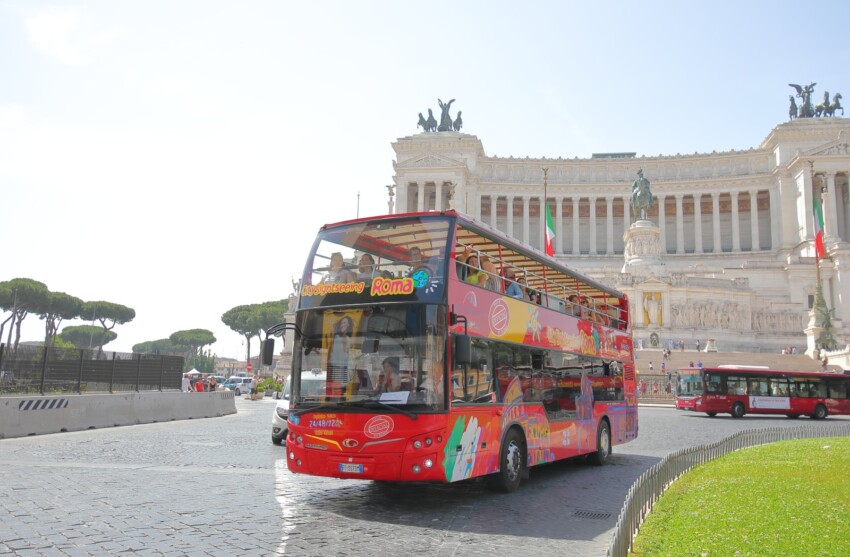
Rome offers Hop On Hop Off tourist buses, which allow you to explore Rome from a privileged viewpoint by taking part in open tours run by the companies City Sightseeing Roma and Big Bus Roma. You’ll climb aboard the famous open-top double-decker buses and admire the city’s main landmarks, such as the Roman Forum, the Colosseum or Piazza Santa Maria Maggiore.
The bus ride comes with an audioguide in 8 languages, and the ticket allows you to get off at any stop and get back on without surcharges. There are three fares available, called Classic, Premium and Deluxe, which vary simply by ticket duration, of 24 hours, 48 hours and 72 hours respectively. The ticket is free for children aged 0 to 4 years.
The final option for getting around Rome is to use a taxi. Travelling by private car has the undeniable advantage of relaxing in complete comfort and journeying safely and reliably, especially during the evening hours. That said, costs can be rather high, both during the day because of the real risk of getting stuck in traffic, and at night due to the standard surcharges on evening fares.
Always remember to use official, licensed taxis that operate a meter and adhere to fixed tariffs, where applicable. The taxi fare schedule is published annually on the City of Rome’s official website, and includes a base charge (which varies depending on the day of the week and time of travel), an hourly rate for speeds below 20 km/h, and a single progressive metered tariff. To call an official taxi, you can use the apps ItTaxi or FREE NOW, which display the estimated fare before you book.
There are discounted fares offering 10% reductions for passengers travelling to one of Rome’s public hospitals, for solo female passengers using taxis between 10 p.m. and 6 a.m., and for young people leaving nightclubs on Friday and Saturday nights, provided the venue has authorised the scheme.
There are also surcharges for each additional bag beyond the first, from the fifth passenger onwards, and for radio taxi call-out fees.
The City of Rome has also set a maximum fare cap for journeys from any point within the Grande Raccordo Anulare ring road to Fiumicino Airport, and a series of fixed tariffs from Fiumicino Airport, Ciampino Airport and Ostia Lido.
City Card allow you to save on public transport and / or on the entrances to the main tourist attractions.


 Hotel
Hotel  Budget accommodations
  Apartments
  Family Hotel
  Luxury Hotel
  Resorts