Bestseller
Rome: Borghese Gallery and Gardens Guided Small-Group Tour
From 99,00 €
Buy the ticket
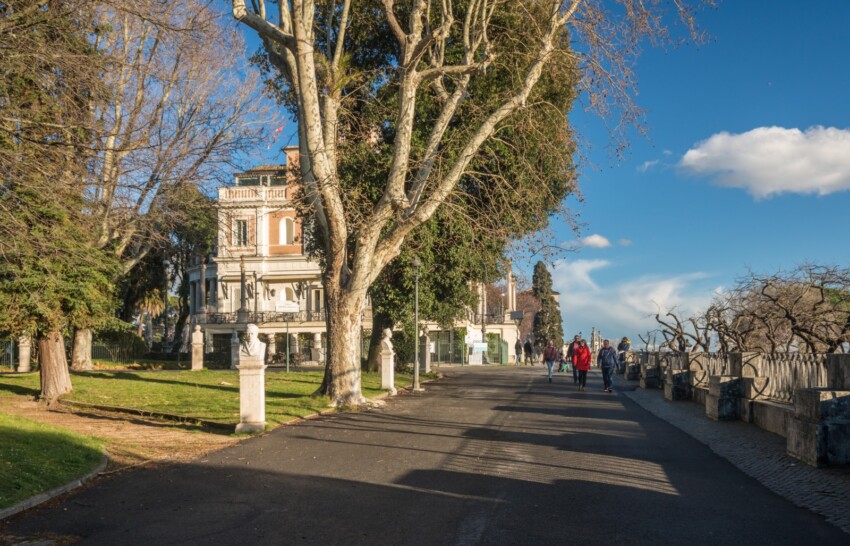
During your stay in Rome, if you visit in summer, you’ll almost certainly find yourself struggling with the heat, and what you’d need is a cool place to walk with plenty of shaded areas that also contains monuments and museums. You’ve found it – Villa Borghese.
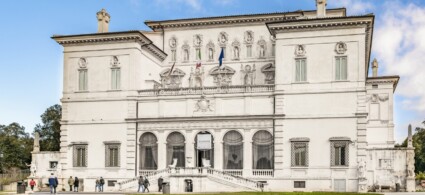
Let’s start by clarifying the name: Villa Borghese is a park, not a villa. The villa within the park is actually Villa Borghese Pinciana, which houses the art museum of the Galleria Borghese. With that cleared up, all that’s left is to explore the 80 hectares of greenery, where you’ll find Italian-style gardens, English-style areas, fountains and small lakes, all owned by the powerful Borghese family since the late 16th century. Within this enormous green space you’ll also discover countless museums, cultural spaces, cinemas, children’s play areas and much more.
The estate, already quite vast originally, was expanded in the 19th century by Camillo Borghese through the purchase of additional land; later, in 1901 it was bought by the Italian state and transferred in 1903 to the City of Rome, to be opened to the public.
The Villa Borghese park is truly enormous, covering 80 hectares and has 9 entrances. It’s not easy to see everything, but here are its most important attractions.
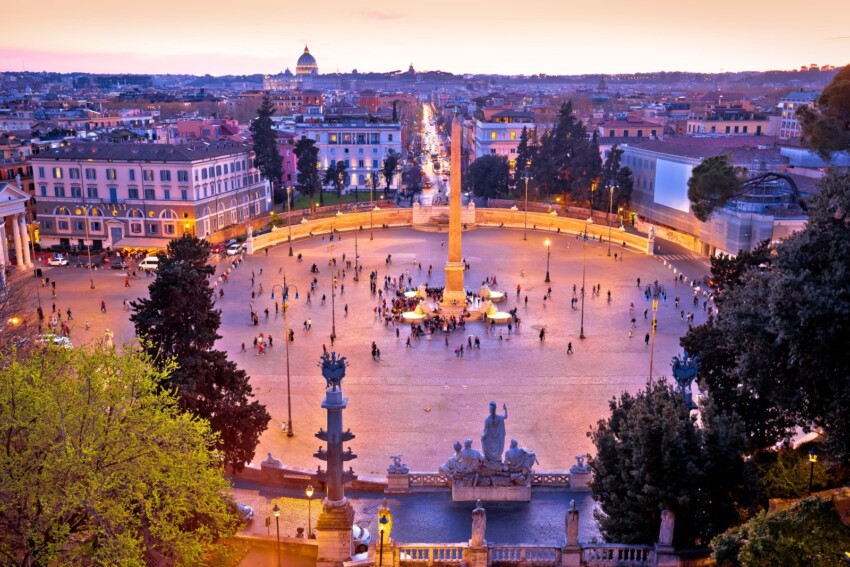
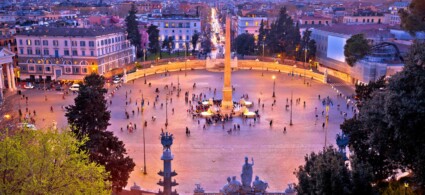
One of the most beautiful views of Rome is the one you can enjoy from the Pincio Terrace, a secret that Romans guard jealously. Away from the capital’s main tourist circuits, climbing up to the Pincio Terrace offers a stunning panorama of Rome with the dome of St Peter’s appearing very close, and Piazza del Popolo just below.
The Pincio Terrace is made even more appealing by the many street artists who perform, entertaining tourists and locals with live music. It’s also the perfect spot to watch one of Rome’s most beautiful sunsets.
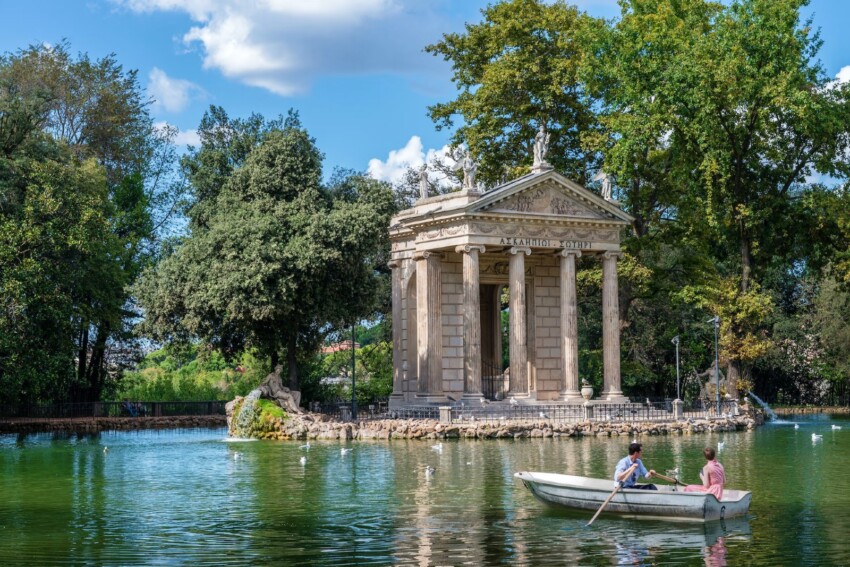
For a romantic outing in Rome, there’s nothing quite like a visit to the Temple of Aesculapius. Indeed, you can only reach it by hiring a small rowing boat and paddling out to the shores of the small island on which it stands.
It sits in the middle of a small lake, but if hiring a rowing boat isn’t for you, you can easily observe and photograph it from the lake’s shores. The temple itself is very small, built in typical Hellenistic style, and houses a large statue inside that’s also visible from outside.
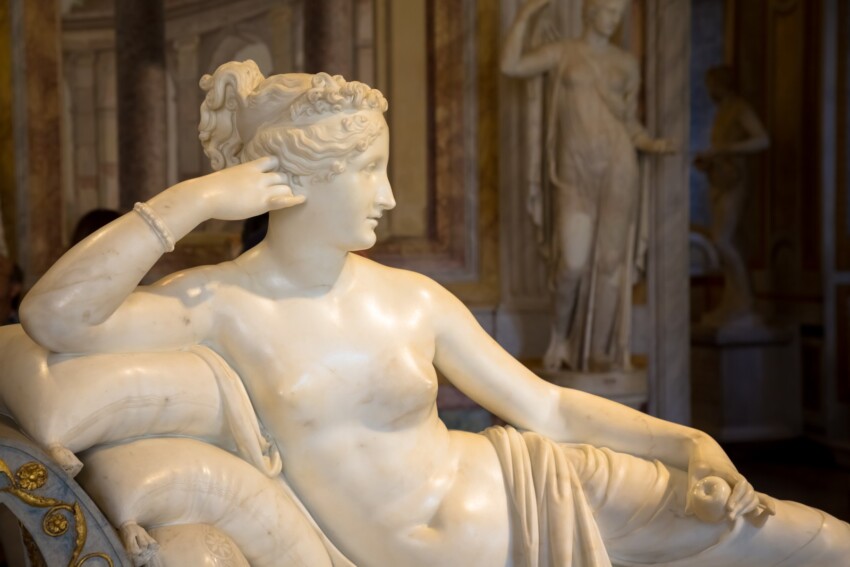
The Galleria Borghese is an art museum housed within Villa Borghese Pinciana, on the north-eastern side of the park. Inside you can admire an extensive collection of works started by Scipione Borghese between the 16th and 17th centuries, showcasing pieces of absolute importance by world-renowned artists including Gian Lorenzo Bernini, Antonio Canova, Caravaggio, Raphael, Pieter Paul Rubens and Titian.
The museum is the world’s leading repository of Bernini sculptures, divided into 20 rooms richly frescoed on their ceilings, and temporary exhibitions dedicated to the museum’s most important artists are regularly held. The museum also dedicates considerable space to families with children through specially organised guided tours and educational workshops.
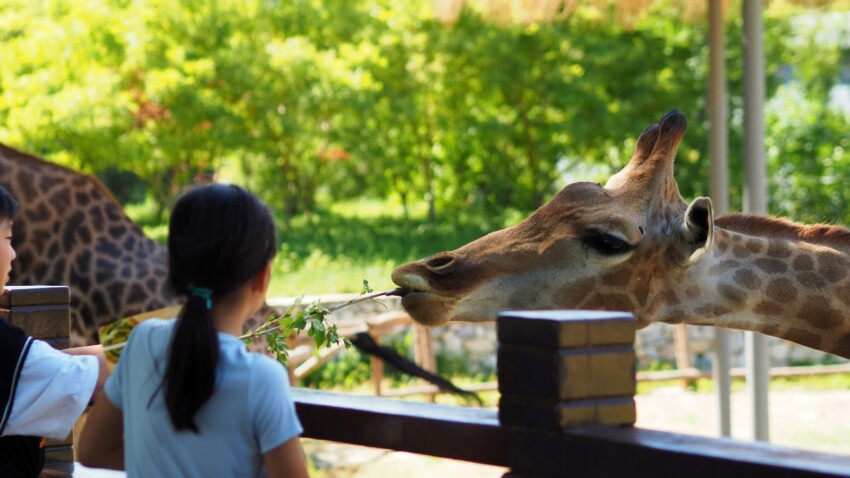
Rome’s zoo, officially known as the Biopark, is located in the northern part of Villa Borghese and represents Italy’s oldest zoological garden. It’s home to over 1,200 animals, belonging to approximately 150 different species.
Partly due to the devastation of the Second World War, which caused precarious conditions for the zoo and its animals for decades, in 1994 the idea was presented to transform it into a biopark – a facility that preserves natural resources, conducts scientific research, and places respect for animal rights at its centre.
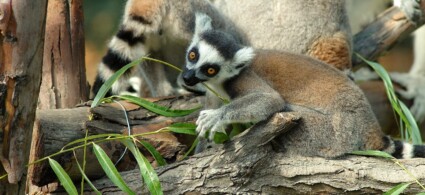
The Rome Biopark is divided into numerous areas, each dedicated to a single animal species: there’s the area for Asian lions, the lakeside oasis, the giraffe house, the area for ring-tailed lemurs, the chimpanzee village, the bear valley, the large aviary, the reptile house, the Komodo dragon area, the small primates area, the orangutan area, the owl area, the Sumatran tiger area, the white rhino area and the blue area, dedicated to marine life.
Next to the Biopark stands the Rome Civic Museum of Zoology, which houses naturalistic collections from the papal courts dating from 1790. Founded in 1932, it’s a natural history museum displaying collections of enormous scientific value, featuring unique materials both in Italy and throughout Europe. The section dedicated to birds is particularly detailed, but there are also sections covering other species such as fish, mammals, molluscs, insects and much more. In total, 5 million specimens are preserved, varying greatly in size: from the few millimetres of molluscs to a 16-metre whale. The richest section is dedicated to molluscs, of which there are 3 million.
However, not all specimens are on display in the museum: most are kept in special storage facilities, made available to researchers upon request, or displayed on special occasions.
Technically, Villa Giulia is not part of Villa Borghese, but rather adjacent to it. It’s located along Viale delle Belle Arti, and takes its name from Pope Julius III, who ordered its construction as a summer residence in 1551.
Today Villa Giulia is home to the National Etruscan Museum, founded in 1889 to gather all artefacts from before the period of ancient Rome found in Lazio and Umbria. Among all the treasures on display, the Sarcophagus of the Spouses stands out – dating from the 6th century BC, an enormous terracotta statue over two metres long by an unknown artist, depicting a married couple reclining.
The National Gallery of Rome houses an extensive collection of Italian and foreign art from the 19th century to today. Nearly 20,000 works are on display, following the movements of neoclassicism, futurism, surrealism, historical avant-garde and impressionism.
The Gallery was established in 1883, and the collection has been added to continuously, especially through donations. The museum route unfolds across 15 rooms dedicated to the 19th century and 20 rooms dedicated to the 20th century, which however includes a “second sector” bringing the total number of rooms dedicated to it even higher.
The Cinema House is one of the most recent additions to Villa Borghese’s artistic heritage: it was founded only in 2004 by journalist and film producer Felice Laudadio. It’s located at Largo Marcello Mastroianni 1, just a short walk from Via Veneto.
It’s housed within the Casina delle Rose, which was specially restored for the occasion. Inside it has five rooms, some dedicated to film screenings, others reserved for conferences, talks or special events. Among these is the Rai Cinema hall, with 20 stations equipped with computers and headphones to watch a catalogue of over 5,000 films on DVD.
The Cinema House is completed by an open-air theatre inaugurated in 2007 with 200 seats, a bookshop and a bar-restaurant.
The world’s smallest cinema is located within Villa Borghese! This venue, which received official certification from the Guinness World Records in 2005, shows children’s films in the afternoon, whilst evening screenings focus on art-house cinema.
When it was founded in 1934, it was named Mickey Mouse House, but Disney stepped in to remove the name of its famous character due to copyright issues. However, the image of Mickey Mouse with a film camera in hand is still firmly rooted in the memory of older Romans, as it remained at the entrance until the 1970s.
Since 2007, Cinema dei Piccoli has organised the Dei Piccoli Film Festival, supported by the Lazio Region, to promote the development of quality cinema for children.
Renamed in honour of Gigi Proietti following his death in 2020, this Elizabethan theatre was originally known as the Silvano Toti Globe Theatre. It’s a theatre that replicates on a small scale the Globe Theatre in London, with a circular shape and a capacity of 1,206 seats, featuring a covered stage that extends into the open-air audience area.
Built in 2003 and inaugurated that same year, it was Gigi Proietti himself who suggested the idea to Rome’s city council, and he personally inaugurated the theatre with a production of Romeo and Juliet that he directed. From then on, Proietti assumed the title of artistic director of the theatre, a position he held until his death in 2020.
Along Viale Fiorello La Guardia, inside what’s known as the “orangery” of Villa Borghese, you’ll find the small Carlo Bilotti Museum, a niche museum but one that contains works of absolute value.
Carlo Bilotti was indeed an Italian-American businessman and collector who owned many works, including 18 originals by Giorgio De Chirico, among which stands out the sculpture Hector and Andromache, situated outside. These are accompanied by Mother and Daughter: Tina and Lisa Biliotti by Andy Warhol, Carlo with Dubuffet in the Background by Larry Rivers, alongside a sculpture by Giacomo Manzù, the Great Cardinal, located outside.
In the heart of Villa Borghese stands a small two-storey building called Casina di Raffaello. It has nothing to do with the artist, who never stayed here, and shouldn’t be confused with the Casino di Raffaello, which is located at Villa Doria.
The building was constructed at the behest of Scipione Borghese, and was initially the wardrobe keeper’s residence for the villa; it later became a private home, a status it maintained until 2003, when it became municipal property. Following meticulous restoration work inside and outside, in 2006 the Rome administration inaugurated the structure as an art and creativity space, a play centre dedicated to children aged 3 to 14.
Younger children can participate in activities, interactive storytelling, educational workshops and book presentations. There are also free spaces for children under three, a specialist bookshop and a series of rooms available for hire for birthday parties.
Piazza di Siena is a huge grassy square situated in the heart of Villa Borghese. Surrounded by greenery, it represents in some ways the focal point of the park, and it’s for this reason that it’s especially crowded at weekends.
The square takes its name from the Tuscan city because the park’s designers originally wanted to give Villa Borghese an open area that recalled Piazza del Campo, Siena’s most important square. Today, Piazza di Siena at Villa Borghese is often used for events, concerts and festivities.
Villa Borghese is a public park, and therefore is open year-round from Monday to Friday, from morning until sunset, and entry is of course free. Once you’ve decided to visit, you’ll need to work out which entrance to use. There are 9 of them, with the main ones being:
Remember that the park is truly vast and the roads and paths crossing it are certainly not easy to navigate in heels or flip-flops. Make sure to wear closed, comfortable shoes, especially since you’ll presumably be doing a lot of walking.
Public toilets are scarce within Villa Borghese; they are however available inside the museums within it. In this case, though, they’re reserved for visitors. Additionally, the park has no facilities such as bars or restaurants, so bring plenty of water with you, and remember that picnicking under the trees is permitted.
If you visit the park with children, be aware that it’s possible to play outdoors, so footballs, rackets and other items for their favourite sport are welcome.
Within Villa Borghese park you can also hire a bike, a rickshaw or a Segway to tour the park in a less tiring and more enjoyable way. The tourist train is also a nice option, taking approximately 25-30 minutes to tour the park, stopping at some strategic points.
The Villa Borghese gardens are so expansive that it’s impossible to provide a single answer to the question of how to get there. Its 9 entrances are scattered across the entire perimeter of the park, which measures roughly 4 kilometres around and covers an area of over 1 square kilometre – more than twice the size of Vatican City.
Near the Porta Pinciana entrance, for example, buses number 61, 89, 120F and 150F stop by. This is on the park’s southern side, conveniently positioned in relation to Termini station, which is only a 20-minute walk away.
The entrance via the ramps at Piazza del Popolo is situated on the western side of the park and represents the most convenient access point for those visiting from the Vatican or Castel Sant’Angelo. Piazza del Popolo is easily reached via the Flaminio stop on Rome’s metro, which is just a few dozen metres away.
If you’re planning to visit the Rome Zoo, we recommend entering Villa Borghese from the northern side, which runs along Via Ulisse Aldrovandi. It’s easily accessible by buses number 52, 223, 360 and 910, some of which depart from Termini.
City Card allow you to save on public transport and / or on the entrances to the main tourist attractions.
 Hotel
Hotel  Budget accommodations
  Apartments
  Family Hotel
  Luxury Hotel
  Resorts