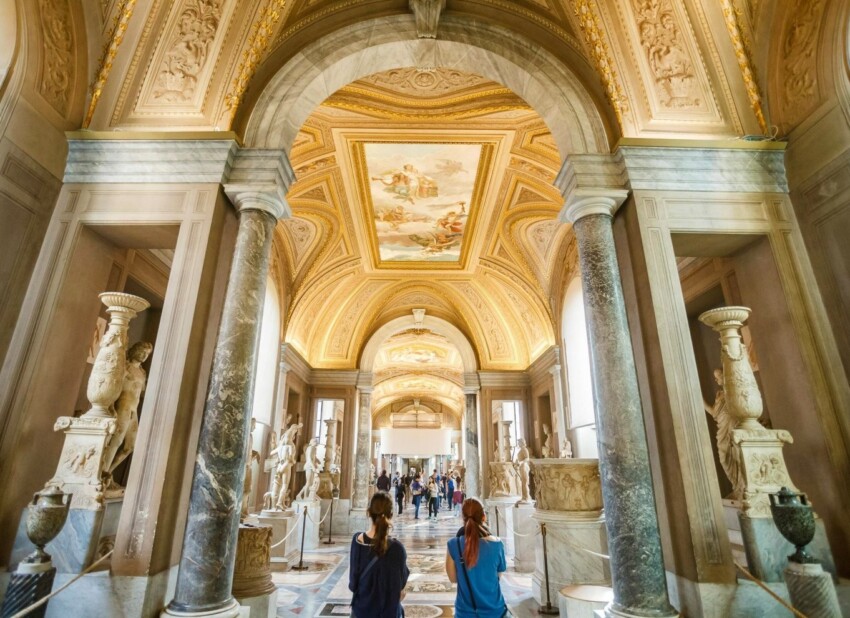
Bestseller
Vatican Museums & Sistine Chapel Skip-the-Line Entry Ticket
From 33,15 €
Buy the ticket
The Vatican Museums are one of the most important and visited attractions in Rome, although they are located within the territory of Vatican City, of which they form the national museum. Today they represent one of the largest art collections in the world, showcasing the countless works that popes have accumulated over the centuries, alongside numerous donations and acquisitions.
Established in 1506 by Pope Julius II, the Vatican Museums only opened to the public in 1771 at the behest of Pope Clement XIV. Today the Vatican Museums are firmly in the top 5 of the world’s most visited art museums, and are undoubtedly one of the essential stops on a visit to Rome.
The Vatican Museums route winds through an extensive network of museums and a series of spaces including halls, palaces and galleries; amongst the highlights are visits to the Sistine Chapel and the papal apartments, featuring spectacular frescoes by Michelangelo and Raphael.
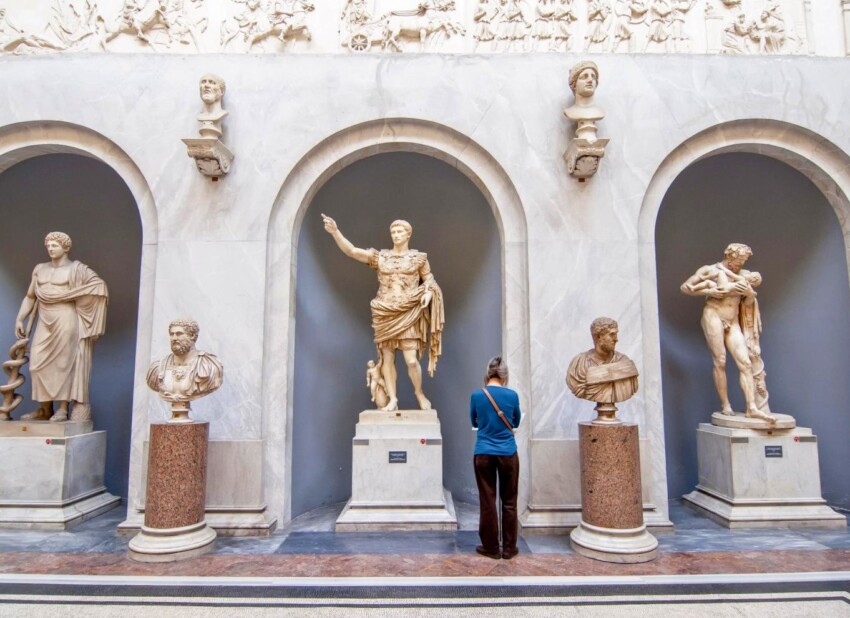
The Vatican Museums are, overall, the most important museum in Rome and in Vatican City. They are a group of art museums centred on works from the Christian tradition.
In total, the Museums house over 70,000 works including paintings and sculptures, particularly from the classical period. Amongst the artists, the principal exponents of the Renaissance stand out, such as Raphael, Michelangelo and Leonardo da Vinci. But there is also considerable space dedicated to modern religious art: it is possible to admire works by Van Gogh, Pablo Picasso and Salvador Dalí.
Amongst the most incredible – and justly famous – spaces in the Vatican Museums, the Sistine Chapel stands out, with its magnificent frescoes created by Michelangelo, alongside other equally striking areas, such as the Raphael Rooms or the Gallery of Maps.
A visit to the Vatican Museums is possible independently or by taking part in guided tours. Admission with audioguide is also available, in Italian or in various other languages.
It is important to note that, whilst easily visitable from Rome, they are in fact part of Vatican City, which is an independent state.
The reason the Vatican Museums are referred to in the plural is that they actually comprise a vast array of museums and collections.
Opened on 27 October 1932, the Vatican Pinacoteca houses works by painters of the calibre of Giotto, Leonardo, Raphael and Caravaggio. It is housed in a building constructed by Luca Beltrami following the directives of Pope Pius XI, situated in an isolated area of the so-called Giardino Quadrato.
The Pinacoteca was established to provide a home for the papal collection paintings, which in previous centuries were constantly moved owing to the lack of suitable premises. Today the collection comprises approximately 460 paintings, arranged in 18 rooms ordered by historical period, from the 12th–13th century through to the 19th century.
Within its 55 rooms, the Collection of Modern Religious Art, or Collection of Contemporary Art, houses 8,000 works, ranging from paintings to sculptures, drawings to video art, spanning a period from the 19th century to the early 21st century. There are many works from the Italian 20th century, alongside highly significant pieces by international artists.
The Collection of Modern Religious Art is displayed between the Borgia Apartments and spaces connecting Raphael’s Rooms to the Sistine Chapel. According to some experts and critics, its placement is not ideal within the museum route, being located far from the entrance; it is reached after approximately an hour’s walk along the guided route.
Among the most important artists whose works are on display are Vincent van Gogh, Francisco Goya, Paul Gauguin and Marc Chagall.
The largest complex within the Vatican Museums is represented by the Pio-Clementine Museum, named after popes Clement XIV, who opened it with a collection he himself acquired, and Pius VI, who expanded it with a magnificent monumental entrance.
Today, within the Pio-Clementine Museum you can admire some of the most important masterpieces of Greek and Roman sculpture, housed in 12 rooms. There is also a lovely courtyard called the Octagonal Courtyard, home to the first proper exhibition of Vatican statues, including the celebrated Laocoön and the Apollo Belvedere.
Particularly noteworthy is the room with statues whose walls are frescoed by Pinturicchio, and the Round Room, which contains a large bronze statue of Hercules.
From the Pio-Clementine Museum, ascending the evocative Simonetti Staircase, you reach the Gregorian Egyptian Museum.
The Gregorian Egyptian Museum is named after Pope Gregory XVI, who in 1839 decided to open a wing of the museum dedicated to treasures and artefacts from ancient Egypt. Here, enthusiasts can admire an extensive collection comprising mummies, papyri, hieroglyphics and even a Book of the Dead, a work of over 30 pages on papyrus detailing the formulae and prayers to be recited to accompany the deceased to the afterlife.
To this collection, originally a papal collection, numerous artefacts found in Rome and its immediate surroundings have been added, including Hadrian’s Villa in Tivoli. In total, the Gregorian Egyptian Museum spans 9 rooms, with a small section dedicated to ancient Mesopotamia and Assyria.
The Anima Mundi Ethnological Museum was founded by Pius XI in 1926, and displays works mainly of a religious nature, donated to the pope from around the world. Inspiration for the museum’s foundation came from the 1925 Vatican Exhibition, when over a million visitors admired more than 100,000 artworks from around the globe.
Until the 1970s, the museum was housed within the Palazzo Laterano, whilst today it forms part of the main Vatican Museums complex. It contains approximately 80,000 objects and artworks, belonging to a highly diverse collection that includes prehistoric artefacts as well as works from Asian, pre-Columbian, Islamic, African and Native American civilisations.
Given the vast number of objects in the Anima Mundi Ethnological Museum collection, they are displayed on a rotating basis in the various rooms.
Across 22 exhibition rooms, the Gregorian Etruscan Museum showcases the works and ancient history of the Etruscan people, from the 9th to the 1st century BC. The museum was founded by Gregory XVI to house artefacts unearthed during archaeological excavations conducted in northern Lazio, territory then owned by the Church. Through vases, sarcophagi, garments and weapons, you will be able to relive the deeds of the ancient people who settled in Central Italy over 2,000 years ago.
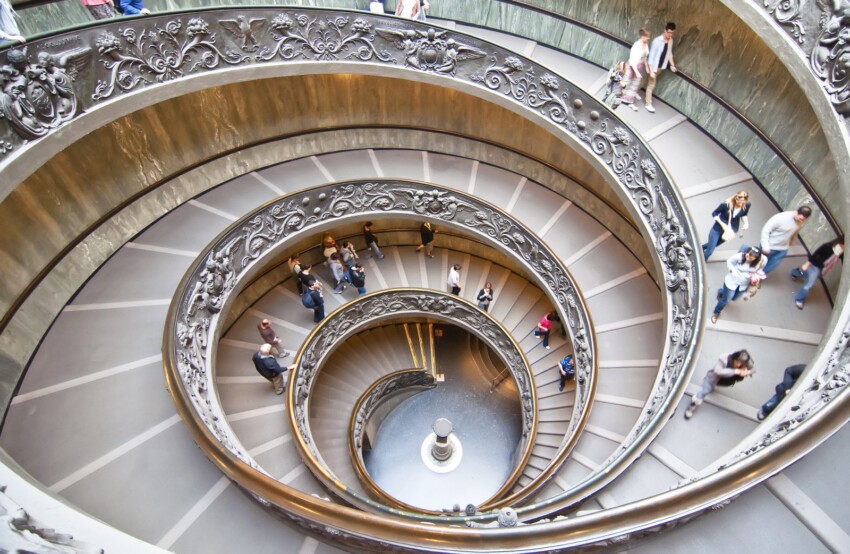
Subsequently, the collection was expanded through a series of donations and acquisitions, so much so that today the museum occupies the entire Belvedere Palace and the Tor dei Venti Apartment. Among the highlights is the magnificent Bramante Staircase, a spiral staircase commissioned in 1505 by Pope Julius II from Donato Bramante.
Within the Palazzo Laterano, the Pio Christian Museum was founded by Pope Pius IX to house evidence of the early Christian community. Initially, some works came from the Christian Museum, others from various churches in Rome, whilst still others had been found in the ancient Roman catacombs.
This diversity made the construction of the museum route highly complex, undertaken by Jesuit priest Giuseppe Marchi and archaeologist Giovanni Battista De Rossi. The collection was substantially expanded over the years, so much so that in 1963 the museum became part of the Vatican Museums collection and was reopened in 1970.
The Profane Museum is dedicated to the secular activities of the Vatican: it houses cameos, ivory sculptures, crystals and bronzes, as well as a series of papal medal collections, so that initially in its history it was simply called the “Medal Room”. During the Napoleonic period, many works from the Profane Museum were removed, with the most valuable pieces still scattered across Europe today; for this reason, it was completely redesigned in the mid-19th century.
Notable are the collections on display, along with a series of materials of unknown provenance, discovered during 19th-century excavations or acquired from private collectors. The Profane Museum is currently divided as follows: there is an encyclopaedic section in the first wing, a section dedicated to 19th-century excavations in the Papal States in the second wing, another for 18th-century excavations in the Papal States in the third wing, and finally a thematic section with materials of unknown origin in the fourth wing.
The Carriage Pavilion is a relatively recent addition to the Vatican Museums. It was opened in 1973 by then Pope Paul VI, and houses some of the most significant modes of transport used by popes during their time in the Vatican.
The star piece is the State Carriage, dating from 1826, alongside 9 ceremonial berlines, a series of protocol carriages, two historic travelling berlines, but also court garments, horse trappings, and the more recent automobiles, including three Popemobiles and the Renault 4 presented to Pope Francis in 2013.
Opened in 1936 and only becoming part of the Vatican Museums in 2007, the Philatelic and Numismatic Museum houses all the postage stamps and coins of Vatican City, since its foundation in 1929. There is also an extensive section dedicated to stamps of the former Papal States.
Philately enthusiasts can admire postcards, aerograms, stamped envelopes and typographic materials used for printing stamps. The numismatic section includes divisional and commemorative coins, euro coins and coins from the Holy Year.
Among the most articulated and extensive sections of the Vatican Museums, the Vatican Apostolic Library Museums are housed within the former premises of the Vatican Apostolic Library. Today you can admire collections such as coins, cameos, glassware, gemstones, crystals and much more. Since the last century, it has been customary practice for gifts presented to popes by kings and heads of state to be displayed in this museum.
In total, the Vatican Apostolic Library Museums comprise 13 sections; among these, the magnificent Sistine Hall stands out, with rich pictorial ornamentation, the Alessandrina Room decorated by Domenico Del Frate, and the Clementina Gallery.
Pope Pius VII, whose name was Barnaba Chiaramonti, lends his name to this important museum, part of the Vatican Museums circuit. It is arranged within the loggia that originally connected the Belvedere Palace with the Vatican Palaces, and inside displays the so-called “three sister arts”, namely sculpture, architecture and painting, the latter in the form of frescoes on the walls of the rooms.
The museum, arranged by Antonio Canova, houses one of the richest collections of Roman portraits, accompanied by funerary sculptures and a thousand pieces of ancient sculpture. It is divided into three galleries, namely the Chiaramonti Gallery, the New Wing and the Lapidary Gallery, the latter comprising over 3,000 monuments and inscriptions, representing the world’s largest collection of this type.
Alongside the many museums that form part of the Vatican Museums circuit are also a series of rooms within the Vatican Palaces, divided into galleries, chapels and halls.
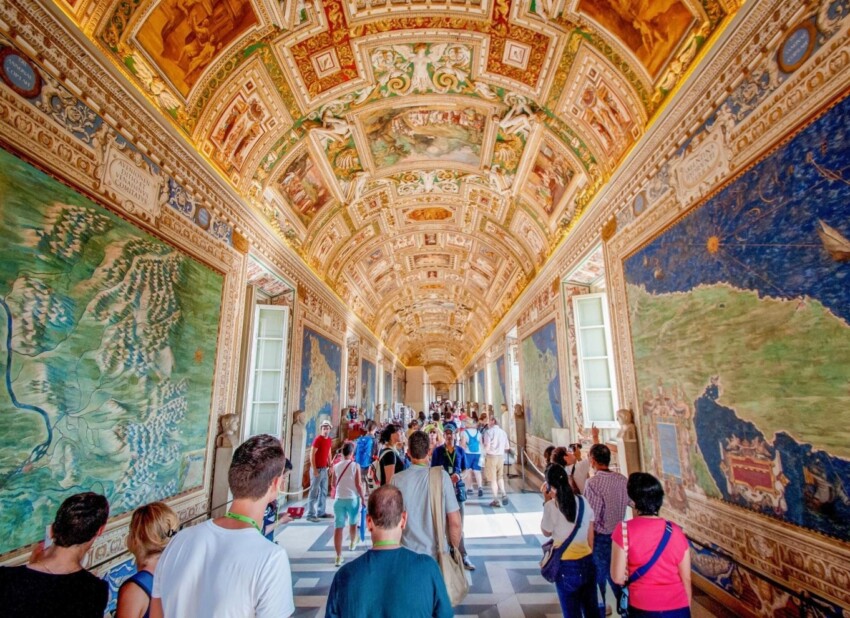
Among the galleries, the Gallery of the Candelabra stands out, furnished with wonderful tapestries, and the Gallery of Maps, which you traverse to reach the Sistine Chapel and which displays the regions that formed Italy between 1580 and 1585, the years of its creation.
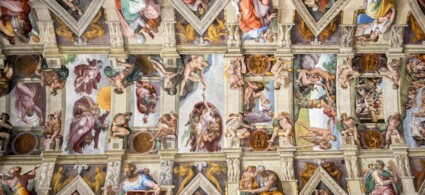
As for the chapels, the most important and famous, which alone merits a visit to the museum, is naturally the Sistine Chapel with its incredible Michelangelo frescoes, alongside the less well-known but equally worthy Niccoline Chapel and Chapel of Urban VIII.
Finally, approximately 10 rooms of the Vatican Palaces are open to visitors: among them worth mentioning are Raphael’s Rooms, consisting of 4 rooms frescoed by him with the help of his pupils, featuring the famous Room of the Segnatura where he depicted the 4 branches of knowledge: theology, philosophy, justice and poetry.
Not to be missed is the Borgia Apartment, actually comprising a series of six monumental spaces, the former private residence of Pope Alexander VI (whose Italianised name was Rodrigo Borgia) located within the Apostolic Palace.
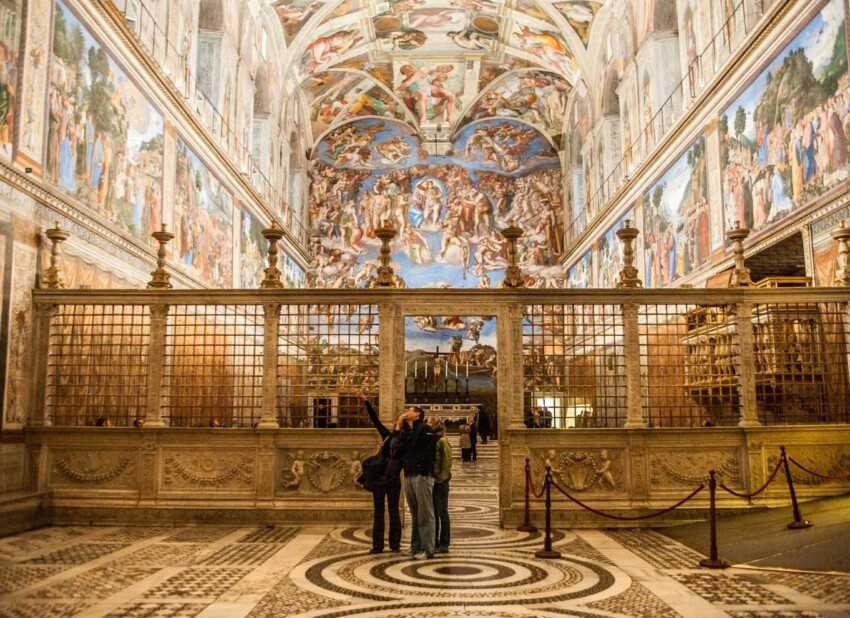
The Sistine Chapel is the most famous and most visited attraction of the Vatican Museums. It represents the masterpiece of Michelangelo, who through his frescoes of the creation of Adam and the Last Judgement demonstrated even more to the world his unique talents.
These are accompanied by other works of absolute importance, created by 15th-century artists of the stature of Perugino, Botticelli and Ghirlandaio.
The chapel is dedicated to the Assumption of Mary, and is the principal chapel of the Vatican Apostolic Palace; it is still used today for the conclave and the pope’s official ceremonies, whilst in the past it has hosted some papal coronations.
The Sistine Chapel is located to the right of the Basilica of St Peter’s; access is via the Royal Hall of the Apostolic Palace, also magnificently frescoed and decorated. One curiosity: the chapel measures 40.93 metres by 13.41 metres, that is the exact dimensions of the Temple of Solomon in Jerusalem, as reported in the Old Testament.
The Vatican Gardens occupy half of the entire territory of Vatican City. Their original purpose was to provide a place of rest and meditation for the pope, as provided for by Pope Nicholas III way back in 1279, when he had an orchard and meadow planted on the land now occupied by the gardens.
In subsequent centuries, the Vatican Gardens developed and became enriched thanks to artists and architects of the highest calibre, such as Donato Bramante and Pirro Ligorio, responsible for extending the park and creating unique works of art, nowadays numbering almost 600.
Within the Vatican Gardens it is pleasant to wander discovering fountains, statues, water features, small temples and also some grottoes, among which stands out a reproduction of the Grotto of Lourdes. There is an Italian-style garden area, an English-style garden and the Pope’s vegetable garden. Within the gardens there is also the helipad of Vatican City.
The Vatican Gardens are open to visitors for an additional fee beyond the standard admission ticket.
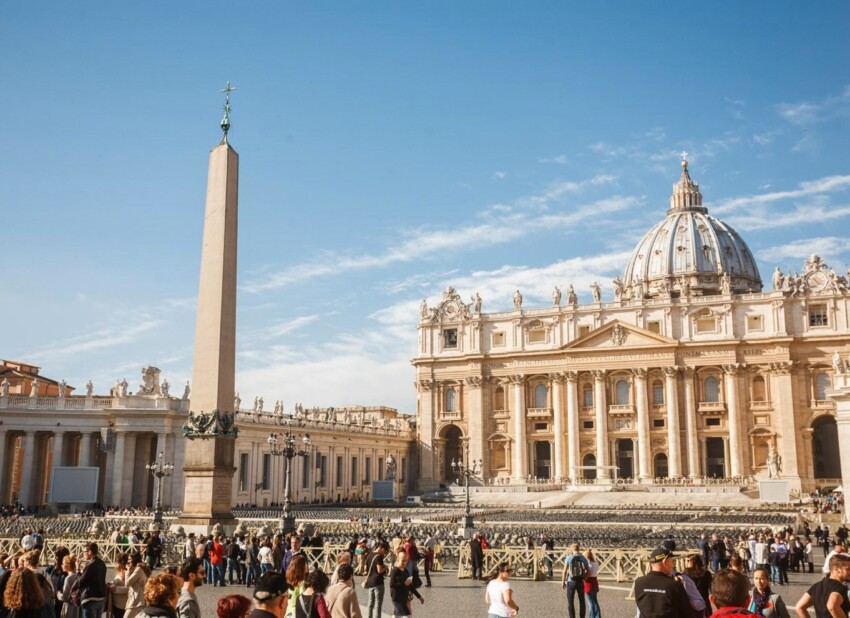
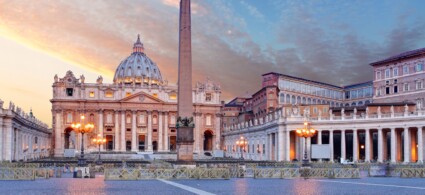
The Basilica of St Peter’s is not included in the Vatican Museums and does not form part of the museum route. Entry itself is free, there is no ticket to purchase; however, paid tickets are available which provide an audioguide service and priority entry, allowing you to skip the queue; of course, you can also book a guided tour to discover through the words of an expert all the secrets and beauty of this unique place.
It is also possible to purchase a combined ticket that unites a visit to the Vatican Museums, or part of them, with a guided visit to the Basilica of St Peter’s including a skip-the-line ticket.
It is highly advisable to purchase Vatican Museums tickets online and in advance to avoid the extremely long queues that form at the ticket office.
There are various options, but we recommend opting for a guided tour, which also allows skip-the-line access to the various attractions. You can join private or group tours, and even enjoy the museums with a VIP ticket that grants exclusive entry after closing hours.
Needless to say, you can also purchase combined tickets that, in addition to the Vatican Museums, include entry to some of Rome’s major attractions such as the Colosseum or the Pantheon, and even full-day tours so you can see as much as possible of the capital.
The Vatican Museums are open Monday to Saturday every day of the year and on the last Sunday of the month (with free admission), except on 1 November, 8 December and Christmas Day. Opening hours are from 8:30 in the morning to 18:30; during the summer season, which ends on 31 October, there is extended opening until 22:30 on Fridays and Saturdays.
Last entry is possible two hours before closing, that is at 16:30 on regular days and at 20:30 for evening visits. You must also leave the galleries 30 minutes before the museum closes.
Given the enormous number of visitors, we do not recommend visiting the Vatican Museums during the Christmas holidays or during peak season, which runs from April to October. If possible, visit between November and February, when Rome is in its low season. If you can’t, at least plan your visit in the afternoon, as there are fewer people then.
The best days of the week to visit the Museums are Tuesday, Thursday and Friday, when it’s less crowded. If possible, avoid weekends.
The Vatican Museums are easily accessible by public transport: metro, bus and tram. You can also reach the Vatican Museums by taxi, as there is a taxi rank in front of the main entrance.
You can also arrive by car, although there is no free parking available. There are paid car parks along the streets in the area, or alternatively you can leave your car at one of the numerous private garages nearby.
It is important to note that, although the Vatican Museums are entirely within Vatican City, the entrance is located on Italian territory. The exact address is Viale Vaticano 6, Rome. From St. Peter’s Basilica, it’s a 15-20 minute walk to the entrance, walking along Via Leone IV and turning left onto Viale Vaticano.
Upon arrival at the entrance you will find three queues: the first (usually the longest) is for those who need to buy a ticket, the second for those who have purchased a ticket online, the third for those who have purchased a skip-the-line ticket.
Entry to the Vatican Museums is subject to appropriate dress code, which respects the sacredness of the place. Remember that we are within Vatican City, which, being an independent state, enforces its own rules.
Being a sacred place, it is required that certain areas of the body are covered; low-cut clothes, sleeveless tops, mini skirts and shorts are therefore prohibited. You must cover your knees and shoulders, and long-sleeved shirts and long trousers are preferable when inside. Sandals are permitted.
For men, a shirt is advisable, but t-shirts are not prohibited as long as they do not contain sensitive images or offensive slogans. Trousers must be at least knee-length, with the knees remaining covered.
For women, you are not allowed to enter the Vatican Museums with bare shoulders; in summer it is therefore necessary to bring a shawl or cardigan. The same rule applies to legs as for men: trousers or skirts must reach at least the knee, and you are not permitted to wear tops that leave the midriff exposed.
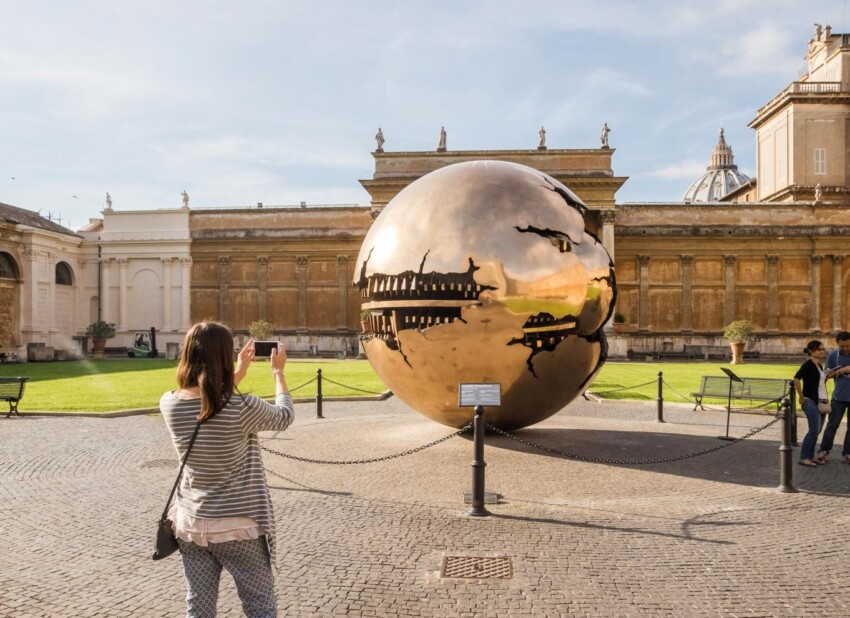
Here are some useful tips and frequently asked questions to help you with your visit to the Vatican Museums.
A visit to the Vatican Museums typically takes 3 to 4 hours, somewhat less if you decide to visit without an audio guide. With a guided tour, the time is even longer, but it’s definitely worth it, as you’ll have the opportunity to discover all the secrets of the history and artworks of the Museums.
Inside the Vatican Museums, smoking is prohibited, including e-cigarettes, and you are not allowed to eat or drink in the galleries or bring alcoholic beverages or firearms. Remember that it is strictly forbidden to touch the artwork.
Photography is permitted inside the Vatican Museums, provided without flash; filming is also allowed. The only exception is the Sistine Chapel, where photography and video filming are prohibited.
Animals are not permitted inside the Vatican Museums, even small ones, with the exception of guide dogs for the blind.
The Vatican Museums have a cloakroom at the entrance where you can leave jackets or bags free of charge; suitcases, luggage and rucksacks must be left at the entrance, as must video cameras, umbrellas and metal items such as knives or scissors.
Along the route there are some rest areas with seating, and numerous toilet facilities marked with specific signage.
If you lose something during your visit to the Vatican Museums, you can contact the Vatican Gendarmerie Corps by emailing info@gendarmeria.va or calling +39-06-69865140.
City Card allow you to save on public transport and / or on the entrances to the main tourist attractions.
 Hotel
Hotel  Budget accommodations
  Apartments
  Family Hotel
  Luxury Hotel
  Resorts