Among Rome's most iconic symbols is the Trevi Fountain, one of the city's most beautiful monuments and certainly among the most beloved by tourists.
It is estimated that Rome is home to over 2000 fountains, some dating back to Ancient Roman times, whilst others were built in subsequent centuries. Among these, the Trevi Fountain is undoubtedly the most famous, the most photographed and the most appreciated by tourists, who flock in crowds to Piazza di Trevi – in the heart of the historic centre – to visit one of the city’s most iconic symbols.
It stands directly in front of the façade of Palazzo Poli, a historic building in the heart of Rome, and was built in the eighteenth century to a design by architect Nicola Salvi, following a competition announced by Pope Clement XII to embellish the square. Its construction took exactly 30 years.
In recent years the Trevi Fountain has undergone several renovations, the first in 1998 and the second in 2014. Finally, in 2019 an artistic lighting system was designed, featuring no fewer than 85 underwater projectors to highlight the details of the monument.
Things to do at the Trevi Fountain
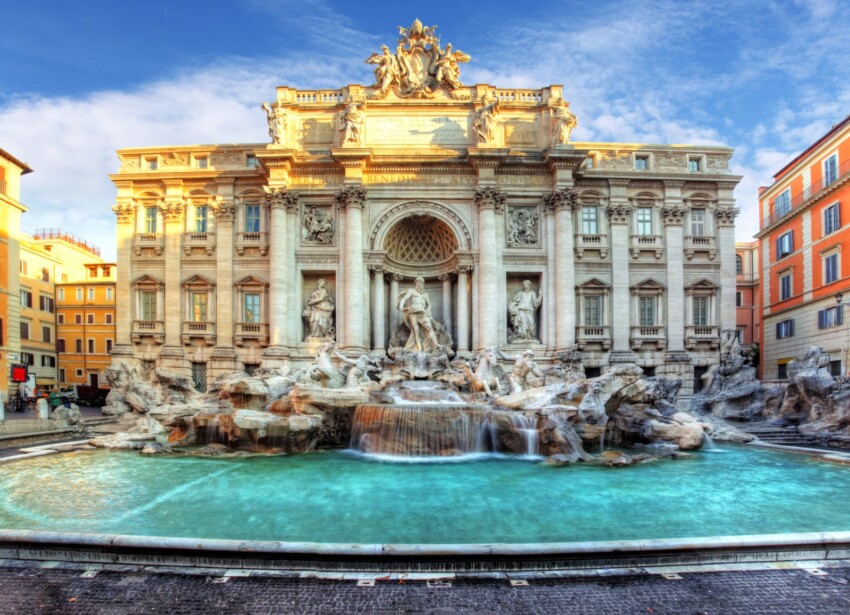
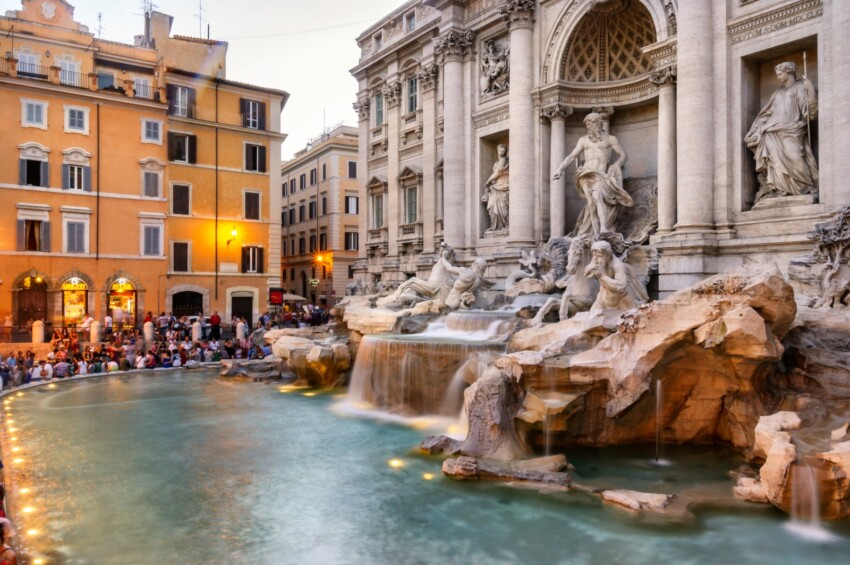
The Trevi Fountain is an enormous fountain whose principal theme is the sea. It can be seen as a single body formed by a rectangular pool with rounded corners, and a rocky cliff, upon which several statues are positioned. Moreover, the particular position of Palazzo Poli in relation to the Trevi Fountain means that some of the decorations on the building’s façade, viewed from the front, appear to belong to the fountain itself.
The statues of the Trevi Fountain
At the centre of the Trevi Fountain stands the statue of Oceanus, which represents its pulsating heart. It was created by Pietro Bracci in 1759, based on a design by Giovanni Battista Maini, and depicts the Greek deity Oceanus, powerful and muscular, seated upon a shell-shaped chariot pulled by two winged horses; the one on the left is the so-called “restless horse”, whilst the one on the right is the “docile horse”, representing the sea which is sometimes turbulent and sometimes calm.
Behind Oceanus, on the façade of Palazzo Poli within two niches, there are two other statues. Both works by Filippo Della Valle, they represent Salubrity – on the left – and Abundance – on the right, depicted with a cornucopia full of fruits and coins.
The relief panels
On the façade of Palazzo Poli are two relief panels, also part of the decorative scheme of the Trevi Fountain complex.
The first depicts Marcus Vipsanius Agrippa, a politician and architect of Ancient Rome who was responsible for the project of the Aqua Virgo, or Aqua Virgo aqueduct, one of Rome’s 11 aqueducts. Still functioning today, it is from here that the water supplying the Trevi Fountain comes. The second panel is also dedicated to the Aqua Virgo, and depicts the virgin showing soldiers the location of the water sources.
The inscription on the arch
On the pediment of the main arch marking the entrance to Palazzo Poli, there is a large inscription that reads “Clemens XII pont max Aquam Virginem copia et salubritate commendatum cultu magnifico ornavit Anno Domini MDCCXXXV Pont VI”, which translates as “Pope Clement XII adorned the Aqua Virgo aqueduct, renowned for its abundance and healthfulness, with magnificent ornament in the Year of Our Lord 1735, the sixth year of his papacy”.
Above the inscription is a shield symbolising the city of Rome, whilst on either side are two statues to give it further prominence.
In popular culture
The Trevi Fountain is one of the strongest symbols of Rome, to such an extent that some of the legends and anecdotes surrounding it have become part of Roman culture.
Throwing a coin
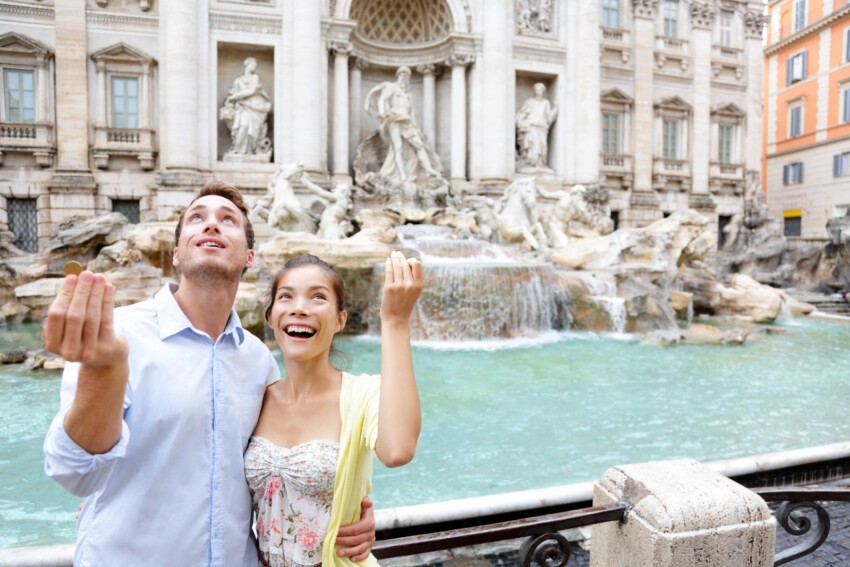
Such is the case, for example, of the famous coin-tossing tradition: it is said that turning your back on the fountain and tossing a coin backwards with your eyes closed is good luck for being able to return soon to visit the city. If your wish is to get married, tradition dictates that you should throw two more coins, so as to ensure you find love for life.
The number of tourists and visitors who perform this gesture is such that it is estimated that approximately €4000 is thrown into the fountain daily. In 2006 the Rome City Council decided that coins recovered should be collected and donated to the local Caritas.
The legend of the Ace of Cups
On the right-hand side of the Trevi Fountain there is a decoration representing a large vase, nicknamed the “ace of cups” because of its resemblance to a playing card. According to legend, architect Nicola Salvi decided to position it in that exact spot so that a barber, who had his shop directly opposite, could not see the works because he was always criticising them.
The fountain and cinema
The Trevi Fountain is also a symbol of la dolce vita romana, to such an extent that the scene from Federico Fellini’s world-famous film featuring Marcello Mastroianni and Anita Ekberg bathing together in the fountain has become one of the iconic scenes of Italian cinema in the nineteen-sixties.
Other Italian directors and filmmakers, especially around the 1960s and 1970s, used the fountain as the setting for some of the main scenes in their films, such as Mario Monicelli for Risate di gioia, Camillo Mastrocinque for Totòtruffa 62, and Ettore Scola for C’eravamo tanto amati.
Visiting the Trevi Fountain
A visit to the Trevi Fountain is completely free of charge, and it stands to reason that it should be, as it is an open-air monument located in a public square. There is no entrance fee and it is open 24 hours a day. However, its fame is such that visiting it can prove more complicated than usual, owing to the enormous number of tourists who crowd the area.
For this reason, if possible, choose to visit it at a suitable time, such as early morning, or around lunchtime or dinner time. Then return to visit the monument when it is dark, to fully enjoy the splendid lighting installed a few years ago.
Remember that you will be surrounded by crowds of people, and therefore there is a risk of becoming a target for pickpockets: keep an eye on rucksacks, bags and personal belongings. In the square you will find numerous street vendors, often unlicensed ones, who will try to sell you – with varying degrees of persistence – souvenirs and gadgets of every kind.
Swimming in the Trevi Fountain is not permitted, so, even though during summer the temptation is extremely strong, you will have to resist and make do with photographing it. There are no exceptions, and fines for offenders are extremely hefty.
The underground chambers of the Trevi Fountain
Not everyone knows that the area beneath the Trevi Fountain is part of a marvellous system of underground chambers built by the ancient Romans, which runs beneath the entire Trevi district. By descending into the depths, it is possible to visit the underground archaeological area of the city’s water system, the Vicus Caprarius. Archaeological research was carried out by the Archaeological Superintendence of Rome and brought to light an incredible residential complex dating to the Imperial age.
It is also possible to see the water collection tank of the Aqua Virgo aqueduct, the so-called castellum aquae, which, in addition to supplying the Trevi Fountain, still provides water today to the pools of a late Imperial age residence.
A visit to the underground chambers of the Trevi Fountain is available for a fee. Access is via Vicolo del Puttarello 25, and booking is advisable during weekdays to avoid queues at the ticket office and to be certain of being able to enter at your desired time and date. Booking is mandatory on Saturdays and Sundays.
Visits are held from Tuesday to Sunday from 11am to 5pm, and you can either visit independently or hire a guide for a private tour or group tour. Allow approximately one hour for your visit.
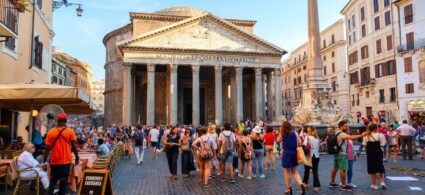
The Trevi Fountain is located in Piazza di Trevi, in the heart of Rome’s historic centre. For this reason, it is highly likely that you will reach it on foot, coming from the capital’s other attractions. It is just a 7-minute walk from the Pantheon, a 10-minute walk from the Spanish Steps in Piazza di Spagna, and around 15 minutes’ walk from both Piazza Navona and the Roman Forum.
From Termini Station, the Trevi Fountain is a 20-minute walk away, continuing along Via del Viminale, Via delle Quattro Fontane, Via Rasella and Via in Arcione, passing behind the Quirinal Palace.
If you prefer to use public transport, the underground stop to consider is Barberini, on Line A. Once you exit the station you will find yourself in Piazza Barberini, and you will reach your destination by taking Via del Tritone and Via in Arcione.
Finally, along Via del Tritone you will find buses numbered 62, 63, 83, 85 and 492, which can be caught from various areas of central Rome. After getting off at the junction with Via della Panetteria, you will reach the Trevi Fountain in just over 5 minutes on foot, taking Via della Stamperia and passing through Piazza Accademia di San Luca.



 Hotel
Hotel  Budget accommodations
  Apartments
  Family Hotel
  Luxury Hotel
  Resorts