Borgo Ripa Urban Travel
Rome - 3 Lungotevere Ripa
Book now
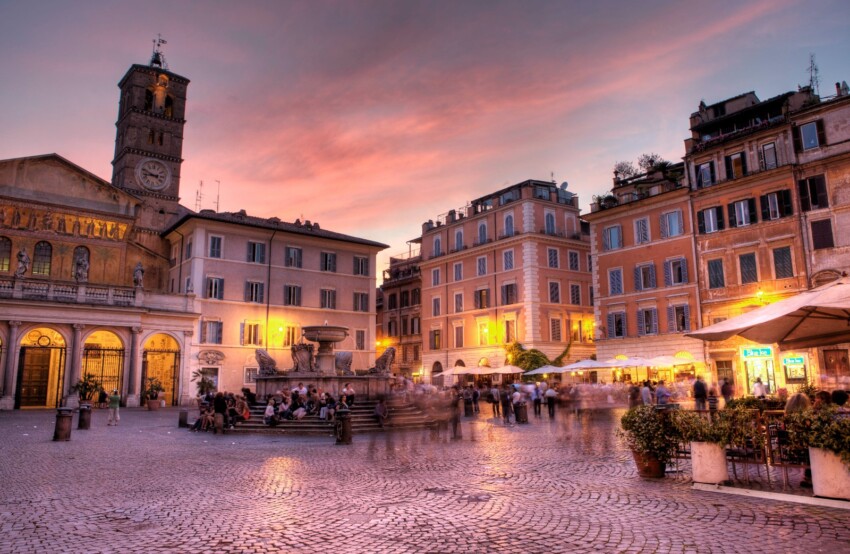
Amongst all of Rome’s neighbourhoods, Trastevere is one with the strongest identity. It’s officially Rome’s 13th rione, and its name indicates precisely its geographical location, meaning “beyond the Tiber”.
It physically stretches across much of the western boundary line of Municipality Rome I, though its heart – and consequently the most touristy part – is located within just a few square kilometres, immediately to the left of the Tiber bend where you’ll also find the Tiber Island.
Typically a workers’ neighbourhood, especially for those whose activities were tied to the river, in the twentieth century it became famous through Alberto Sordi, who was born here in a house on via San Cosimato. And it’s precisely its decadent yet captivating atmosphere, far removed from the splendour of Rome’s more touristy and glitzy side, that makes Trastevere an unmissable stop on any Rome visit.
What’s particularly characteristic are its winding cobbled streets, lined with former working-class medieval townhouses. By contrast, after sunset Trastevere transforms into something chic and glamorous, thanks to the abundance of restaurants – many serving traditional Roman fare – as well as bars and pubs for evening entertainment.
Trastevere covers roughly a triangular area with a base of 2-3 kilometres and a height of 1 kilometre, with the Tiber defining its north-east and south-east sides. It’s therefore not too vast, and lends itself well to exploring on foot. It’s an authentic Rome neighbourhood, very genuine and off the main tourist circuit; however, don’t expect to have it to yourself – you’re still visiting one of the world’s most famous cities!
There are plenty of things to see in Trastevere, including art museums, gardens and churches. But also dedicate time to discovering the neighbourhood without a specific destination, wandering its streets and little squares, resting along the Tiber, and lunching or dining at one of the many traditional local trattorie in the area, where you can savour the finest dishes of Roman cuisine.
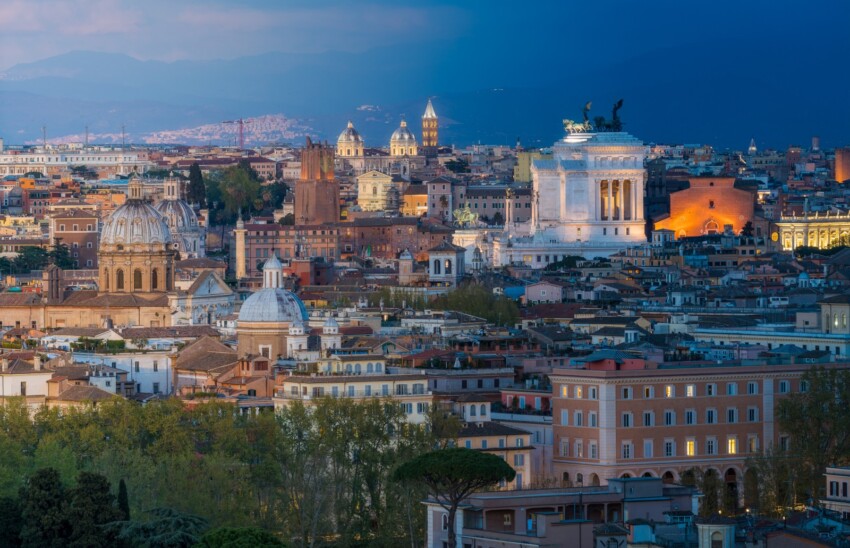
The Gianicolo hill is one of Rome’s seven hills, and sits immediately north of Trastevere. The Gianicolo terrace is one of the capital’s main viewpoints, can be visited every day of the year, and entry is free and open to all. It’s splendid at sunset, to see Rome from above and enjoy a spectacular panorama.
You can reach it easily by buses 115, 75 or 870, though you can also make the journey on foot – though bear in mind the climb to reach an altitude of 88 metres will take some effort. Effort that will be thoroughly rewarded, however, by the incredible panorama that will unfold before you, with a beautiful Rome skyline and the Tiber immediately below!
At sunset the atmosphere is very evocative, and Gianicolo remains one of Rome’s most romantic spots. Nonetheless, it’s also interesting to visit at midday, when the traditional cannon shot is fired to mark the exact hour.
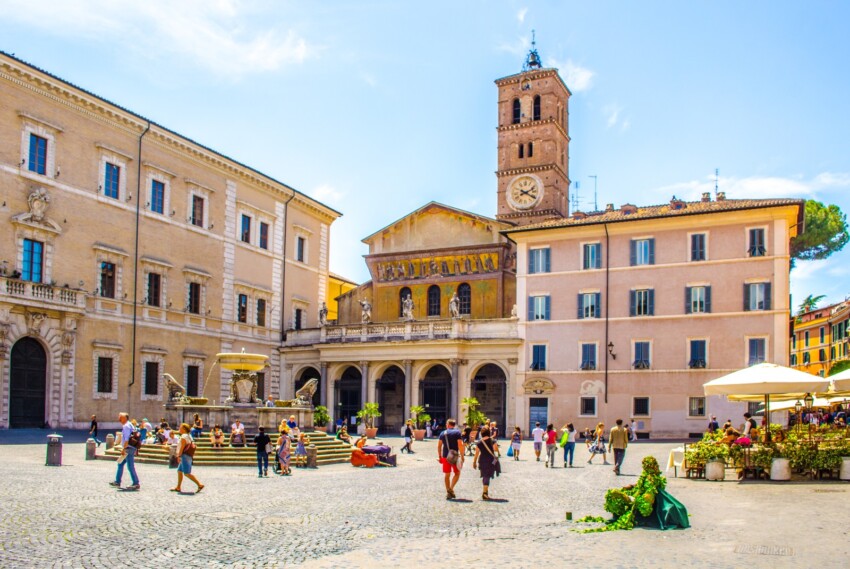
The most famous and important church in the rione is the Basilica of Santa Maria in Trastevere, located in Piazza di Santa Maria in Trastevere. Its origins are extremely ancient: it’s said to have been founded in 217 by Pope Callixtus I, with its original construction dating back to the 4th century. In subsequent centuries, naturally, the church was altered several times, most recently around 1870, during the papacy of Pius IX.
Amongst the most beautiful and distinctive things to see at the Basilica of Santa Maria in Trastevere is the niche with the mosaic of the Madonna and Child, positioned at the top of the bell tower, and the splendid mosaics on the façade, dating back to the 13th century. The apse is remarkable, with a sumptuous mosaic of the Virgin and Christ covering its vault, a work by Pietro Cavallini.
Inside there’s a beautiful wooden ceiling by Domenichino and a series of paintings and frescoes dating to the 19th century, from the period of restoration commissioned by Pius IX. The two pipe organs are also very interesting, from completely different periods: one dates from 1702 and is by Filippo Testa, whilst the other is from over 200 years later: dating from 1911, it was created by the French Mutin Cavaillè-Coll firm.
The Basilica of Santa Maria in Trastevere is open daily from 7.30 to 21.00, except Friday when it opens at 9.00 and Saturday and Sunday when it closes at 20.00. In August, the church remains closed from 13.00 to 15.30. Masses are held at 8.30 and 17.30 on weekdays (in August only at 17.30), and at 9.30, 11.00, 17.30 and 19.00 on Sundays and holidays. The 11.00 mass is the solemn service celebrated by the parish priest.
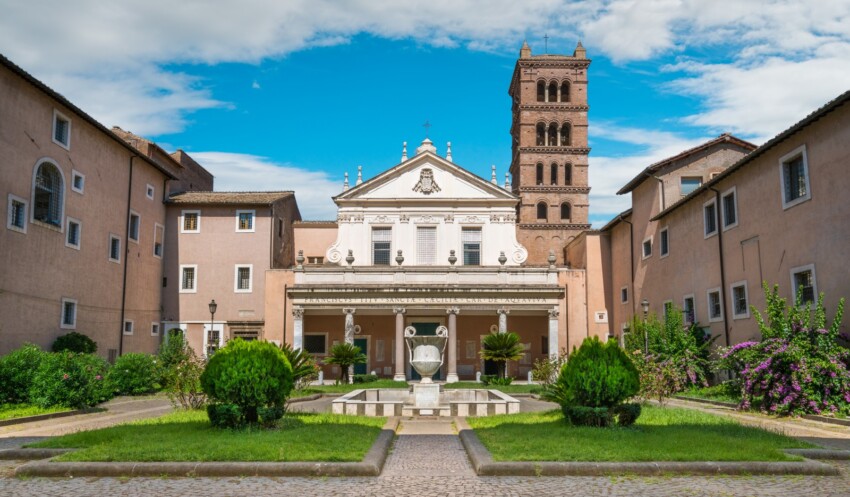
The second most important church in Trastevere is the Basilica of Santa Cecilia, the patroness of music. It’s located in Piazza di Santa Cecilia and is characterised by its beautiful white marble façade, with the imposing bell tower behind it. The church was founded in the 5th century, but was altered and rebuilt in Baroque style during the 17th century.
The church is beautiful both inside and out, thanks to the splendid work of architect Ferdinando Fuga, who was entrusted with the restoration of the building by Cardinal Francesco Acquaviva d’Aragona. As a result, Fuga designed the dramatic monumental entrance façade, the spacious courtyard and a series of additional rooms. The cardinal and his family were subsequently buried within the basilica.
Inside the Basilica of Santa Cecilia you’ll also find the convent of Benedictine nuns of Rome.
Celebrated for Raphael’s frescoes, Villa Farnesina is a splendid art museum located in the heart of Trastevere, originally a sixteenth-century villa built at the behest of the wealthy Sienese banker Agostino Chigi. Today the villa is owned by the Accademia Nazionale dei Lincei, and its elegant halls host an exciting museum experience.
It begins at the entrance atrium on the ground floor; during your visit you’ll pass through the beautiful Loggia of Galatea, where you can admire frescoes by Raphael, Del Piombo and Peruzzi, then on to the famous Loggia of Cupid and Psyche, on whose vault Raphael painted another extraordinary fresco. You continue along the Frieze Room, named after Baldassarre Peruzzi’s fresco on the vault, and ascend to the first floor continuing your visit through the Hall of Perspectives and the Wedding Room.
Don’t leave Villa Farnesina without having visited its beautiful garden, with fruit trees, fountains, statues and splendid flowers.
Museum entry tickets can be purchased on site or directly online, to avoid queues at the entrance and to pre-select your visit time slot. Discounts are available for those over 65, teachers and young people aged 10 to 18; children under 10 enter free, as do disabled visitors, journalists and tour guides.
For more information you can email farnesina@lincei.it or call +39-0668027268.
The National Galleries of Ancient Art are located immediately opposite Villa Farnesina, in the northern part of Trastevere. They’re a national art museum whose itinerary actually comprises two separate and distinct sections: the Corsini Gallery at via della Lungara 10, and the adjacent Palazzo Barberini at via delle Quattro Fontane 13. In total it’s possible to admire over 5,000 works, spanning paintings, sketches, sculptures and decorative arts, from the thirteenth to the eighteenth centuries.
Inside the Corsini Gallery only works from the Corsini collection are displayed, donated to the state in 1883. This enormous treasure came into the possession of Pope Clement XII Corsini in 1736, when he purchased the palazzo, which during his papacy was transformed into a magnificent royal residence.
A visit to the Corsini Gallery thus allows you to admire the papal apartments, and certain special rooms such as the alcove of Queen Christina of Sweden – who lived in the building during the seventeenth century. Amongst furniture, stuccos and frescoes, it’s impossible not to notice some masterpieces of Renaissance art, including St John the Baptist by Caravaggio or Prometheus by Salvator Rosa.
The National Galleries of Ancient Art are open Tuesday to Sunday from 8.00 to 19.00, with last entry at 18.00. Booking is only mandatory on the first Sunday of the month, as this is Rome’s free museum Sunday. Tickets can be purchased directly at the till; discounts are available for young people aged 18 to 25, whilst under-18s enter free.
If you love plants and flowers, the Rome Botanical Garden is the perfect destination. It’s located at the northern edge of Trastevere at largo Cristina di Svezia 23A, on the slopes of Gianicolo, occupying 12 hectares. In total you can admire 2,500 plant species, as well as archaeological finds, sculptures and eighteenth-century fountains.
There are also several historic glasshouses to visit, including the tropical greenhouse, the Corsini greenhouse, the monumental greenhouse and the French greenhouse. Particularly interesting are the Garden of the Senses, the rose garden and the beautiful staircase of the eleven fountains.
The Rome Botanical Garden is open daily from 9 to 16.30 during standard time, and from 9 to 18.30 during daylight saving time, with last entry one hour before closing. Booking for admission tickets is not necessary except for Saturdays, Sundays and public holidays, and entry is free for children aged 0 to 5, disabled visitors with companions, and teachers accompanying school groups. It’s possible to purchase online on specific dates, or at the entrance when you visit.
Furthermore, the botanical garden organises guided tours for schools, groups and associations, comprising at least 10 people. Alternatively, you can visit independently. The garden is managed by Sapienza University.
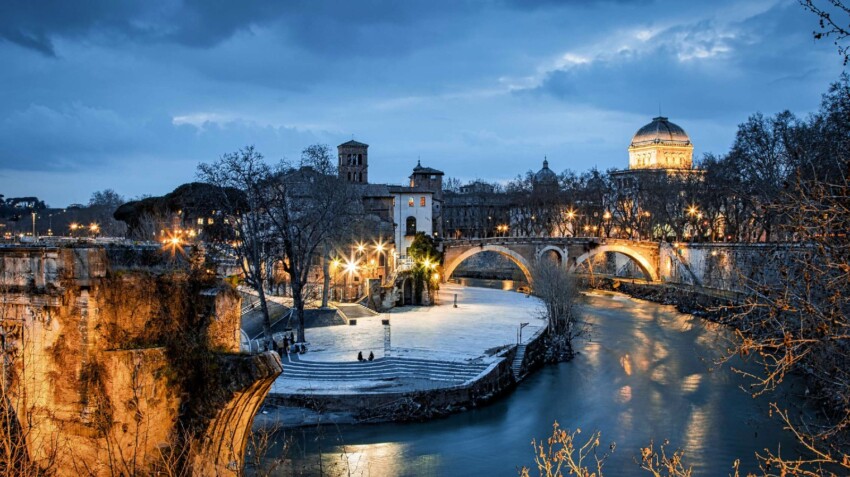
Tiber Island is the only island formed by the Tiber within Rome’s urban area. Though technically not part of Trastevere, you can reach it conveniently from the neighbourhood via the Cestius Bridge; continuing to the other side along Lungotevere dei Cenci, you’ll cross the Fabricius Bridge, Rome’s oldest bridge, dating back to 62 BC. Additionally, the western tip of the island is easily visible whilst crossing the Garibaldi Bridge, though you cannot disembark from there.
For just under half its area, Tiber Island is occupied by the Fatebenefratelli Hospital and another healthcare facility, one of three Roman locations of the Israelite Hospital; elsewhere you’ll find a famous Roman trattoria, an elegant Baroque church – the Basilica of San Bartolomeo all’Isola – the remains of the Temple of Aesculapius, and a spacious paved area with steps, where you can enjoy the leisurely flow of the Tiber at sunset whilst sipping a drink.
Since April 2022, Tiber Island has hosted a permanent exhibition, featuring a series of stelae dedicated to Virgil’s Georgics, conceived and created by artist Corrado Veneziano. The island also hosts L’Isola del Cinema, a film festival event showcasing the season’s cinematographic programme.
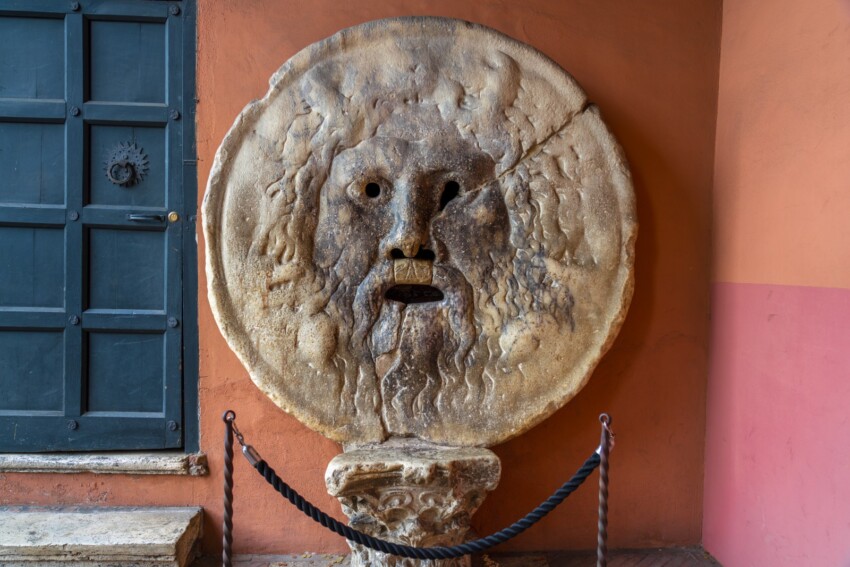
Like Tiber Island, the Mouth of Truth isn’t actually located in Trastevere, but since you’re so close by, it would be a shame to miss it! It sits on the wall of the portico of the Church of Santa Maria in Cosmedin in the Ripa neighbourhood, just beyond the Palatine Bridge, which you reach from Trastevere via Piazza Castellani.
The Mouth of Truth is a large marble medallion depicting a male face with hollowed-out eyes, nose and mouth. Its original representation remains uncertain; scholars have proposed Jupiter, the god Oceanus, an oracle, or a faun.
The sculpture, almost certainly originally a drain cover, acquired an ancient and legendary reputation, such that by the 11th century it was said the mouth possessed the power to pronounce oracles, whilst during the medieval period it was believed that the scholar Virgil Maro Grammaticus had constructed it for dubious spouses to test their partner’s fidelity (or infidelity).
The Mouth of Truth gained further fame through the film Roman Holiday: the memorable scene of Audrey Hepburn rendered speechless before Gregory Peck is unforgettable. Today, the monument is an unmissable stop on any Rome visit, with tourists queuing to have their photograph taken with their hand inserted into the mouth.
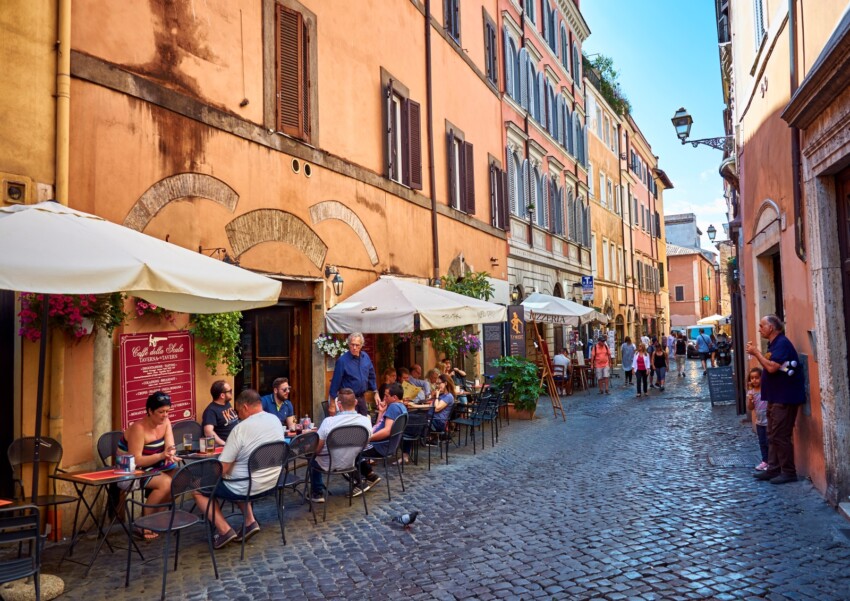
Trastevere is the ideal place to savour authentic Roman gastronomic culture, with its wide choice of restaurants, trattorias and osterie, offering traditional and authentic local dishes, paired with a glass of local wine. Here are some of the most famous restaurants in Trastevere:
Trastevere is one of Rome’s most interesting neighbourhoods for nightlife, especially for aperitivos and early evening hours. The neighbourhood isn’t famous for nightclubs, as it’s primarily residential. Some of the best venues in Trastevere for aperitivos and evenings are:
Furthermore, you can experience Trastevere as locals do by heading to Piazza di San Calisto19, where the neighbourhood’s nightlife scene is concentrated. You can stop by for dinner to enjoy traditional dishes at the numerous osterie, then continue the evening at its pubs and bars. Piazza Trilussa20 is also popular with young people, who gather on the steps of the Fontana dei Cento Frati in the evenings.
In the following map you can see the location of the main places of interest mentioned in this article.
Trastevere is one of Rome’s most charming neighbourhoods and one of the best areas to stay if you want to enjoy authentic Roman atmosphere. There are many accommodation options in Trastevere, including hotels, bed and breakfasts, apartments, as well as luxury lodgings.
Staying in Trastevere is a good choice because you’re close to Rome’s main attractions, yet can also enjoy a quieter, more authentic atmosphere compared to busier tourist zones like the historic centre. Moreover, the neighbourhood is rich in restaurants, bars and trendy shops, making it perfect for those wanting to experience genuine Roman life.
Depending on your location in Rome, you can reach Trastevere from the north, east or south. It’s unlikely you’d want to approach from the west, unless your accommodation is in the Gianicolo neighbourhood.
First, it’s worth noting that Trastevere is not served by Rome’s metro: the nearest station on the A line is Ottaviano, about 3.5 kilometres away on foot, whilst on the B line, Circo Massimo is the closest stop, roughly 2 kilometres distant.
It’s much better served by tram: lines 3 and 8 run right through the heart of Trastevere. However, many of Rome’s tram lines aren’t of great tourist interest, so this isn’t an option frequently used by visitors.
As for buses, those stopping across the Tiber on Lungotevere dei Vallati, Lungotevere Aventino or Lungotevere dei Cenci are very convenient, such as lines 23 and 280, from which you reach Trastevere by crossing one of the numerous bridges. Alternatively, lines 44, 170, 716 and 781 stop at Piazza Bocca della Verità, from where you reach Trastevere simply by crossing Palatine Bridge.
City Card allow you to save on public transport and / or on the entrances to the main tourist attractions.

 Hotel
Hotel 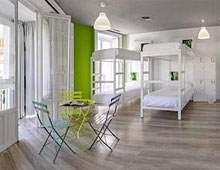 Budget accommodations
 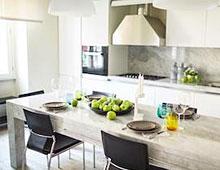 Apartments
  Family Hotel
 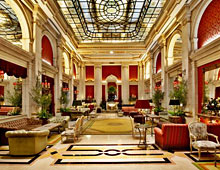 Luxury Hotel
 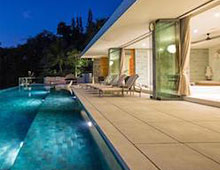 Resorts