Bestseller
Rome: Vatican Museums & Sistine Chapel Guided Tour
From 122,00 €
Buy the ticket
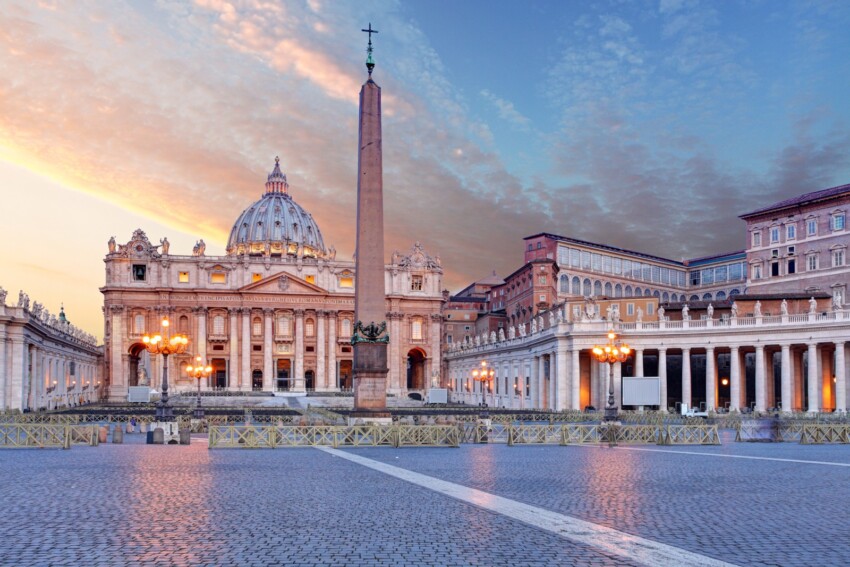
A symbol of the Vatican and papal power, St Peter’s Basilica is an absolute must for any worthwhile visit to Rome. It’s the largest basilica in the world and a monument that takes your breath away with its grandeur and beauty. Of particular importance to those of Christian faith, it houses works of immeasurable value, including Michelangelo’s Pietà and Bernini’s Baldachin.
St Peter’s Basilica, along with Vatican City, was declared a UNESCO World Heritage Site in 1984. Built in Renaissance and Baroque style, construction began in 1506 and was completed just over 100 years later. It was worked on by architects and sculptors of the highest calibre, including Donato Bramante, Raphael, Michelangelo and Gian Lorenzo Bernini.
In front of the basilica stands the enormous colonnade of St Peter’s Square, designed by Gian Lorenzo Bernini, itself an icon of Christianity as it’s here that the Sunday Audience and the Angelus are held, presided over by the Pope. A climb to the dome is also not to be missed – a symbol of Rome itself, at over 133 metres high it’s visible from several points across the city.
St Peter’s Basilica, beyond the splendid church itself, comprises a series of world-renowned attractions that are absolutely worth visiting, both inside and outside the church.
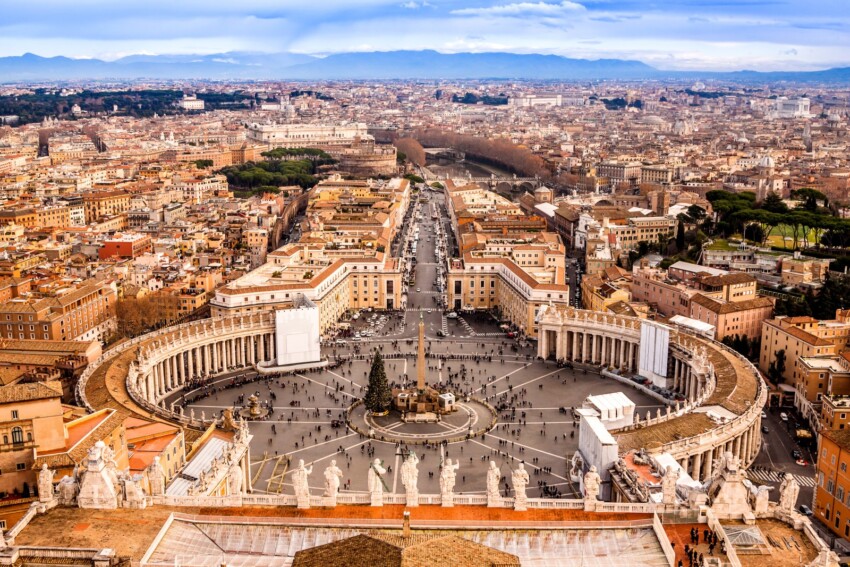
Bernini’s colonnade, also known as the colonnade of St Peter’s Square, is undoubtedly one of Rome’s main attractions, even though technically it sits within Vatican City territory. It delimits St Peter’s Square and at the same time marks the boundary between Italy and Vatican City; it can be accessed via Via di Porta Angelica and Via della Conciliazione, and it’s definitely the first thing you’ll see before visiting the Basilica.
St Peter’s Square has existed since 1500, but Bernini’s colonnade dates to the late 1600s; since its creation it has represented a perfect example of Baroque urban architecture. You can enter the square and walk beneath the columns without paying any admission fee, but you will need to pass through a security check with a metal detector.
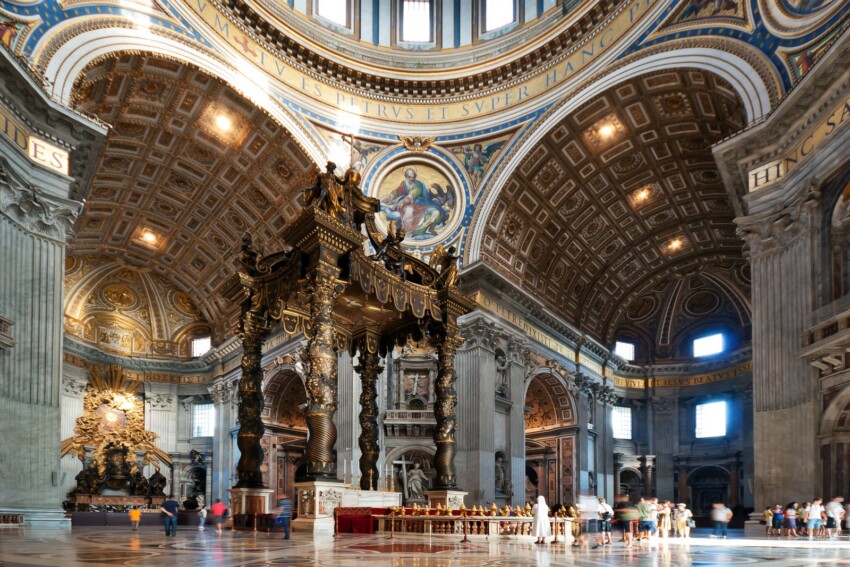
Once you’ve crossed St Peter’s Square you’ll reach St Peter’s Basilica. Inside you’ll be astounded by the scale of its naves and the beautiful decorations on the walls. Among the countless sacred artworks housed within, make sure to visit the magnificent Pietà by Michelangelo, located in the first chapel on the right. It’s one of the famous sculptor’s most celebrated works, in which he chose to depict Mary holding the body of Jesus Christ after he was taken down from the cross.
After the Pietà, don’t miss the bronze statue of St Peter, dating from medieval times, situated on the right side of the central nave, and especially the baldachin above the basilica’s main altar, supported by four columns and created by Gian Lorenzo Bernini above the tomb of St Peter.
The Dome of St Peter’s, an icon of Christianity worldwide, was begun by Michelangelo and later completed by Giacomo della Porta. The design was inspired by the dome of Santa Maria del Fiore in Florence, the work of Brunelleschi.
It’s one of the largest masonry domes ever built by mankind, with an internal diameter of almost 42 metres. Known to Romans by the nickname the Great Dome, it’s also one of the most beautiful vantage points in all of Rome, as from its summit you can enjoy a truly stunning 360-degree panorama.
Viewed from inside the basilica, the Dome impresses with its majesty. The interior is decorated with a coffered ceiling motif, and two Latin inscriptions run around its circumference.
Here are some interesting facts about the dome to give you an idea of its incredible dimensions:
You can climb both the inner and outer dome. It’s open every day of the year, from 1 October to 31 March from 7:30 to 17:00, and from 1 April to 30 September from 7:30 to 18:00. The stair climb closes an hour before closing time. During major masses or papal audiences, opening times may vary.
The dome is accessible with a ticket, the cost of which varies depending on the type of climb: you can take the lift to the terrace level and then continue on foot, climbing 320 steps, or you can make the entire climb on foot – a total of 551 steps; in this case, you’re entitled to a small discount.
Though not the highlight of the entire St Peter’s Basilica complex, the Treasury Museum is nonetheless very interesting for anyone keen on Vatican iconography. On display are accessories such as crosses, jewels, reliquaries and papal vestments.
The museum route comprises nine rooms, some of which display truly unique pieces, including the tabernacle of the Blessed Sacrament by Donatello, the funerary monument to Sixtus IV by Antonio del Pollaiolo and the sarcophagus of Junius Bassus, a true masterpiece of early Christian art, dating from the fourth century.
The Treasury Museum is accessed via the sacristy corridor in the left transept of St Peter’s Basilica; an additional ticket is required for entry.
The Vatican Necropolis lies 5 to 12 metres below the floor level of St Peter’s Basilica, beneath the central nave. It’s a Roman-era burial ground where you can visit both pagan and Christian tombs. The necropolis excavations were carried out between 1939 and 1949, during the papacy of Pius XII, whilst restoration work began in 1998. Among the most important discoveries within the necropolis is undoubtedly the tomb of St Peter, a true pilgrimage site for the faithful from around the world, and the Mausoleum of the Valerii, a Roman tomb decorated with stuccos and frescoes.
Visits to the Vatican Necropolis are by concession of the St Peter’s Basilica Works Administration, limited to a maximum of 250 visitors per day. Groups of approximately 10 participants are created and divided by language, and only those aged 15 and above can participate. Groups are then accompanied by a specialist guide through a route lasting around one and a half hours.
To book a visit to the necropolis you need to submit a written request via email to scavi@fsp.va, or by fax to +39-0669873017; alternatively you can go directly to the basilica’s excavations office; the entrance is on the left of Bernini’s colonnade.
The request must include the number of participants and their names, the preferred method of reply (email, fax or post), the language required for the visit and the desired period for the visit; the time will be communicated in response and is subject to availability. The necropolis is open from 9:00 to 15:30 Monday to Friday and from 9:00 to 12:30 on Saturday. It remains closed on Sundays and public holidays.
On the day of your visit, you should be at the excavations office 10 minutes before the appointed time, which is located on Via Paolo VI at the left colonnade, at the entrance to the General Audiences Hall. You must present the Swiss Guards with your visit confirmation receipt or the office’s communication. Appropriate dress is required – shoulders covered, trousers for men and skirts below the knee or trousers for women.
Bulky items such as rucksacks or suitcases, or photographic equipment, are not permitted inside the necropolis; before reaching the excavations office you therefore need to leave them at the free deposit located to the right of the basilica’s façade.
The Vatican Grottoes are underground galleries located beneath the Basilica’s ground, where the remains of many former popes are kept, including John Paul II. It’s important to note that the grottoes are not the burial place of St Peter, who rests in the Necropolis.
Visits to the Vatican Grottoes are free, and they can be reached from inside the basilica through a small door. They are divided into two levels, consisting of two underground floors in total.
Entry to St Peter’s Basilica is free. However, admission tickets are available for some of the attractions within it, such as the dome, or for priority access, skipping the queue at the entrance.
St Peter’s Basilica is open daily with the following hours:
You can also visit the basilica with an audioguide, allowing you to take a guided tour in six languages – Italian, German, Polish, English, Spanish and French. There’s also a radio guide service available, allowing families and groups to take a guided tour with commentary transmitted through a small amplifier, to avoid noise inside the sacred space.
It’s possible to attend mass at St Peter’s Basilica, though it’s not celebrated by the Pope in person, except on special occasions such as Christmas or Holy Week. Masses are celebrated daily from 7:00 to 18:00.
At St Peter’s Basilica you can also make confession in various languages: Italian, English, French, Spanish, Polish, German, Portuguese, Chinese, Romanian, Malayalam and Maltese. Confession times are from 7:00 to 12:30 and from 15:30 to 18:30 on weekdays, and from 7:00 to 13:00 and from 15:30 to 18:30 on weekends and public holidays.
Thanks to Rome’s public transport network, you can reach St Peter’s Basilica by bus, metro and tram.
Buses 49, 492 and 913 stop near Piazza del Risorgimento, a 10-minute walk from St Peter’s Square. Tram number 19 also stops in Piazza del Risorgimento, connecting various parts of central Rome.
The nearest metro station is Ottaviano-S.Pietro, on Line A; once you exit you’ll need to walk for about 20 minutes along Via Ottaviano and Via di Porta Angelica. Alternatively, you can use the Lepanto station and reach the basilica by walking along Via Cola di Rienzo.
As a sacred place and the spiritual centre of Christianity, visiting St Peter’s Basilica requires appropriate dress. In particular, both men and women must cover their shoulders and knees, and therefore entry is prohibited in short skirts, sleeveless tops or shorts.
If summer temperatures make this type of clothing impractical, we recommend bringing a scarf or shawl, and perhaps a long skirt or pair of long trousers to put on just before entering and remove once you’ve left.
Below are some helpful tips to make the most of your visit to St Peter’s Basilica.
As mentioned, entry to St Peter’s Basilica is free, which is why queues at the entrance can be remarkably long. If you’d prefer to skip them, consider joining a guided tour, which offers the added benefit of exploring the basilica with a professional who can provide comprehensive insights into the monuments, artworks and significant historical events that have taken place within its walls over the centuries.
After passing through Bernini’s colonnade, you’ll need to queue; you’ll then have to go through the metal detector for security screening, which will almost certainly mean facing a second queue.
Visiting St Peter’s Basilica in summer means enduring the heat whilst waiting in the queue under the sun. Bring a hat and plenty of water with you, and sunscreen if you think it necessary.
For this reason, it’s advisable to visit St Peter’s Basilica outside the summer months, when temperatures are milder and Rome attracts fewer tourists. If possible, choose a weekday visit, or at least avoid Sundays.
St Peter’s Basilica and all the other interesting attractions in the surrounding area can easily consume an entire day. If you’re in Rome for just a weekend or a short stay, consider a quick visit, focusing on the main areas and monuments. You can join a guided tour lasting around an hour, which is roughly the same time you’d spend exploring the basilica independently whilst stopping at sites you find most interesting.
Add an hour to visit the necropolis, and a couple of extra hours for the dome, as you’ll need time to climb and descend. All of this, of course, is before accounting for entrance queues, unless you purchase a skip-the-line ticket.
It’s highly unlikely that the Pope will spontaneously be present inside St Peter’s Basilica. However, the Pontiff celebrates Midnight Mass at Christmas and Easter Mass; alternatively, you can attend the Sunday papal audience, the Angelus or the Wednesday blessing, which take place in St Peter’s Square and are open to all. Remember that you’ll need to pass through security checks to access the square.
City Card allow you to save on public transport and / or on the entrances to the main tourist attractions.
 Hotel
Hotel  Budget accommodations
  Apartments
  Family Hotel
  Luxury Hotel
  Resorts