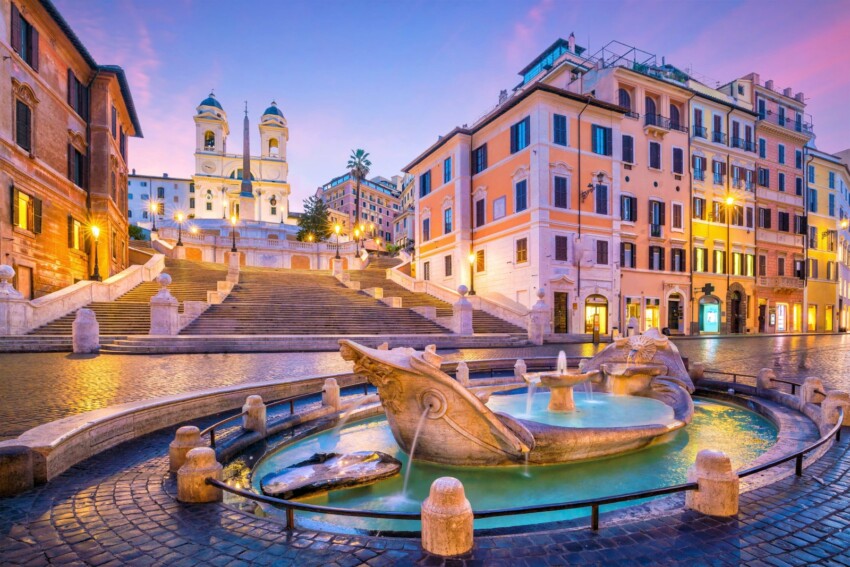
Among Rome’s most famous squares, amongst the city’s principal landmarks, Piazza di Spagna certainly stands out. An essential stop during any tour of the capital, it’s home to some splendid monuments, the most celebrated, crowded and photographed of which is undoubtedly the Spanish Steps.
Yet beyond this, Piazza di Spagna boasts several beautiful points of interest, including the Fontana della Barcaccia, the Column of the Immaculate Conception and a series of elegant palaces, as well as two fascinating niche museums: the Keats-Shelley Memorial House and the Giorgio de Chirico House Museum.
Finally, from Piazza di Spagna one takes the elegant Via Condotti, one of Rome’s most famous streets and the city’s principal luxury shopping destination: here you’ll find the major high-fashion boutiques of the city.
The square is triangular in shape, with its apex pointing south; on the eastern side, the Spanish Steps open up, as if forming an extension of it. Here’s a curiosity: not everyone knows that the square takes its name from the Spanish Embassy, which overlooks the piazza. Until the 17th century it was actually called Piazza di Francia, as numerous palaces were French-owned.
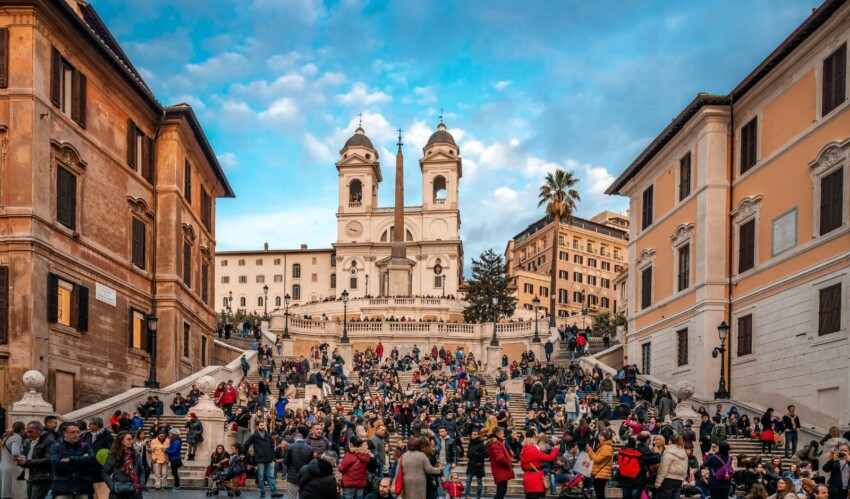
There are plenty of things to see in Piazza di Spagna: here are the main ones to make the most of your time in the area.
On the east side of Piazza di Spagna lies the monumental staircase, which leads up to the Trinità dei Monti church. Dating from 1725, it comprises 135 steps in total and was built specifically to connect the Spanish Embassy with the church. Since its construction, the steps have become one of Rome’s most iconic symbols. They were completely renovated in 1995, and again in 2015.
Climb the Spanish Steps to enjoy a beautiful view across Rome’s rooftops and domes, with the Fontana della Barcaccia below and Via Condotti in the distance; then sit down and watch the sunset: it’s the perfect spot for a romantic pause!
Atop the steps stands the Trinità dei Monti church, one of Rome’s five French churches. The church dates to the 16th century, and the entire complex also includes a convent.
The building features an austere, symmetrical façade with twin bell towers, and before the entrance stands the Obelisco Sallustiano, made of red granite around the 2nd century as an imitation of Egyptian obelisks. Inside, there is a single nave with six side chapels, some beautifully frescoed.
Visits are available Tuesday to Sunday from 6:30 to 20:00. Admission is free, though it’s customary to leave a donation at the entrance.
The convent, adjacent to the church, is well worth visiting thanks to its many sacred artworks and magnificent spaces, including the Prospective Gallery with frescoes by Andrea Pozzo and the Room of Ruins, dating to the late 18th century. Also stunning is the Pucci Chapel, adorned with frescoes by Perin del Vaga and the Zuccari brothers.
Overlooking Piazza di Spagna is the Palazzo di Propaganda Fide, an extraterritorial possession of the Vatican City, and therefore exempt from requisition and taxes. The building was designed by Gian Lorenzo Bernini and Francesco Borromini and originally served as the first seat of the Pontifical Urban College for training Catholic missionaries.
Commissioned by Pope Gregory XV, the palace was built between 1620 and 1640. In subsequent centuries, after losing its original function, it housed the ethnographic-missionary collection of the Museo Borgiano, later moved to the Vatican.
One section of the palace contains the Chapel of the Magi, also designed by Gian Lorenzo Bernini and Francesco Borromini, which displays a series of sacred artworks including the Conversion of St Paul by Carlo Pellegrini in the first chapel on the right, the Adoration of the Magi by Giacinto Gimignani on the altar and the Mission of the Apostles by Lazzaro Baldi.
On the left side of the Spanish Steps, overlooking Piazza di Spagna, stands an elegant building that houses the Keats-Shelley Memorial House on the second floor, a museum dedicated to British poets John Keats and Percy Bysshe Shelley.
Established in 1909, it’s certainly not one of Rome’s most visited museums, but it’s particularly fascinating for literature and poetry enthusiasts. You can also take part in a guided panoramic tour: the route includes the apartment where Keats died of tuberculosis in 1821, and spaces dedicated to Percy Bysshe Shelley, Mary Shelley and Lord Byron.
The museum is open Monday to Saturday from 10:00 to 13:00 and from 14:00 to 18:00, with last entry at 17:45. Tickets can be purchased directly at the desk or online, with discounts available for under-18s, over-65s and university students, whilst children under 6 and disabled visitors enjoy free admission.
Inside the Palazzetto Borgognoni, an elegant building at number 31 Piazza di Spagna, lies the Giorgio de Chirico House Museum, which he purchased in 1948 and converted into his residence and working studio, where he spent the last 30 years of his life. The spaces include a spacious terrace on the top floor offering stunning views.
Inaugurated in 1998 by the painter’s widow on the twentieth anniversary of his death, the museum displays numerous paintings by Giorgio and Isa de Chirico. The museum is open by reservation only: simply email prenotazione@fondazionedechirico.org to book your visit, or visit https://prenotazioni.fondazionedechirico.org/.
Guided tours are available Monday, Thursday, Friday and Saturday at 10:30, 11:30, 14:00, 15:00, and on the last Sunday of the month at 11:00, 12:00, 14:00, 15:00. Discounts are available for under-18s and those over 65, whilst children under 12 enter free. After booking, you’ll receive your ticket by email to show at the museum entrance; payment will be made at that time.
For further information, you can call +39-066796546.
Beside the Palazzo di Propaganda Fide, at the southern end of Piazza di Spagna, stands the imposing Column of the Immaculate Conception. Inaugurated in 1857, the monument comprises a marble base supporting a marble column, nearly 12 metres high, topped with a bronze statue of the Virgin Mary.
The statue was created by sculptor Giuseppe Obici, whilst the column was discovered in the monastery of Santa Maria della Concezione in 1777. The base features 4 statues, one on each side: David by Adamo Tadolini, the prophet Isaiah by Salvatore Revelli, the prophet Ezekiel by Carlo Chelli and Moses by Ignazio Jacometti.
Every year, since 1923, Rome’s firefighters mark the Feast of the Immaculate Conception by climbing to the top of the statue and presenting a flower wreath to the Virgin Mary. The Pope regularly attends the ceremony.
One of Rome’s six talking statues, the Babuino statue stands on Via del Babuino at its intersection with Piazza di Spagna, at the north-west end of the square. It depicts a silen, a figure from Greek mythology representing the old god of drunkenness and wine before Dionysus, reclining on its side and positioned on a rocky base.
The name derives from Roman popular tradition, as locals believed the statue was so ugly and deformed it resembled a baboon. The sculptor is unknown, as is the date of creation. Nevertheless, the statue is an integral part of Roman culture and is regularly maintained and restored: the last two restorations took place in 2007, when fencing was placed around the fountain, and in 2015, work financed by clothing company Brioni.
The most beautiful and famous fountain in Piazza di Spagna is undoubtedly the Barcaccia, located right at the foot of the Spanish Steps. It was created by Pietro Bernini and his son Gian Lorenzo in 1629 using water from the Acqua Vergine aqueduct. The fountain was unique for its time, being the first not to represent a classical basin with geometric forms.
Indeed, the Fontana della Barcaccia represents a boat with an elongated shape, featuring an inner basin and an outer one. Water jets spring from the boat – and thus from the inner basin – and flow into the outer basin.
The Fontana della Barcaccia has unfortunately suffered numerous acts of vandalism, especially in recent times. In 2007, four drunk men scratched it with a large screwdriver, which they also used to threaten the police who arrived at the scene, whilst in 2015 it was again damaged by Dutch football fans who came to Rome for the Roma-Feyenoord match.
From the opposite side of the Spanish Steps extends Via Condotti, one of Rome’s most important shopping streets. It’s a pedestrian area about 300 metres long connecting Piazza di Spagna to Largo Carlo Goldoni and Via del Corso, and takes its name from the aqueduct conduits that carried water from the Acqua Vergine aqueduct to the Trevi Fountain.
Via Condotti represents Rome’s luxury street, lined with internationally renowned fashion house boutiques including Dior, Gucci, Hermès, Armani, Prada, Rolex, Tod’s and many others. Via Condotti is also home to the historic Caffè Greco, one of Rome’s oldest bars, founded as far back as 1760. A gathering place for intellectuals and bohemians since its opening, it houses over 300 works and is therefore the world’s largest privately-owned art gallery open to the public.
On the top floor of the building housing Bulgari’s boutique, during the 1970s and ’80s, the criminal association Masonic Lodge Propaganda 2 (P2) was based.
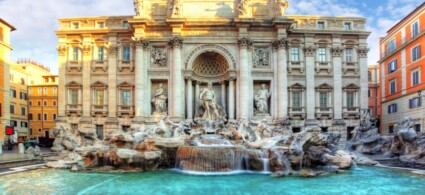
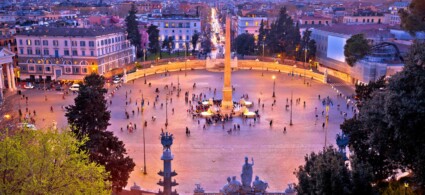
Piazza di Spagna is in the heart of Rome’s city centre, so you’re likely to reach it on foot. For instance, the Trevi Fountain is just 8 minutes’ walk away, the Pantheon and Piazza Navona about 15 minutes on foot, and Piazza del Popolo roughly 10 minutes’ walk. The square is also reachable on foot from Termini Station, though it’s not particularly close: the walk takes less than half an hour.
Alternatively, Piazza di Spagna is served by the Spagna stop on the Metro A line. By bus, you can reach it via line 119, which stops first outside the Trinità dei Monti church and again at the corner with Via del Babuino.
City Card allow you to save on public transport and / or on the entrances to the main tourist attractions.
 Hotel
Hotel  Budget accommodations
  Apartments
  Family Hotel
  Luxury Hotel
  Resorts