Bestseller
Vatican Museums & Sistine Chapel Skip-the-Line Entry Ticket
From 33,15 €
Buy the ticket
Towards the end of the fifteenth century, Pope Sixtus IV decided to renovate the ancient Cappella Magna in the Vatican. He did so on a grand scale, bringing in some of the most prominent painters and artists of the time, including Pietro Perugino, Sandro Botticelli and Domenico Ghirlandaio. A few years later, in 1483, Sixtus IV consecrated the new chapel, which thereafter became known to all as the Sistine Chapel.
Some 20 years later, Pope Julius II entrusted Michelangelo Buonarroti with the task of redoing the decoration, painting the ceiling and the lunettes on the upper part of the walls.
Today, over 500 years on, the Sistine Chapel is one of Rome’s most visited monuments – although technically it falls within the territory of Vatican City – and Michelangelo’s frescoes, thanks to their beauty and complexity, are considered among the finest works in the history of painting, drawing hundreds of thousands of visitors each year on their own. Part of the Vatican Museums complex, of which it is undoubtedly the main attraction, the Sistine Chapel is truly an absolute must-see on any respectable Rome tour.
The Chapel is also the venue for the Pope’s official ceremonies, including the Conclave, the occasion when cardinals gather to elect a new pontiff.
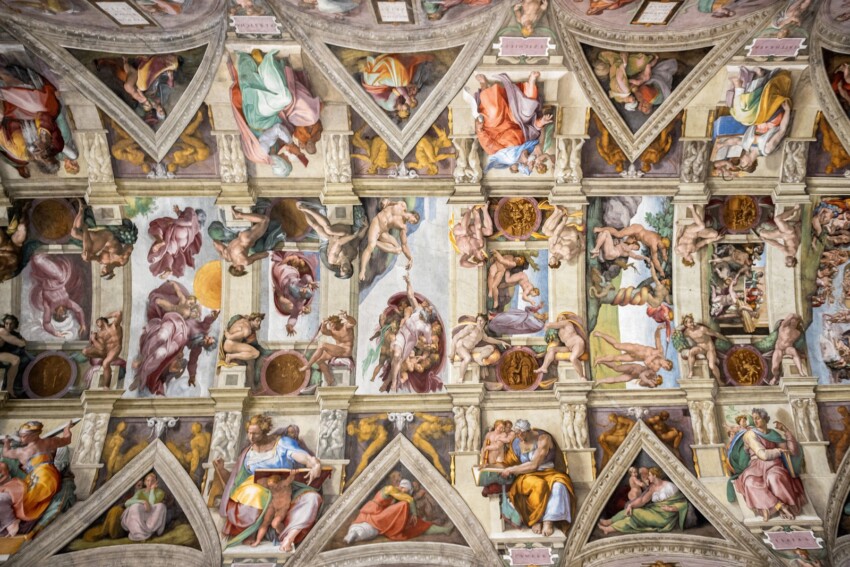
The Sistine Chapel is essentially an enormous empty room completely covered in frescoes: ceilings, vaults and walls are richly decorated with various scenes from the Old and New Testaments.
Michelangelo’s frescoes are perhaps the main reason tourists visit the Sistine Chapel. Michelangelo is indeed the author of all the paintings on the ceiling and the back wall. The cycle of ceiling frescoes dates from 1508-1512, and among them the Creation of Adam stands out above all, depicting the moment God gives life to Adam; the decoration of the wall is represented by the Last Judgement, a massive painting of 13×12 metres dating from 1536-1541, which depicts what is described by John in his Apocalypse.
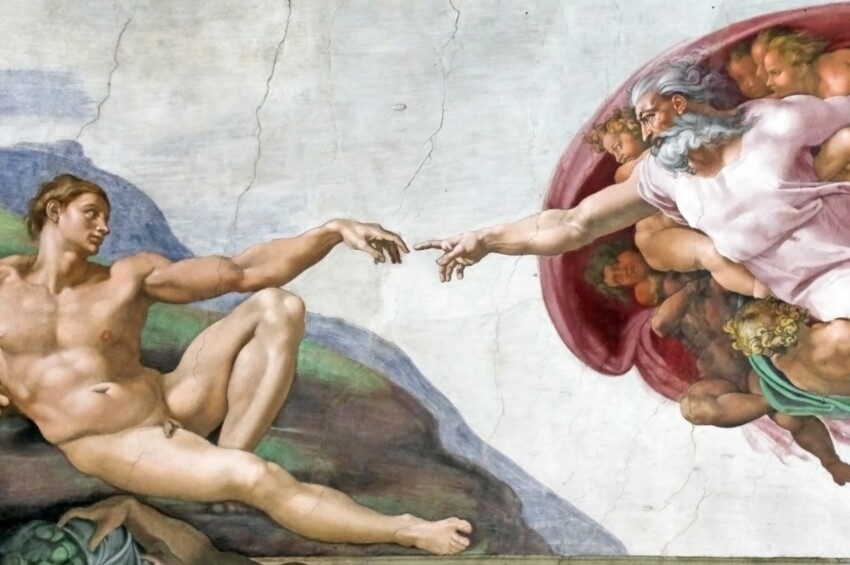
The ceiling of the Sistine Chapel spans almost 500 square metres. Entirely frescoed by Michelangelo in 4 years – from 1508 to 1512 – at its centre are scenes from the Book of Genesis, including the fall of man following Noah’s flood and the celebrated Creation of Adam.
On the sides of the ceiling are depicted the Prophets and the Sibyls, both of whom had foretold the arrival of the Messiah, whilst in the 16 lunettes framing the window arches are shown the ancestors of Jesus and a series of stories from the Hebrew people.
The ceiling frescoes are centred on God’s Creation, reaching its climax with the incarnation of Christ, the perfect fulfilment of divine creation. It was partly for this reason that Michelangelo decided to represent and celebrate the beauty of the naked human body.
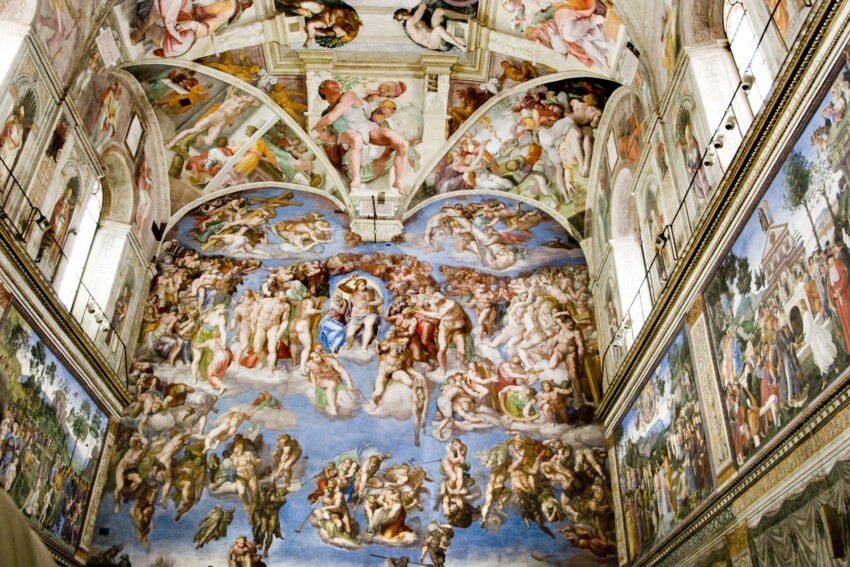
The wall behind the altar is decorated with a massive fresco measuring 13.7×12 metres, painted by Michelangelo between 1536 and 1541: it is the Last Judgement, one of the absolute masterpieces of Western art.
The work was commissioned to Michelangelo by Pope Clement VII, and confirmed by Pope Paul III. After five years of work the artwork was completed, and was then unveiled on 31 October 1541, exactly 39 years after the revelation of the ceiling frescoes.
The enormous Last Judgement is divided into three zones: above are angels with the instruments of the Passion, then Christ and the Virgin among the Blessed, and finally the end of times, with angels sounding the trumpets of the Apocalypse and the fall of the damned.
In total Michelangelo painted over 400 figures, varying in height between 1.5 and 2.55 metres.
On the walls of the Sistine Chapel, on the left are scenes from the Old Testament, with stories of Moses, whilst on the right are scenes from the New Testament, with stories of Christ. On the main entrance wall are two frescoes that complete the cycle, being respectively the “Disputation over the Body of Moses” and the “Resurrection of Christ”.
The authors of the beautiful works on the Chapel’s walls are Perugino, Botticelli and his workshop, Biagio d’Antonio, Cosimo Rosselli, Signorelli and Ghirlandaio.
Among the most famous works we can certainly point to the “Delivery of the Keys of the Church by Jesus to Peter“, a work by Perugino, which depicts an octagonal Renaissance-style temple flanked by two triumphal arches, as if to represent a continuity between past and present.
The lower part of the Sistine Chapel’s walls was, during important ceremonies, adorned with a series of 10 tapestries designed by Raphael and crafted by Flemish workshops. Today such tapestries have been removed and placed in room VIII of the Vatican Picture Gallery, whilst 7 of Raphael’s original cartoons are held at the Victoria and Albert Museum in London.
The Sistine Chapel tapestries reproduce stories of the apostles Peter and Paul, including the Miraculous Draught of Fishes, the Stories of Moses, the Martyrdom of Saint Stephen and the Preaching of Saint Paul to the Athenians.
A very recent addition to the Sistine Chapel is the pipe organ, inaugurated only in 2002 with a concert by organist Gianluca Libertucci. The organ was built by Mathis Orgelbau, features two keyboards with 56 keys and a pedalboard with 30 keys.
The Sistine Chapel, being part of the Vatican Museums circuit, can be visited by purchasing a ticket on site or, preferably, online. It is definitely better to plan your visit carefully and buy tickets in advance, as queues can become very long. Moreover, given the extremely high influx, booking in advance will allow you to choose the day and time of your visit, something certainly not to be taken for granted when booking close to entry time.
There is also the possibility of being accompanied by a guide, taking part in a group or private tour according to your needs. In this case, it is possible to skip the queue at the entrance by taking advantage of priority access.
The Chapel is also included in a special one-day guided tour devised by the Vatican Museums, which allows you to visit it along with the Museums, the Vatican Gardens and the villas of Castel Gandolfo.
It is finally possible to purchase a ticket for an early morning guided tour, before the Sistine Chapel opens. The cost is higher, but you will have the opportunity to walk around inside the Chapel on your own, a rare opportunity indeed.
The Sistine Chapel is part of the main Rome tours, and you will therefore have the possibility of purchasing combination tickets of all kinds, which include its visit together with other leading attractions in the capital, such as the Colosseum or the Vatican.
Below is a series of useful information to help you plan your visit to the Sistine Chapel.
The Sistine Chapel is open Monday to Saturday from 9:00 to 18:00, with last entry at 16:00. It is closed on Sundays except for the last Sunday of the month when entry is free, and also on 1 November, 8 December and Christmas.
Inside the Sistine Chapel photography is not permitted. Security personnel continuously check that visitors do not take photos with or without flash.
Being a place of worship, you may visit the Sistine Chapel only if dressed appropriately. In particular, it is necessary to cover shoulders, knees and necklines. If you are visiting Rome in summer and want to walk around the city in light clothing, we recommend bringing a scarf or shawl with you to cover your shoulders.
You might want to spend days inside the Sistine Chapel, but unfortunately the time at your disposal will be limited by security personnel, who, after about 30 minutes, will ask you to move on to the next rooms of the Vatican Museums. This is to ensure everyone has the opportunity to enjoy the visit in peace, as space inside is limited.
At the same time, if you take part in a guided tour, you will be given the opportunity to remain inside the Chapel for approximately 15-30 minutes
Active for 1500 years, the Sistine Chapel choir is the oldest choir in the world still in operation. It plays a primary role during papal celebrations at St Peter’s, but at the same time performs around the world.
It is made up of 20 adult singers and 35 boys; the latter attend the free school Schola Puerorum, which runs from third grade through to third year of secondary school.
Despite its name, the Sistine Chapel choir today performs at the Basilica of St Peter’s; however it is called this because it was previously positioned inside the Chapel itself.
During the Feast of the Baptism of the Lord, held on the first Sunday after Epiphany, the Pope baptises newborns at the baptismal font of the Sistine Chapel, which represents the tree of life, at the base of which is a stone from the River Jordan, where Jesus Christ was baptised.
The waiting list, as you can imagine, is very long, and the procedure for baptising your child is rather complex. However it is not impossible, unless the child is the offspring of divorced or separated parents, or of couples not married in church.
Once these initial requirements are met, you will need to speak with your parish priest, who must write a letter of suitability to baptise outside his parish. Parents must have completed the pre-baptism formation course, and the parish priest must testify in writing that they are active participants in parish life.
At the same time, parents must write a letter to the Pope, explaining the request and asking to celebrate their child’s baptism. If your family is selected, there will be a baptism rehearsal without the Pope, who will meet the couple and the child only on the day of baptism. Should the family be rejected instead, the Vatican will explain the reason, often consisting of the large number of requests.
The queues at the Sistine Chapel can be very long. For this reason we recommend visiting around lunchtime, on working days. Remember that on the last Sunday of each month entry is free, and therefore you should expect even more people than usual. As a general rule, if you can, avoid visiting at weekends and public holidays.
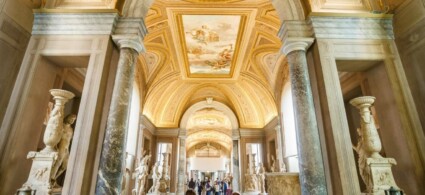
Access to the Sistine Chapel is from the Sala Regia, a grand ceremonial hall of the Apostolic Palace of the Vatican.
The Sistine Chapel is an enormous rectangular room approximately 40.93 metres long and 13.41 metres wide, that is, the dimensions of Solomon’s Temple, the first temple of Jerusalem according to the Old Testament.
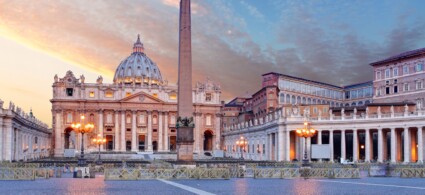
The Sistine Chapel is located within the territory of Vatican City, situated immediately to the right of St Peter’s Basilica, in a hidden position and almost invisible from St Peter’s Square. You can reach it using Rome’s public transport. In particular you can use buses number 49, 492 and 913, which stop in Piazza del Risorgimento. Once you get off the bus it is just a 10-minute walk to St Peter’s Square itself. The tram number 19 also stops in Piazza del Risorgimento.
For those who prefer to use the metro, the nearest stop is Ottaviano-S.Pietro, which is on line A; after exiting you need to walk along Via Ottaviano and Via di Porta Angelica, covering a total distance on foot of approximately 20 minutes. The Lepanto stop is also fairly close, and you reach the Sistine Chapel by walking along Via Cola di Rienzo.
City Card allow you to save on public transport and / or on the entrances to the main tourist attractions.

 Hotel
Hotel  Budget accommodations
  Apartments
  Family Hotel
  Luxury Hotel
  Resorts