If you have three days to visit Rome, here is an itinerary that covers the city's principal attractions, divided into three themes and historical periods.
To explore Rome properly would require far more than a month. That said, most visitors arrive for a considerably shorter stay – often just a weekend, a long weekend, or a brief break, sometimes even just a single day. While it’s better than nothing, a short visit still allows you to get a sense of the main monuments and hopefully inspires you to return for a more leisurely exploration.
However, given the sheer number of Rome itineraries available, 3 days gives you the chance to delve properly into several aspects of the capital. In particular, you can cover three distinct historical periods: Imperial Rome, through visits to key sites like the Colosseum and the Roman Forum, Catholic Rome, with its focus on the Vatican and the immense treasures it contains, and Baroque Rome, with the beauty that cinema has made famous worldwide – including the Trevi Fountain and the Spanish Steps at Piazza di Spagna.
Here then is an itinerary to discover Rome in 3 days that will take you through the city’s major monuments. You’ll certainly need to keep up a brisk pace and will inevitably have to skip some sights, but you’ll definitely gain a solid overview of what Rome has to offer, with a little time left for a well-deserved rest at the end of each day.
Day one: the history of Rome
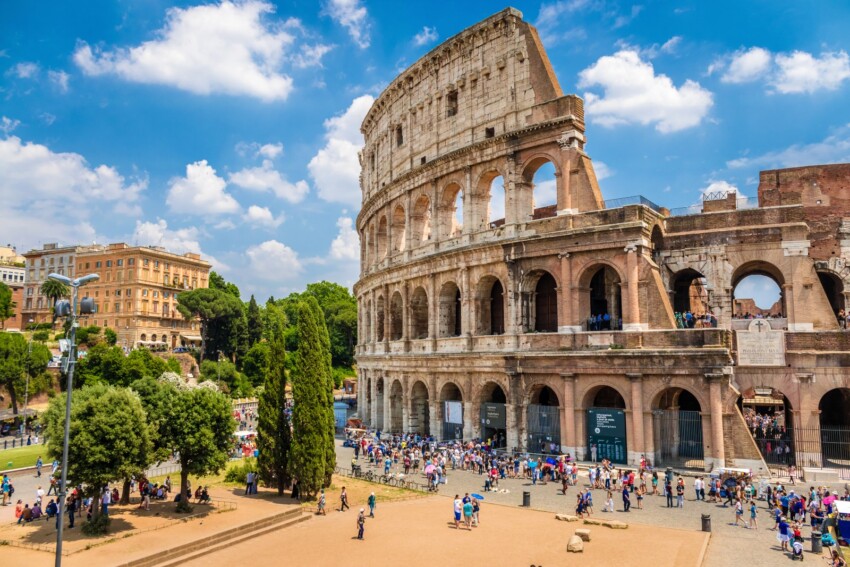
Get up early and begin your Rome visit with the sites that have shaped the city’s history across millennia. The principal symbol of Rome for first-time visitors is undoubtedly the Colosseum, officially the Flavian Amphitheatre. It’s the largest Roman amphitheatre in the world and could hold, by some estimates, over 80,000 spectators. Listed among the New Seven Wonders of the World, you can visit it from the outside or venture inside, exploring the underground chambers either independently or with a guided tour.
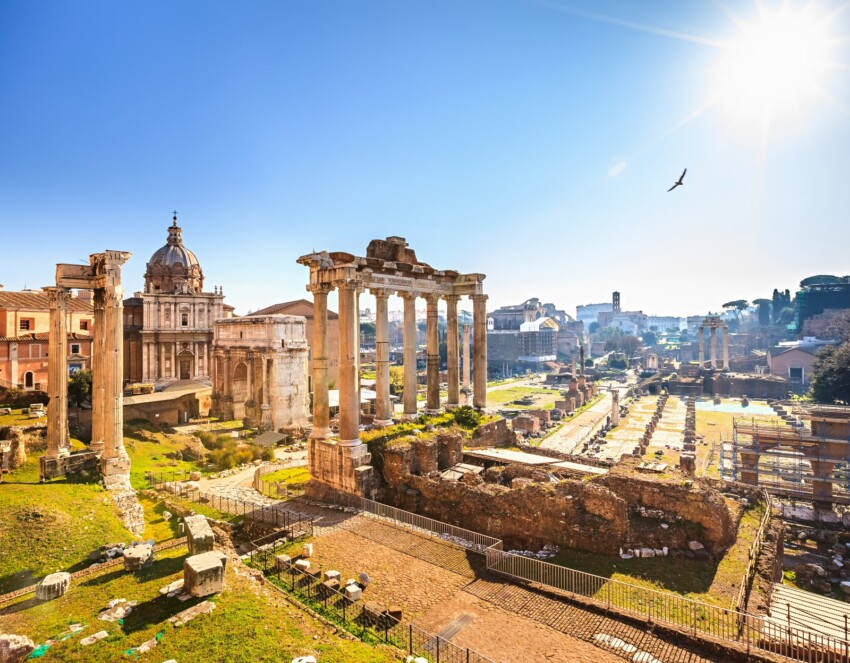
From the Colosseum, you can easily reach on foot a series of attractions all linked to Rome’s long history. To start with, the amphitheatre forms a single vast museum complex called the Colosseum Archaeological Park, together with the sites of the Roman Forum and the Palatine Hill, located nearby. First, visit the Forum to step back into Ancient Rome and connect with its culture and traditions: during your visit you’ll admire remarkable structures whose remains still stand today, stretching out from the Via Sacra, including the Arch of Titus and the Temple of Vesta. At the Palatine, don’t miss the Domus Augustea, the home of Emperor Augustus, as well as the Temple of Apollo Palatinus, the Palatine Stadium and the Palatine Museum, which tells the story of the area.
Finally, the last must-see attraction for an itinerary covering historic Rome is the Domus Aurea, a vast villa built by Emperor Nero after a fire destroyed much of Rome in 64 AD. The Domus Aurea visit takes place through virtual reality, allowing you to travel back in time by two thousand years from a unique perspective.
Moving further south, end your first day exploring Imperial Rome by admiring two other essential city landmarks that have marked Rome’s history: the Circus Maximus and the Baths of Caracalla. The first is certainly less demanding than the second, which requires a more thorough visit. Choose what to see based on how tired you are and how much you feel like continuing to walk.
To wrap up the day, head west from the Circus Maximus, pass by the Church of Santa Maria in Cosmedin where you can stop for a photo at the famous Mouth of Truth, then cross the Tiber on the Ponte Palatino and you’ll find yourself in Trastevere, where you can end your day by choosing a traditional trattoria to enjoy specialities of Roman cuisine.
Day two: the Vatican
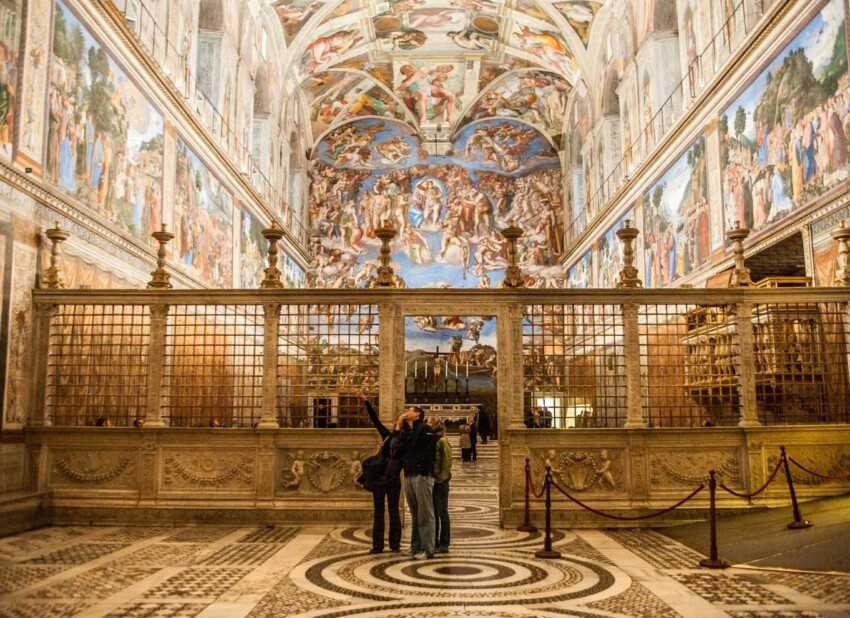
The spectacular Sistine Chapel
After spending the first of your three days in Rome exploring the city’s imperial past, dedicate your second day to discovering the treasures of the Vatican. The world’s smallest city-state is located west of Rome’s centre and is easily accessible by public transport or underground.
Upon arrival, spend time visiting the imposing St Peter’s Square, where you can admire Bernini’s huge colonnade, certainly the sculptor’s most fascinating and famous work. From there, head inside the St Peter’s Basilica, a true icon of the city. You can admire only the exterior, or decide to visit the interior by taking part in a guided tour, which will also allow you to climb the dome, the “Cupolone” as Romans affectionately call it.
After a lunch break – being careful of the area’s well-known tourist traps – continue your Vatican visit and make your way to the Vatican Museums, one of Rome’s most important and visited attractions. They represent one of the world’s largest art collections and were established in 1506 by Pope Julius II. The Vatican Museums are referred to in the plural because they actually consist of a complex of many museums, housing over 70,000 works of art, including paintings and sculptures, created by world-renowned artists such as Raphael, Michelangelo and Leonardo da Vinci. Among the museums stand out the Vatican Picture Gallery, the Pio-Clementino Museum, the Gregorian Egyptian Museum, the Philatelic and Numismatic Museum and the museums of the Vatican Apostolic Library.
The most famous and most beautiful attraction of the Vatican Museums is, however, the Sistine Chapel, which houses the celebrated cycle of Michelangelo’s frescoes, depicting the Creation of Adam and the Last Judgment. The Chapel, dedicated to the Assumption of Mary, is where the papal conclave and official papal ceremonies are held. An interesting fact: its dimensions are 40.93 metres by 13.41 metres – exactly the same as Solomon’s Temple in Jerusalem.
Day three: Baroque Rome
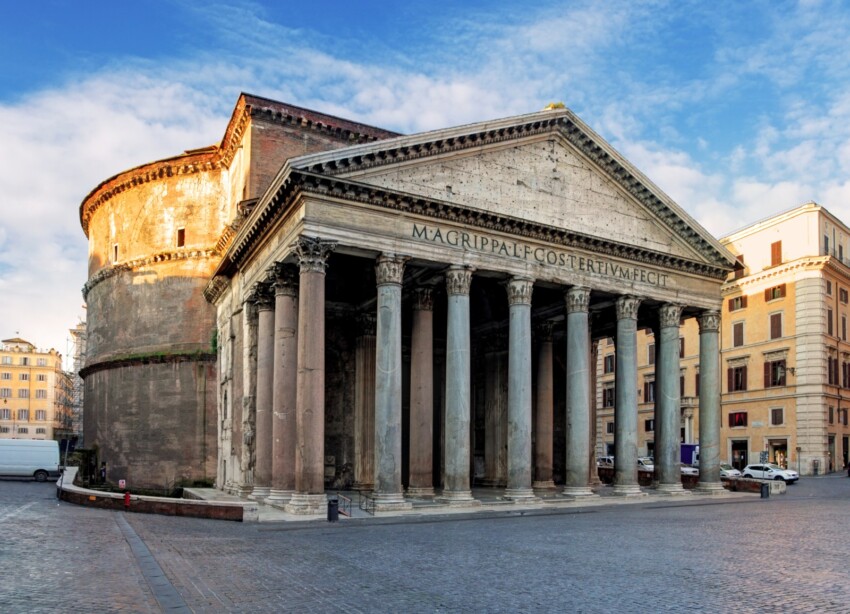
The Pantheon
Dedicate your third and final day in Rome to exploring the splendours of Baroque Rome, starting with the world-famous Trevi Fountain, located in the heart of the city. Among Rome’s estimated 2,000 fountains, this is certainly the most famous and most photographed. It stands in front of the façade of Palazzo Poli and was designed by architect Nicola Salvi in the 18th century. The fountain is adorned with a series of statues and holds cultural significance, as it’s a must for tourists to toss a coin whilst turning their back to the fountain.
From the Trevi Fountain, head west towards Piazza di Monte Citorio, where Palazzo Montecitorio, home of the Chamber of Deputies of the Italian Republic, is located, then continue south and you’ll reach the Pantheon, a beautiful building from ancient Rome that actually has little to do with a Baroque itinerary but is absolutely worth visiting. Continue on to Piazza Navona, one of the most beautiful and captivating squares in central Rome, where you can admire the Obelisk of Agonalis dating from the 1st century and the trilogy of fountains – the Fountain of the Four Rivers, the Fountain of the Moor and the Fountain of Neptune.
The last unmissable stop on a Baroque Rome itinerary is Piazza di Spagna, with its famous monumental staircase, which leads up to the Church of Trinità dei Monti, one of Rome’s symbols: sit on its steps to enjoy a beautiful panoramic view that overlooks the elegant Via Condotti and the Fontana della Barcaccia, the main sculpture in Piazza di Spagna.
At this point in the itinerary, you’ll be right in the heart of Rome: spend some time relaxing and enjoying yourself, stroll along the city centre’s main shopping streets and find a good restaurant where you can end your third and final day in Rome.
One more day: Tivoli
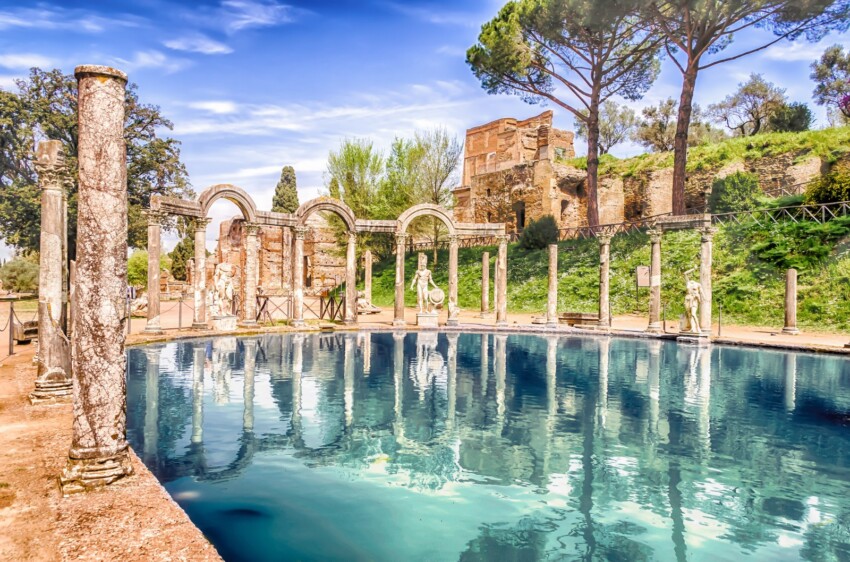
The Canopus at Villa Adriana, Tivoli
As mentioned at the start, three days are certainly not enough for a thorough visit to Rome: upon reflection, you’ve left out absolute gems such as Castel Sant’Angelo, the Gianicolo Belvedere, Campo dei Fiori market, the Basilica of St John Lateran and much of the northern part of Rome, with the Borghese Gallery museum, the Zoo and a host of other truly interesting attractions.
But if you have one extra day and want to conclude your Roman holiday, we recommend a day trip to discover the beauties of Tivoli, a town located about 35 kilometres from Rome to the east and easily reached by car or train. Tivoli has three attractions of international significance that are well worth visiting and very different from one another. These are Villa d’Este, Villa Adriana and Villa Gregoriana, which together form a circuit known as “the road of the villas”, one of Italy’s most beautiful itineraries.
In particular, Villa Adriana is a villa from Imperial Rome, built by Emperor Hadrian around the time of Christ; Villa d’Este is a splendid Baroque villa with magnificent gardens adorned with fountains, and Villa Gregoriana is actually a park, particularly special because it’s built on the steep slope of a hill, descending from the top to a sheer drop down to the valley below where the Aniene river flows.
Guided and free tours of Rome
Discover Rome through the eyes of expert guides who will take you on a tour of the city's hidden treasures. Participating in a guided visit or a free tour will allow you to capture the true essence of Rome.
The free tours are a viable alternative to traditional guided tours. They work like this: participation is free and at the end of the visit you can leave a tip at your discretion. Below you will find our favourite free tour, otherwise you can see the full list by visiting this page.

 Hotel
Hotel  Budget accommodations
  Apartments
  Family Hotel
  Luxury Hotel
  Resorts