Bestseller
Colosseum, Roman Forum & Palatine Hill Guided Tour
From 49,00 €
Buy the ticket
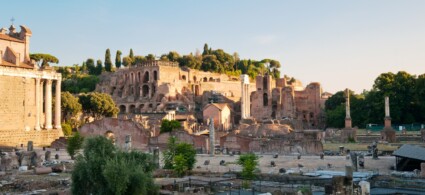
Part of the same museum circuit that also includes the Colosseum and Palatine Hill, the Roman Forum is a genuine journey back in time. Walking through the ruins of Ancient Rome, you can relive the city’s golden age, when this area was the hub of public life. It was here that buildings for political, social, religious and commercial activities stood, representing the true administrative and representative centre of the city. Interestingly, the area where the Roman Forum now stands was originally a swamp, which was drained in the 6th century BC, partly thanks to the construction of the Cloaca Maxima, the world’s oldest sewage system still in use today.
As dynasties and emperors came and went, the Roman Forum was enriched with additional monuments, including the Temple of Vespasian and Titus, that of Antoninus Pius, and the Arch of Septimius Severus, to name but a few. The last monument to be built within the Forum was the Column in honour of Phocas, Byzantine Emperor, dating from 608 AD. Subsequently, the Roman Forum was abandoned and forgotten until Italian unification, when excavations were finally begun in the area, bringing to light the wonders that you can still admire today.
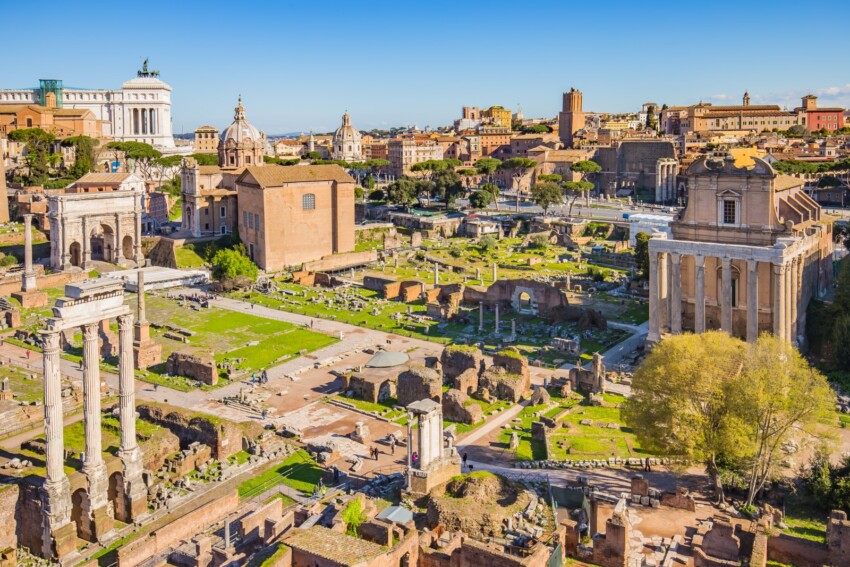
Although essentially a collection of remains and ruins, there are many monuments of the Roman Forum still in excellent condition today. Here are the main points of interest, many of which are located along the Via Sacra, the main street of Ancient Rome that connected Campidoglio Square with the Colosseum.
The Regia, today also known as the King’s House, is one of the oldest buildings in the Roman Forum. It is located at the south-east end of the area, and is very likely part of what was originally a much larger zone. It was where the Rex sacrorum and the Pontifex Maximus performed their sacred duties. Rebuilt in 36 BC, around it you can still see some wells and, above all, the Temple of Vesta, which has a circular form and is one of Rome’s oldest temples.
Only three columns of the Temple of the Deified Vespasian, or Temple of Vespasian and Titus, survive. It stands at the foot of the Capitoline Hill, measures 33 metres by 22 metres and dates from 81 to 87 AD. It was dedicated to Emperor Vespasian, who was deified after his death.
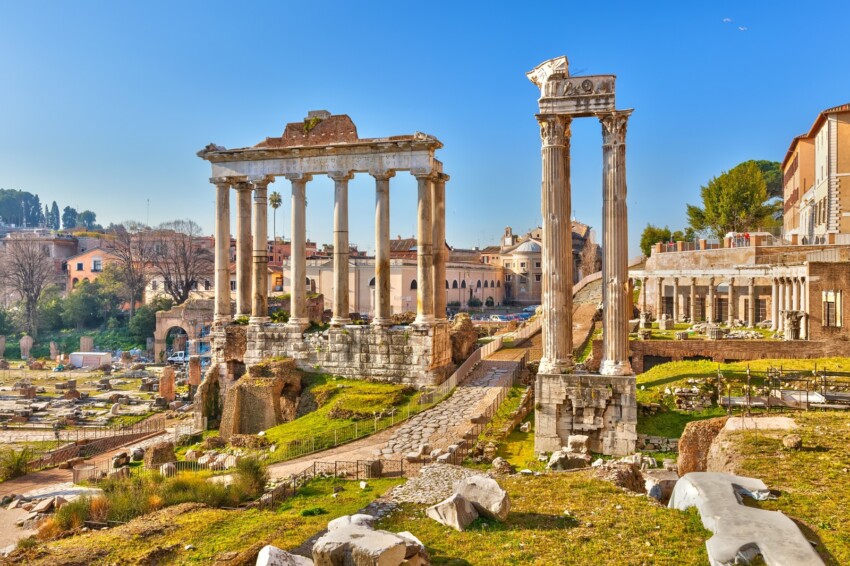
Located at the foot of the Capitoline Hill and home to the state treasury, the temple takes its name from the statue of Saturn that was kept inside, which was wrapped in woollen bandages and covered with oil throughout the year, except for the Saturnalia, festivities held from 17 to 23 December. The remains of the Temple of Saturn visible today are the granite columns and the four-sided Ionic capitals.
Dedicated to Castor and Pollux and dating from the 5th century BC, the Temple of the Castors has three columns remaining from the long side and the core of the podium. It experienced its heyday in the 1st century BC, when it was an important public building where official weights and measures were kept.
Located right on the Capitoline Hill, the façade of the Tabularium with its characteristic arches dominates the entire Forum. Built in 78 BC, it originally served as the state archive, where public records and peace treaties were kept, inscribed on bronze tablets (tabulae, hence the name Tabularium).
Built on a slight slope from 54 BC by order of Caesar, the Basilica Giulia caught fire in a blaze that occurred a few years later, but was quickly rebuilt. Its fate was truly unfortunate, however, as it caught fire a second time in 283 AD, and although restored again by Diocletian in 285 AD, today only the podium, some steps and a few semi-columns remain standing.
Probably commissioned by Domitian, the Arch of Titus stands just outside the Forum area, along the Via Sacra. It is a splendid triumphal arch that symbolises the splendour of the Flavian era, built after Emperor Titus’s death in 90 AD, in memory of the war he fought in Galilee.
Built almost 200 years after the Arch of Titus, the Arch of Septimius Severus stands at the north-western corner of the Roman Forum. It was erected to celebrate Emperor Septimius Severus’s victory in war against the Parthians. It was one of four monumental entrances to the forum square, not passable by chariots.
Technically not part of the Roman Forum proper, but located right next to it. The Basilica of Maxentius dates from the 4th century AD, under Emperor Constantine I. It is the largest civil basilica in the Forum area, and its profile with three enormous arches is also used as a backdrop for events, concerts and festivals.
The Column of Phocas was the last monument to be added to the Roman Forum. It dates from 608 AD and was erected by order of the Senate to celebrate Phocas, Eastern Roman Emperor. It is made of white marble and today stands in rather isolated position among the ruins.
Access to the Roman Forum is available exclusively by purchasing online tickets. The requirement to buy tickets online should not be seen as a constraint, but rather as an opportunity: by booking in advance, you can choose your visit time, ensuring a place for your chosen day and hour. At the same time, advance booking allows you to avoid queues at the ticket office, which before this system was introduced could sometimes stretch for hours.
Admission to the Roman Forum also includes entry to the Colosseum and Palatine Hill. There are two types of tickets:
Valid for 24 hours, it permits one entry to the Roman Forum, one to the Colosseum and one to Palatine Hill; current exhibitions are included.
Valid for two consecutive days, it includes all standard ticket access plus entry to the first floor of the Palatine Museum, the exteriors and study of the House of Augustus, the Temple of Romulus, the Schola Praeconum – weekends only, and the floor of the Arena or underground chambers of the Colosseum.
It is possible to visit the Roman Forum for free in two ways. The first is to enter on the first Sunday of the month, when entry to Rome’s museums is free. The problem, in this case, is that you should expect huge crowds, surrounded by thousands of tourists. Paradoxically, it’s better to buy an admission ticket!
Alternatively, there is still the possibility of getting an idea of the Forum and seeing it without having to pay: indeed, from Via dei Fori Imperiali, which connects Piazza Venezia to the Colosseum and is entirely pedestrianised on Sundays, you will have an elevated view of a good portion of the Forum. You won’t have the chance to enter, but you can still get a panoramic view and take wonderful photos.
Among the various options for booking a visit to the Roman Forum, you can also purchase tickets that include a guided tour, which very often also covers the Colosseum and Palatine Hill areas; remember that the three attractions are part of a single museum circuit.
With the support of a guide, you’ll be able to immerse yourself in life in Ancient Rome and understand the functions of the buildings whose remains you can admire during your Forum visit.
As is very often the case in archaeological parks, a tour with a guide is almost essential. You will essentially only see remains and ruins, and although some of them are well preserved, an expert guide will help you reconstruct the buildings, explain their original purpose and help you understand how daily and social life unfolded in the Forum – a genuine journey back in time that’s really worth experiencing.
Moreover, the Colosseo Park, the museum body that also manages the Roman Forum, periodically organises a series of official guided tours that allow you to explore the area with the help of expert professional guides. These are often special events, held once or twice, so we suggest you keep an eye on the park’s website to find out about upcoming events.
The Roman Forum is open every day of the week from Monday to Sunday, except on Christmas Day and New Year’s Day. The last entry is permitted up to one hour before closing time, which varies depending on the time of year according to the following schedule:
If you’re wondering how long it takes to visit the Roman Forum, the answer isn’t straightforward. Allow approximately one and a half hours to walk through it along the Via Sacra, but there are many possible detours to make and monuments to visit, so the visit could easily extend for half a day or even longer if you’re passionate about history and want to explore every corner.
As always, choose your visit time carefully, also depending on how many days you’ll be spending in Rome.
Today, the two main access points to the Roman Forum are at Largo della Salara Vecchia 5/6, Via del Tulliano or on the Via Sacra. It’s very easy to get there by public transport, especially using the metro and buses; the nearest landmark is the Colosseum, where the underground train and several bus lines stop.
In particular, travelling on Line B of the underground, simply get off at Colosseum and continue on foot. With the bus, there are several lines you can take, depending on where you’re coming from: among these, lines 51, 75, 81, 85, 87 and 118 are worth noting. Alternatively, you can also reach the Roman Forum using the tram, particularly line 3.
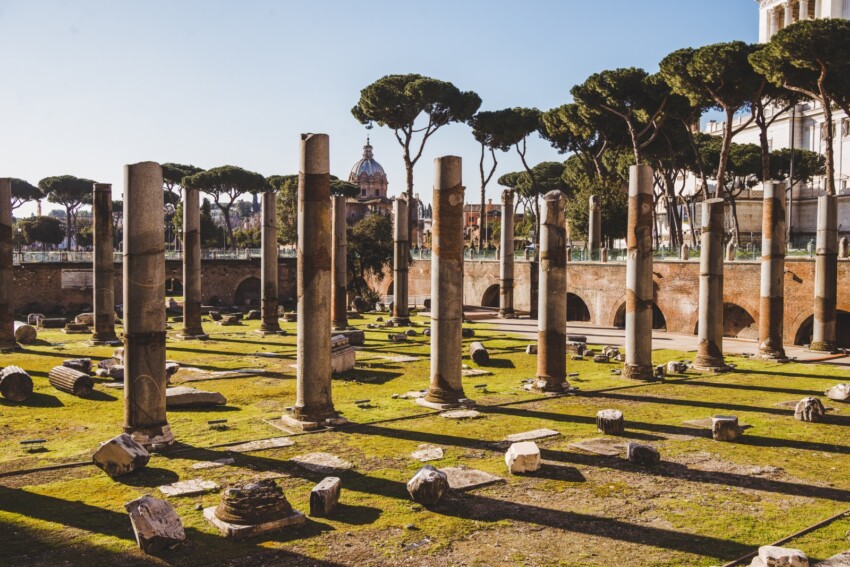
Our first tip is to wear comfortable shoes. Remember that much of the route is on unpaved ground, grass or potentially slippery stones. Avoid wearing inappropriate footwear such as high heels, flip-flops or sandals.
Given the lack of shelter from the sun, we recommend visiting the Forum early in the morning, as this will allow you to avoid both the oppressive summer heat and the crowds. Remember that, especially in summer, the heat can become excessive, as the route is practically all in the sun, so bring sunscreen, a hat and plenty of water with you.
If possible, avoid visiting during weekends and public holidays, when visitor numbers are obviously higher. Try to arrive early in the morning or late in the afternoon, as the middle hours of the day are when organised groups and tours arrive.
The best time to visit the Roman Forum is ideally a weekday in spring, when you’ll find fewer people and pleasant temperatures. Of course, we understand that not everyone can afford a trip to Rome out of season on a working day, but if you have the opportunity, take advantage of it and you won’t regret it.
Beware of tourist traps: within the Forum you’ll come across so-called actors dressed as gladiators, who will try in every way to approach you to take a photo together, after which they’ll obviously want a contribution or tip. Also remember that restaurants, bars and shops in the immediate vicinity of the Forum are designed exclusively for tourists, so on average you’ll find lower quality and higher prices.
Don’t use unofficial guides: near the Forum and Colosseum you’ll be approached by touts or unofficial guides who will contact you to sell you tickets and guided tours at below-normal prices, unfortunately often of inferior quality.
Among the services available for your visit to the Forum, we highlight the visitors’ shop, a refreshment area, an information point and a baby care facility.
You are not allowed to bring bottles, glass containers, alcoholic beverages, spray cans, camping rucksacks and bulky bags such as suitcases or trolleys into the Roman Forum. You may, however, bring medium and small-sized shoulder rucksacks, which will be subject to metal detector screening at the entrance.
City Card allow you to save on public transport and / or on the entrances to the main tourist attractions.

 Hotel
Hotel  Budget accommodations
  Apartments
  Family Hotel
  Luxury Hotel
  Resorts