Piazza Navona Underground - The Stadium of Domitian
329 reviews
Buy now
From 10,00€ per person
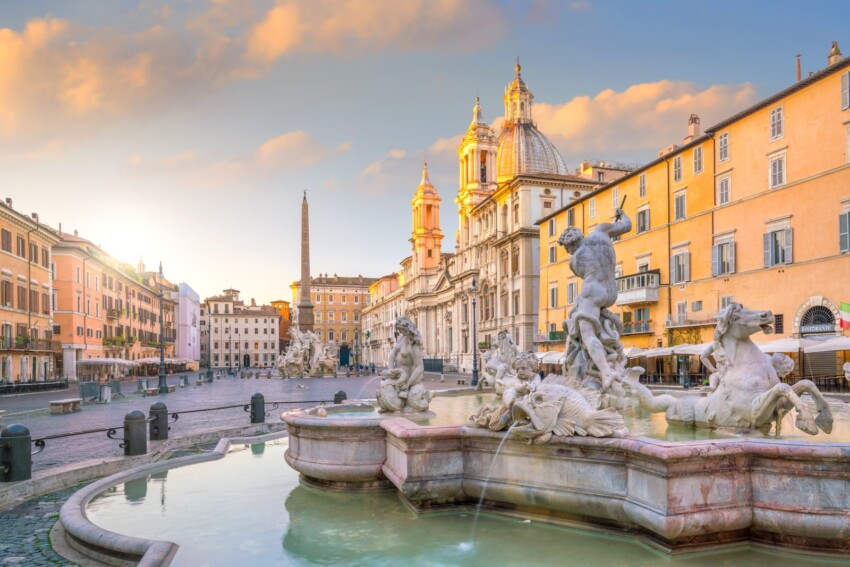
Amongst Rome’s countless piazzas, Piazza Navona is undoubtedly one of the most celebrated. Located in the Parione district, on the right bank of the Tiber, it boasts a distinctive elongated shape reminiscent of an ancient stadium. However, its current construction has nothing to do with ancient Rome, as it was built at the behest of Pope Innocent X by the Pamphili family, Roman nobility who lived between the 16th and 17th centuries.
Where Piazza Navona stands today, in ancient Roman times there was Domitian’s Stadium, which gradually fell into disrepair and was abandoned in the centuries following its construction. Nevertheless, the piazza has always been used for recreational purposes, hosting knightly tournaments, carnivals and jousting competitions. Today, Piazza Navona, entirely paved with cobblestones, features three fountains and an obelisk, with an elongated rectangular layout that terminates in a semicircle on one of its sides.
The piazza represents a vibrant area in Rome’s centre, surrounded by bars and restaurants, and equally enjoyed by Romans and tourists alike. A symbol of Baroque Rome, thanks to its numerous architectural and sculptural elements, fountains, an obelisk and splendid palaces overlooking it, it ranks amongst the capital’s iconic landmarks and is an essential stop during any visit to the city.
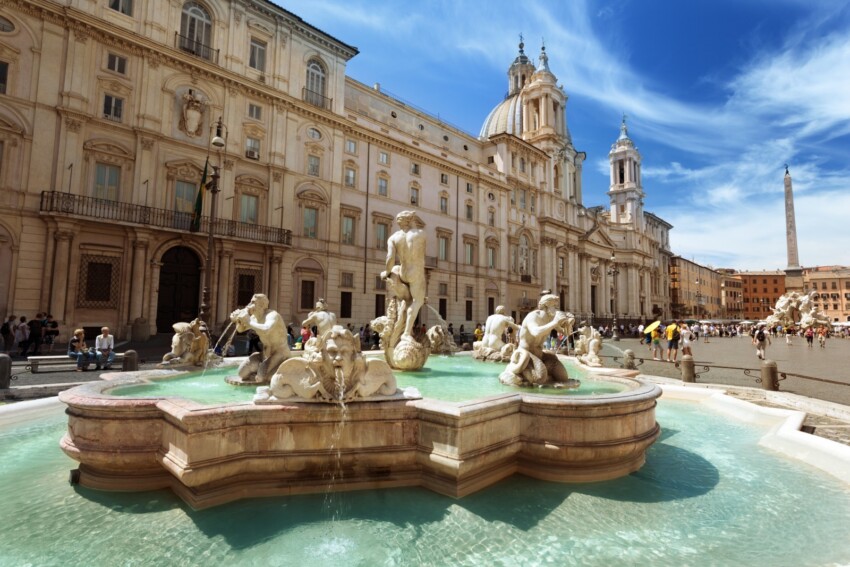
Piazza Navona is truly expansive, brimming with art and beauty. Between palaces, fountains and museums, there is so much to explore that a single day would hardly suffice.
Dating back to the 1st century, the Obelisco Agonale stands majestically in the centre of Piazza Navona, towering above the Fountain of the Four Rivers. It was fashioned in red granite at the quarries of Aswan, in Egypt, during the reign of Emperor Domitian.
Given its Egyptian origins, it naturally follows Egyptian models; upon its arrival in Rome, it was decorated with a series of hieroglyphics, including characters representing Domitian’s name. It was originally placed near the Temple of Serapis, and in 311 Emperor Maxentius moved it to his private villa on the Appian Way. Collapsed during the medieval period, it was restored at the behest of Pope Innocent X and placed in Piazza Navona, where it was integrated above the Fountain of the Four Rivers.
The obelisk stands over 16 metres tall, reaching 30 metres when the base and the bronze dove sculpture crowning its apex are included.
The only church overlooking Piazza Navona is the magnificent Church of Sant’Agnese in Agone. It was built on the exact spot where, according to legend, Agnes suffered martyrdom at just 12 years of age; however, an ancient basilica had previously occupied this site, and before that a small church.
The design for the Church of Sant’Agnese in Agone dates to the mid-1600s, by architect Girolamo Rainaldi, commissioned by Pope Innocent X, who is buried here. Externally, the church’s façade is characterised by two bell towers, a central dome and a solemn entrance, whilst internally, with a Greek cross layout, it features lavish decorations, gilded stuccos and a series of statues and sacred artworks.
The high altar dates to 1720 and is elevated on four columns of verde antico marble; the main organ, located above the tomb of Innocent X, is equally striking.
Several magnificent palaces overlook Piazza Navona, erected between 1550 and 1750.
Noteworthy amongst these are Palazzo Braschi, dating to the late 18th century and housing the Museum of Rome’s galleries, Palazzo De Torres – Lancellotti, dating to the 16th century and still owned by the Lancellotti family, and Palazzo Pamphilj, constructed in Baroque style during the 17th century by the powerful Roman family. Today, Palazzo Pamphilj remains family-owned, though one wing has been converted into the Brazilian Embassy.
The Nile, the Danube, the Ganges and the Río de la Plata are four of the world’s most important rivers, one per continent. They are the protagonists of the Fountain of the Four Rivers, located in the centre of Piazza Navona in front of the Church of Sant’Agnese in Agone.
Commissioned by Pope Innocent X and designed by Gian Lorenzo Bernini, the Fountain of the Four Rivers was created by a group of sculptors affiliated with him between 1648 and 1651. It is a Baroque masterpiece, and the Obelisco Agonale rises above it.
Each of the four rivers is represented by white marble statues depicting nude men reclining on the central rock. Seven animals and a bronze dove, positioned atop the obelisk, accompany them.
According to historical sources of the era, the fountain’s construction proved so costly that the pope was forced to increase the bread tax and reduce the weight of a standard loaf. Roman residents vented their frustration not on the pope, but on his sister-in-law, whom they held indirectly responsible for the levy.
Of secondary importance to the Fountain of the Four Rivers, the Fountain of the Moor and Fountain of Neptune adorn the southern and northern sides of Piazza Navona respectively.
The Fountain of the Moor was designed and created by Giacomo Della Porta and subsequently revised by Bernini, who added dolphins to it. The Fountain of Neptune, meanwhile, met a sadder fate, as after its design—once again by Giacomo Della Porta—it was abandoned until the end of the 19th century, when fortunately it was completed by artists Zappalà and Della Bitta.
The triptych of Piazza Navona’s fountains is the subject of a curious fact: until the end of the 19th century, the drainage outlets of the three water features were closed, allowing water to inundate the entire piazza. This created a veritable water mirror, called “the Lake of Piazza Navona”, which provided cooling relief and entertainment for the city’s residents.
Entirely housed within the elegant Palazzo Braschi, at the southern end of Piazza Navona, the Museum of Rome comprises 20 rooms spread across the second and third floors of the building, plus additional spaces housing a library and an exhibition of period carriages.
Inaugurated in 1930, it was only transferred to Palazzo Braschi in 1952; the museum route allows visitors to admire paintings, sculptures and furnishings made of precious woods, as well as mirrors, plinth bases for busts, ceramics and medals. Some museum rooms are devoted to a single theme, such as the history of Pope Pius VI, the Roman Senate or fashion codes. Others are dedicated to the great families who lived in Rome, such as the Barberini, the Rospigliosi or the Torlonia. Finally, a series of rooms are dedicated to Rome’s landmarks.
The Museum of Rome is also perfect for viewing Piazza Navona from above, as the palace’s north-facing windows offer magnificent views over the piazza.
On the eastern side of Piazza Navona sits the Museum of Gladiators, dedicated to the heroes of ancient Rome and ancient combat. It displays reconstructions of helmets, armour and lances spanning nearly 1,000 years of the city’s history, from the 6th century BC to the 4th century AD.
The artefacts have been reconstructed using casting and embossing techniques, and there are numerous panels and drawings describing the various objects with archaeological precision and rigour. There is also a section dedicated to the enemies of the ancient Roman army.
The Museum of Gladiators is open daily from 10:00 to 19:30; tickets are purchased directly at the counter. For more information, call +39-068891777 or email info@gladiatormuseum.com.
A traditional market operates at Piazza Navona, originally established as a neighbourhood market, later relocated to the nearby Campo dei Fiori; today, Piazza Navona’s market has transformed into a Christmas market, active during the festive season and coinciding with Epiphany celebrations, thanks to the famous Befana of Piazza Navona.
Since the 1960s, Piazza Navona has been populated with artists, painters and draughtsmen who display their paintings and works on temporary easels. They have been joined by other artists creating portraits and caricatures, particularly for tourists.
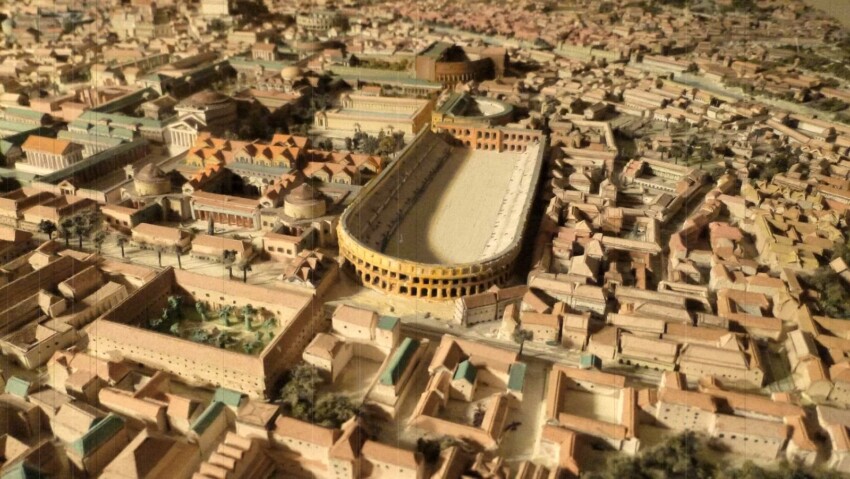
Domitian’s Stadium was the first masonry stadium built in Rome, where Piazza Navona now stands. In 2014, following an extensive archaeological campaign, the underground chambers of the piazza opened to the public, allowing visitors to descend to the level of Rome from 2,000 years ago, approximately 5 metres below the current ground level. Here it is possible to visit the remains of the stadium and discover the history of sport in ancient Rome.
In particular, the archaeological area comprises two distinct sectors: the curve area, situated in the centre of the semicircle on the northern side of the piazza, and the tribune area, situated on the eastern side of the semicircle. Here, alongside remains from the Roman era, there are also traces of a shop, medieval and Renaissance dwellings, and a small late-antique cemetery.
The archaeological area is open daily from 10:00 to 19:00, with last admission at 18:20. Two different tour options are available:
To access Domitian’s Stadium, you must purchase an admission ticket on site or online. There are two different ticket types based on the tour you wish to take, a choice between standard and exclusive. For the exclusive tour, online purchase is mandatory.
Three price bands are available: the standard full price ticket, the reduced ticket for young people aged 12 to 17 and those over 65, and the junior ticket for children aged 8 to 11. Only for the exclusive tour is there a fourth price band, reserved for children aged 1 to 7, who receive an additional discount.
Free admission is available to disabled visitors, EU-qualified tourist guides and Turbopass Roma cardholders.
Upon request, it is possible to arrange exclusive activities such as a guided tour of the Stadium with aperitif, corporate events, educational activities for schools and children’s birthday parties.
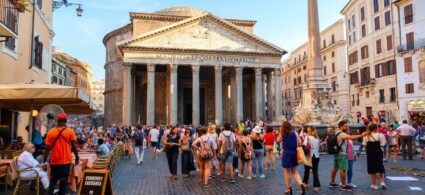
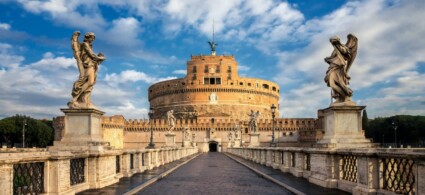
Piazza Navona is located in the heart of the Parione district, just steps away from the banks of the Tiber. Given its position, you will most likely reach it on foot: for example, Castel Sant’Angelo is just 10 minutes’ walk away, the steps of Trinità dei Monti 15 minutes’ walk away, and the Pantheon just 5 minutes’ walk away.
If you wish to reach it by public transport, the metro is certainly not the most convenient option: the nearest stop on Line A is Barberini, which is 20 minutes’ walk away. On Line B, the nearest stop is Colosseo, just under 30 minutes’ walk away. Fortunately, both walks are extremely pleasant, passing through some of Rome’s most exclusive areas and some stunning monuments.
It is far more convenient to reach it by bus, as just a few metres from the south-eastern corner of the piazza there is the Rinascimento stop, along Corso del Rinascimento, where buses 30, 70, 81, 87, 492, 628, C3 stop, as well as night buses n70, n201 and n913.
City Card allow you to save on public transport and / or on the entrances to the main tourist attractions.

 Hotel
Hotel  Budget accommodations
  Apartments
  Family Hotel
  Luxury Hotel
  Resorts