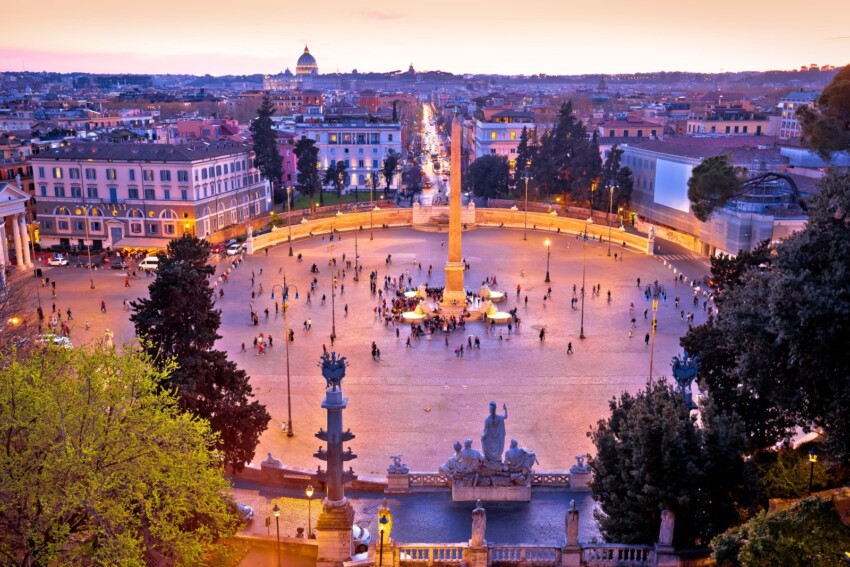
At the foot of Pincio Hill lies the celebrated Piazza del Popolo. We’re in the heart of the Campo Marzio district, and it was here that architect Giuseppe Valadier designed, in the early 1800s, what would become one of the capital’s most famous and iconic squares.
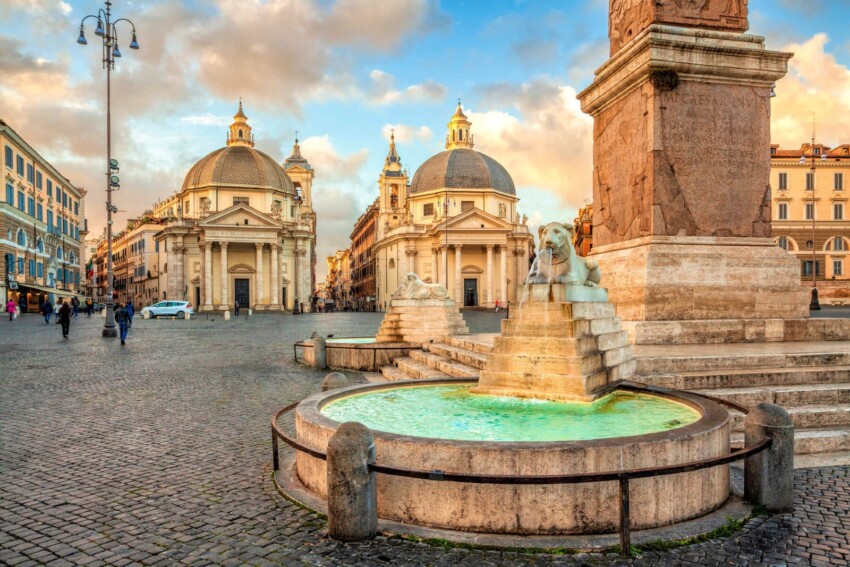
Characterised by the presence of three churches – the Basilica of Santa Maria del Popolo and the two twin churches of Santa Maria in Montesanto and Santa Maria dei Miracoli – as well as three fountains and an obelisk, Piazza del Popolo is a vast pedestrian area of almost 17,000 square metres, accessed via the Porta del Popolo, beyond which begins the Via Flaminia. Its dimensions allow it to accommodate up to 65,000 people, which is precisely why numerous public events, rallies and open-air concerts by internationally renowned artists are held here.
From the southern end of Piazza del Popolo, three of Rome’s main thoroughfares branch off: Via del Babuino, Via di Ripetta and Via del Corso. Piazza del Popolo is therefore an important tourist hub and an essential stop on any worthwhile visit to Rome. Additionally, take the opportunity to visit it at sunset, when from the steps that form the Pincio Terrace you’ll admire a truly magical panorama.
There are truly plenty of things to see in Piazza del Popolo. A thorough visit can take up half a day or more, especially if you stay to watch the sunset from the Pincio Terrace. Therefore, plan your itinerary carefully, based on your preferences.
From Piazza del Popolo, ramps lead up to the Pincio Terrace, one of Rome’s best-kept secrets amongst locals. It’s a unique spot to admire the sunset, but also to enjoy a perfect panorama of the city, with St. Peter’s Basilica and Castel Sant’Angelo on the horizon, the Quirinal Palace to the left, Garibaldi’s statue on the Janiculum Hill in the distance, and the many beautiful sixteenth-century palaces of Rome.
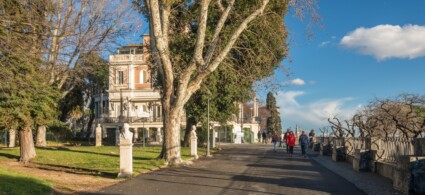
Obviously, looking down you have an almost perfect view of Piazza del Popolo. The terrace was created in 1826 by architect Giuseppe Valadier, who was also responsible for the construction of the square itself. From the terrace, the Pincio Promenade extends, from which you can also access Villa Borghese’s gardens, perfect for a break amongst greenery and nature.
Entry to the Pincio Terrace is free, and the location is open 24 hours a day.
The Porta del Popolo, or Porta Flaminia, officially marks the northern entrance to Piazza del Popolo. Originally part of the Aurelian Walls of Rome, it divides the square from the Piazzale Flaminio beyond. The ancient city gate dates back to the third century, though its current appearance dates from the sixteenth century.
The external façade facing Via Flaminia, commissioned by Pope Pius IV to Michelangelo, was actually subcontracted to Baccio Bigio, who designed it inspired by the Arch of Titus, whilst the internal façade was created by Jacopo Barozzi da Vignola. At the end of the nineteenth century, significant restoration work modernised the Porta del Popolo to meet contemporary needs, particularly to improve city traffic. On this occasion, the towers flanking the gate were demolished.
Next to the Porta del Popolo stands the Basilica of Santa Maria del Popolo, a church originally built in 1099 but enlarged, rebuilt and extended over the following centuries. The appearance we see today dates from an extensive restoration carried out between the fifteenth and sixteenth centuries, when it was given a baroque style.
The façade of the Basilica of Santa Maria del Popolo is clad in travertine, and on the central portal is a beautiful sculpture of the Madonna and Child, whilst inside there are three naves and 4 chapels on each side. The high altar, dating from 1627, is particularly striking, as is the choir, restructured by Bramante in the sixteenth century, featuring magnificent works by artists of the calibre of Andrea Sansovino and Caravaggio.
Inside the Basilica of Santa Maria del Popolo, a visit to the Chigi Chapel is essential, located in the second chapel of the left nave, as it contains works by Raphael and Gian Lorenzo Bernini, and became well-known to the general public thanks to its mention in Dan Brown’s novel Angels & Demons.
The Basilica of Santa Maria in Montesanto is one of the two “twin churches” of Piazza del Popolo, alongside the Church of Santa Maria dei Miracoli. Also known as the Church of Artists, it’s a true gem both inside and out. Dating from 1675, it was designed at the behest of Pope Alexander VII by architect Carlo Rainaldi with supervision by Gian Lorenzo Bernini.
Beyond its religious functions, the Basilica of Santa Maria in Montesanto also hosts numerous events, including sacred music concerts, chamber concerts and cultural events. Mass is celebrated Monday to Friday at 7:00 PM, and on Sundays at 12:15 PM.
The twin church to Santa Maria in Montesanto is the Church of Santa Maria dei Miracoli, located right beside it. Nearly identical in exterior appearance, with a portico supported by four columns, the two churches differ mainly in their interior layout: Santa Maria dei Miracoli has a circular plan, whilst Santa Maria in Montesanto has an elliptical plan.
The interior features 4 side chapels and in each of these you can admire interesting works of sacred art, including the funerary monument to Antonio d’Este, disciple and friend of Antonio Canova, an altar panel depicting the Madonna of the Rosary, and a statue of Saint Michael Garicoïts, founder of the Priests of the Sacred Heart.
The Flaminian Obelisk stands in the centre of Piazza del Popolo. It’s one of Rome’s 13 ancient obelisks and stands approximately 26 metres high, reaching 37 metres if you include the base and the cross at the top.
It’s an obelisk made of red granite of Egyptian origin, with a truly ancient history, as it’s estimated that construction began in 1300 BC at the behest of Pharaoh Seti I. Over 1,000 years later, in 10 BC, the obelisk was brought to Rome by ship and positioned in the Circus Maximus. It was destroyed during the barbarian invasions and rediscovered in 1587 broken into three pieces; it was then rebuilt and relocated to Piazza del Popolo in 1589.
In the nineteenth century, during an extension of the monument, the Fontana dei Leoni was created at the base of the Flaminian Obelisk by architect Giuseppe Valadier.
In Piazza del Popolo there are two beautiful fountains, positioned on the east and west sides. They are the Fontana della Dea Roma and the Fontana del Nettuno; they were created by sculptor and architect Giacomo Della Porta with a very similar structure, as both fountains consist of a large basin at street level where water flows from a basin set on the wall above.
The Fontana del Nettuno is located on the side of the Tiber and takes its name from the statue surmounting it, positioned on a group of rocks and flanked by two tritons and two dolphins. The Fontana della Dea Roma, meanwhile, is located on the Pincio side, and the composition is virtually identical: on the group of rocks sits the Goddess Roma, flanked by statues representing the Tiber and Aniene rivers, and the Capitoline she-wolf nursing the twins.
Furthermore, beneath the Flaminian Obelisk stands a third fountain, the so-called Fontana dei Leoni, a work by Giuseppe Valadier created in the first half of the nineteenth century.
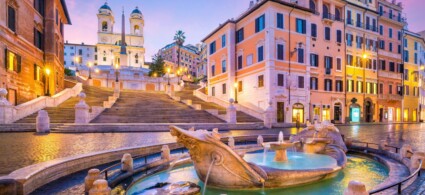
Piazza del Popolo is located at the northern edge of Rome’s historic centre, and you’ll likely reach it on foot whilst exploring the city’s main monuments and attractions. For example, it’s just an 8-minute walk from Piazza di Spagna, along the entire Via del Babuino. It’s also a 20-minute walk from Castel Sant’Angelo and a 15-minute walk from both the Pantheon and the Trevi Fountain.
However, if you’re in more distant areas of Rome like the Colosseum or the Vatican, or near Termini station, you might consider using public transport. It’s certainly not a problem, as the square is excellently served by the metro, thanks to the Flaminio stop on Line A. The number 2 tram is also convenient, stopping practically next to the metro station, in Piazzale Flaminio. Also in Piazzale Flaminio are the stops for buses 89, 490, 495, 590, C3 and G40.
City Card allow you to save on public transport and / or on the entrances to the main tourist attractions.

 Hotel
Hotel  Budget accommodations
  Apartments
  Family Hotel
  Luxury Hotel
  Resorts