Bestseller
Rome: Pantheon Priority Entry Ticket & Interactive App
From 12,00 €
Buy the ticket
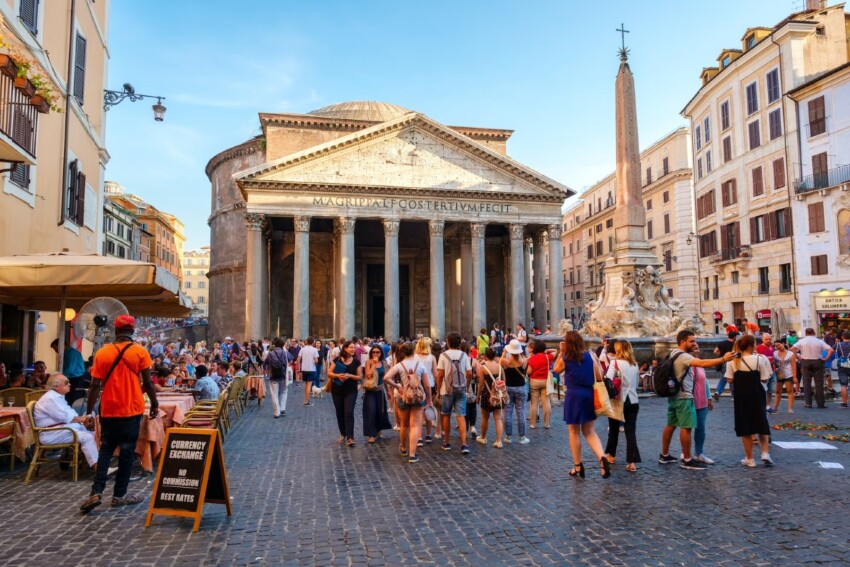
The Pantheon in Rome, officially the collegiate basilica of Santa Maria ad Martyres, is located in the Pigna district in the heart of the historic centre and is one of the capital’s most important monuments. As we know it today, it was built by Emperor Hadrian in the 2nd century AD, although its original construction is even older, dating back to 27 BC, when it was founded by Marcus Vipsanius Agrippa and dedicated to all the gods. It is precisely from this fact that the name Pantheon derives, which in Greek means “temple of all the gods”.
Protected by the ministry for cultural heritage and activities, it is among Rome’s most visited monuments and is undoubtedly one of the symbols of the Eternal City. From the outside, it appears as a large circular structure, connected to the entrance via a series of Corinthian columns supporting a pediment. The interior, also circular in shape, is open to visitors and consists of a large atrium with a series of pillars supporting the enormous dome, still the largest in the world built in brick.
The Pantheon is a large temple in the historic centre of Rome that also serves as a Christian basilica. You can visit it from the outside, but you can also go inside. Visits are not permitted during religious services and events that are occasionally held.
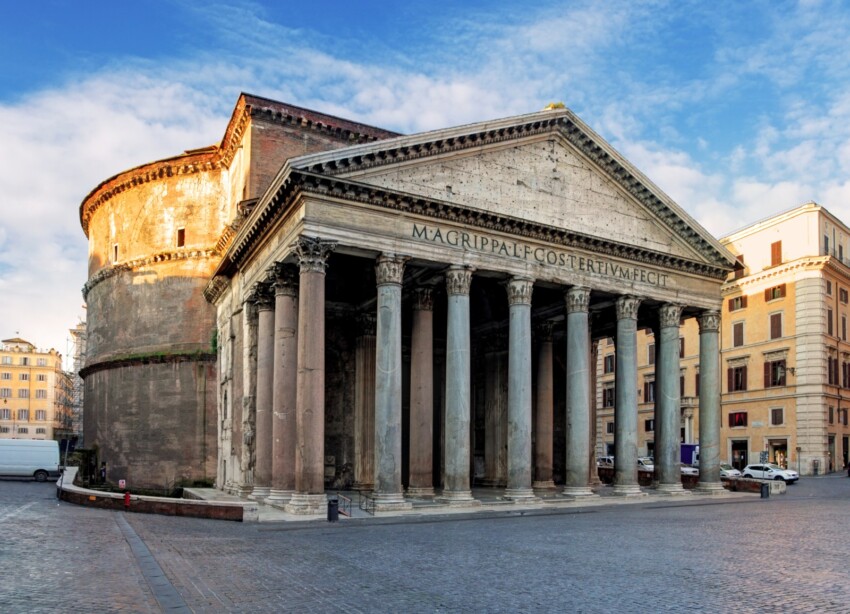
The Pantheon portico represents its main entrance. Here you will find the 16 columns that support the pediment, of which 8 are grey granite from the island of Elba, whilst the other 8 are pink granite from Egypt. Its dimensions are impressive: 34 metres long and 15 metres wide, and as it sits at a higher level than the square, you need to climb 5 steps to reach it.
The floor and sides of the portico are paved with coloured marble, which forms a series of geometric patterns.
On the Pantheon pediment, on the outside of the portico, there is the famous inscription that reads “M. Agrippa L. F. Cos. Tertium fecit”, which is the abbreviation of the Latin phrase “Marcus Agrippa Luci filius consul tertium fecit”, translatable as “It was built by Marcus Agrippa, son of Lucius, in the year of his third consulship”.
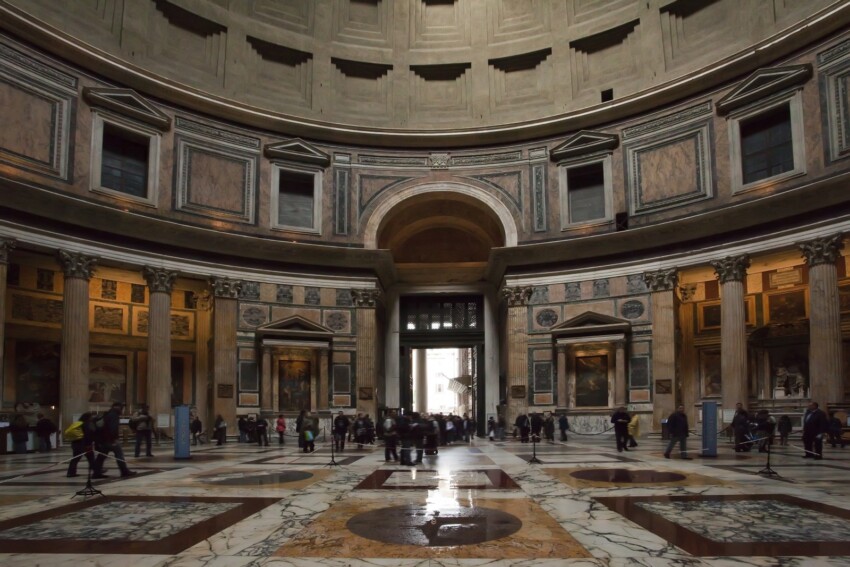
The main body of the Pantheon is made up of the rotunda, that is, its interior. It is an enormous cylinder covered by the hemisphere that represents the dome. On the ground floor there are six large niches, in addition to the entrance and the apse; the floor was reconstructed in 1873 but the effect and decorations are the same as the original.
The Pantheon is also home to numerous frescoes, the most famous of which is the Annunciation, a work by Melozzo da Forlì, located in the first chapel on the right.
Inside the Pantheon lie some illustrious figures from Italian history, including the painter and artist Raphael, the musician Arcangelo Corelli, and the first two kings of Italy Victor Emmanuel II and Umberto I, his son. The tomb of the former is located in the central chapel on the right, whilst that of the latter is on the opposite side. It was precisely for this reason that the Pantheon became one of the main shrines of the House of Savoy.
Inside there is also a fine pipe organ, though it certainly does not date from the Ancient Roman period. In fact, it dates only to 1926, built by the prestigious Tamburini company. It is still used today as musical events are frequently held at the Pantheon.
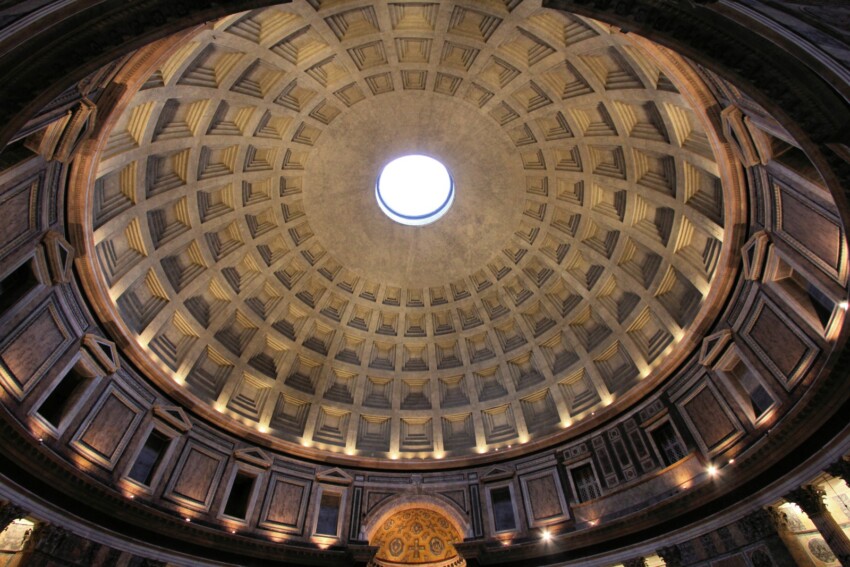
Once inside the Pantheon, when you look up, you cannot help but notice the enormous dome, over 43 metres in diameter and weighing over 5,000 tonnes; this makes it the largest dome in the world, even larger than St Peter’s and Brunelleschi’s dome in Florence. Decorated with coffered panels of decreasing size, it was built using superior architectural techniques, which were employed to lighten the structure.
The distinctive feature of the Pantheon’s dome is that it has a large central opening, through which sunlight filters, creating a truly striking effect. The opening in the Pantheon was necessary both for technical reasons, as the dome would have collapsed from the weight without it, and for symbolic reasons, namely to communicate directly with the gods.
On Pentecost Sunday, a shower of rose petals falls from above inside the Pantheon at the end of the Corpus Christi celebration.
The opening is also the subject of a legend, according to which water does not enter inside the Pantheon when it rains. This is obviously not true, but the opening creates the so-called “chimney effect”, a draught of air that allows water droplets to break apart, giving the impression that it is not raining, or at least that it is raining less. There are drainage holes in the floor, however, to prevent puddles from forming.
Finally, do not leave the Pantheon area without first admiring all the details of the structure’s exterior. Essentially, the exterior structure is nothing more than a huge covering of the dome, which conceals a third of it. As the dome is round and the walls are vertical, a gap is created inside, in which a ring-shaped corridor has been built.
The exterior of the Pantheon was originally flanked by other buildings, which is why it is not particularly ornate. However, it is possible to observe three horizontal bands at different heights, created in different periods with different materials.
Once free, since March 2023 admission to the Pantheon is charged and access is only permitted outside liturgical services. However, ticket reductions are available for young people up to the age of 25, whilst for Rome residents and those under 18 years old, protected categories, teachers and school groups, admission remains free.
Due to the enormous flow of tourists, on Saturdays, Sundays and public holidays, booking is mandatory with at least one day’s notice.
The Pantheon in Rome is open every day from 9:00 to 19:00, with last admission at 18:30. The only two days of closure during the year are Christmas and New Year’s Day.
It is possible to visit the Pantheon with the official audio tour, available in 8 languages. The narrative lasts approximately 30 minutes, spread over 15 listening points inside and outside the building; you will also be provided with a map to find the points of interest.
Alternatively, you can book the official guided tour of the Pantheon, which takes place in Italian or English. The tour lasts an hour and you will be given the opportunity to learn about all the secrets of the building, its construction details and the works of art housed within it.
Finally, it is possible to organise an independent guided tour of the Pantheon, either private or group, by contacting one of the many tour guides in Rome.
All of these options are chargeable.
Being a consecrated church, the Pantheon is used for the celebration of religious services, the Eucharist and sacraments. On Sundays and public holidays, Mass is held at 10:30 in the morning, whilst on Saturdays and the eves of public holidays it is held at 17:00.
In addition to the Mass schedule, the Pantheon hosts special religious events, such as the Mass for All Saints’ Day on 1 November, for the veneration of the dead on 2 November, for the Immaculate Conception on 8 December, and of course for Christmas Eve, Easter and Holy Week. From time to time concerts are also held; we recommend visiting the relevant section of the official website to access an updated calendar.
During special celebrations or important events, visits to the Pantheon for tourists are suspended.
The Pantheon is located in Piazza della Rotonda, one of the main squares in Rome’s historic centre, a stone’s throw from Piazza Navona. It is about half an hour’s walk from Termini Station, about 15 minutes’ walk from Piazza di Spagna and less than 10 minutes’ walk from the Trevi Fountain, and is therefore easily accessible on foot from the city’s main tourist attractions.
The nearest metro station is Barberini, on line A, about 15 minutes’ walk away, whilst the Colosseo stop, on line B, is about 20 minutes’ walk away.
To reach the Pantheon by bus you can use lines 62, 85 and 492, which stop along Corso Minghetti, from where you reach your destination by walking for 5 minutes along Via del Seminario. Other bus lines that stop near the Pantheon are 87, 81, 85 and 628; with these you need to get off at the Argentina stop located in Largo delle Stimmate, which is along Corso Vittorio Emanuele II, then walk for 5 minutes on foot heading north along Via di Torre Argentina.
City Card allow you to save on public transport and / or on the entrances to the main tourist attractions.


 Hotel
Hotel  Budget accommodations
  Apartments
  Family Hotel
  Luxury Hotel
  Resorts