Bestseller
Colosseum, Roman Forum & Palatine Hill Guided Tour
From 49,00 €
Buy the ticket
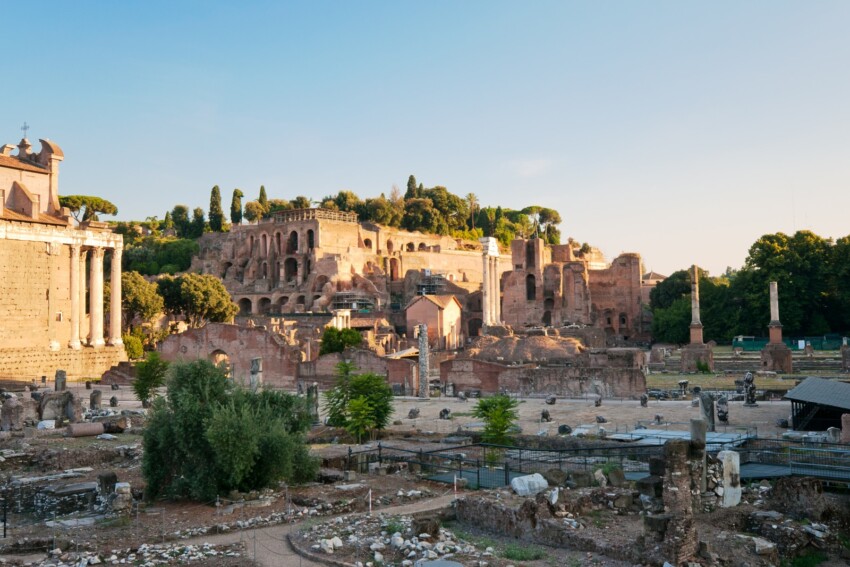
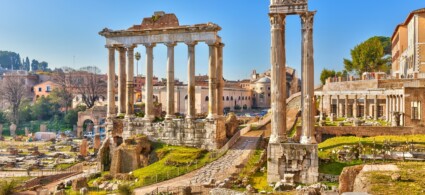
Among Rome’s seven hills, the Palatine is undoubtedly one of the most famous. Both among historians, as this is where Rome was founded (legend has it that a she-wolf suckled Romulus and Remus in her den on this very hill), and among tourists, because fundamentally today the Palatine is an enormous open-air museum which, together with the Colosseum and the Roman Forum, forms a single museum complex called the Colosseum Park, a splendid archaeological park visited by millions of people every year.
On the Palatine Hill and in its immediate surroundings, you’ll find remains dating back to the earliest period of Roman civilisation; but not only that, because centuries later, the site transformed into the area where the aristocracy of Ancient Rome lived. It was here that elegant houses were built – the celebrated Domus – decorated with mosaics and frescoes, and as if that weren’t enough, it’s also here that numerous imperial palaces were constructed.
The importance of the Palatine and its buildings in modern civilisation is such that the noun “palatium”, which became “palazzo” in Italian, derives directly from the name of the hill.
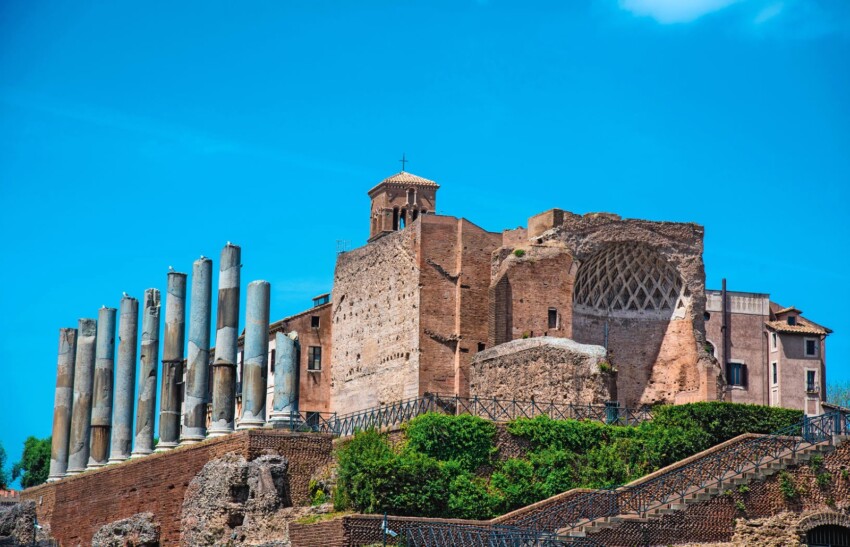
There are truly many things to see at the Palatine, all of absolute historical and cultural interest. Here are the main ones:
The famous Domus Aurea was the house of Emperor Nero after the fire of 64 AD destroyed much of central Rome. Following the tragic event, Nero decided to build a new residence, so luxurious and lavish that it was called the Domus Aurea, or the golden house.
The house and the entire property, originally consisting of gardens, woods and even an artificial lake, stretched across two of Rome’s hills: the Palatine and the Oppian. Today it’s only possible to visit the Domus Aurea on the side of the Oppian Hill; the path allows you to admire a series of perfectly preserved rooms, as they were buried after Nero’s death and remained unknown until the Renaissance.
It’s possible to visit the Domus Aurea also through a route called the Domus Aurea Experience. This allows you to observe the restoration site with virtual reality, and runs Friday through Sunday, with departures every 15 minutes from 9.15 to 17.00. Booking online is mandatory.
The visit to the Domus Aurea is not included in the Palatine entrance ticket; the relevant ticket must be purchased separately.
Augustus’s house, or the Domus Augustea, is one of the most important things to see at the Palatine as it represents the home of the first Roman emperor. It’s located on the south-west side of the hill, and it was this very building that initiated the urban development of the area. In fact, the emperors who came after Augustus chose to stay in this area as well, so much so that in the following years, the entire Palatine Hill became a large imperial quarter.
Among the numerous temples built on the hill, we must certainly highlight the Temple of Apollo Palatinus, constructed at the behest of Emperor Octavian following a battle victory in 36 BC. Even today the remains of the marble floor are visible, as well as the columns and Corinthian capitals. Originally the temple consisted of a portico with six columns on the façade.
The House of the Griffins takes its name from its principal decoration, a lunette depicting griffins. It’s an example of an ancient Roman house, and for many experts in the field represents the best-preserved Republican house in Rome, so much so that you can still admire the original paintings from the 2nd century BC. The House of the Griffins is located on the north side of Domitian’s Palace.
In 1868, on the remains of Domitian’s Palace, the convent of the Nuns of the Visitation was built, within which the museum route of the Palatine Museum now winds. Completely reorganised and renovated in the 1990s, the museum visit spans two floors of the building.
On the ground floor there are a series of reconstructions of environments from the time of the ancient Romans, with original structures from the old Domus. There’s also a dedicated section that tells the history of the Palatine from the city’s origins until the birth of Christ. Going up to the first floor, you’ll find an enormous quantity of works, among which stand out artefacts from the Augustan era and paintings from the Domus Transitoria, which belonged to Nero.
A visit to the Palatine Museum lasts around an hour.
The botanical garden of the Palatine is represented by the Horti Farnesiani, a pleasant terraced green area that starts from the base and reaches the summit of the hill. It’s certainly not a construction from the time of the ancient Romans, as the Horti date only to the sixteenth century, during the full Renaissance period, when Cardinal Farnese decided on its construction.
Particularly beautiful is the staircase leading up to the Nymph of Rain fountain sculpture, as well as the Great Fountain theatre, a large water-themed sculpture, with pools, niches and water spouts.
On the southern side of the Palatine stands the Schola Praeconum, the headquarters of the heralds’ guild, those tasked with announcing the circus processions. The Schola dates to the 3rd century AD during the Severan dynasty, and consists of a rectangular courtyard onto which a series of rooms open.
Within the Schola Praeconum you can admire important painted decorations, often depicting male figures, as well as a beautiful black and white mosaic floor, where 8 male figures are depicted in two groups of 4.
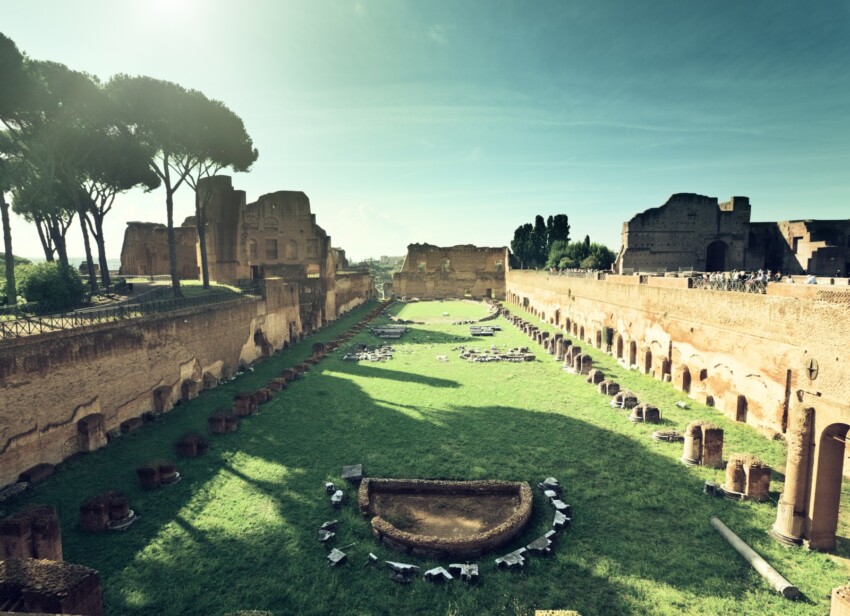
One of the most important attractions of the Palatine is represented by Domitian’s Palace, the principal imperial complex of the entire area. It’s actually subdivided into three sub-areas, which are the Domus Flavia, the Domus Augustana and the Stadium of Domitian, which was originally adorned with statues and marble, later moved inside the Palatine Museum.
The Domus Flavia represents the public and official part of the palace, with ceremonial functions, of which it represents the western zone. It includes within it a private sector, the Domus Augustana, built on the eastern side. The two zones are connected to each other via complex underground corridors.
The Palatine, like the Colosseum and the Roman Forum, can only be visited with online booking. There are two types of tickets you can purchase.
Valid for 24 hours and allows one entry to the Palatine and one entry to the Colosseum and Roman Forum, including current exhibitions.
Valid for two consecutive days, and at a premium cost allows access to the Palatine and special sites such as the Palatine Museum, the exteriors and study of Augustus’s house, the Temple of Romulus and the Schola Praeconum, as well as the Roman Forum, the Colosseum including the arena floor and the underground areas.
Remember that both tickets do not include access to the Domus Aurea.
During the online purchase procedure you’ll be asked to choose the date and time of your visit, so you’re practically certain to avoid queues. Implicitly, the online ticket is also a skip-the-line ticket, as you won’t be forced to queue at the box office, which before this system was introduced was really quite long.
The Palatine, like the other attractions of the Colosseum archaeological park, is open every day of the year with the exception of Christmas and New Year’s Day. Opening hours vary depending on the season, according to the calendar set out below.
Last entry is strictly one hour before closing time.
Within the Palatine there’s the possibility of undertaking some guided tours with the park’s official guides, which are arranged and organised from time to time; you can only take part by booking in advance online on the official website.
Alternatively, if you can’t be present during these appointments which occur on a fixed schedule, you can arrange with a professional guide your own personal tour of the Palatine, taking part in a private or group tour.
The main entrance to the Palatine is located at Via San Gregorio 30, through the Vignola gate. Other secondary entrances are found at the Arch of Titus, along Largo della Salara Vecchia and at the Mamertine Prison. Exits are instead located at Largo della Salara Vecchia, at the Arch of Titus, at the main entrance of Varco Vignola and at Via Petroselli.
The Palatine area is easily reached using Rome’s public transport, first and foremost the metro: getting off at the Colosseum stop on line B you’ll arrive at your destination in a short time. You can also reach the Palatine by bus, in particular with lines 51, 75, 81, 85, 87, 118, and with tram number 3.
Here are a series of useful tips to help you organise your visit to the Palatine as best as possible.
We recommend visiting the Palatine outside of the high season periods so you can access the area with fewer crowds. Don’t expect to be alone, though! At any time of day there will certainly be plenty of people to keep you company.
Obviously, a summer Saturday will generally be much more crowded than a Wednesday in November, so if possible, plan to visit the Palatine out of season, and always if possible, during weekdays.
Visiting during low season periods also brings another huge advantage: you’ll be able to escape the summer heat, which can become even unbearable. Bear in mind that almost the entire tour route is exposed to the sun, and shaded areas are few: so bring plenty of water, sunscreen and a hat to protect your head and shoulders from intense sun rays.
Be aware that at the Palatine you’re not permitted to bring large items, such as trolleys or suitcases. Given that there’s no cloakroom at the entrance, avoid bringing bulky objects with you, otherwise you won’t know where to leave them. Rucksacks and small bags are permitted instead.
Given its size and the enormous amount of things to see, visiting the Palatine can take an entire day. Even if you decide to skip some Domus and concentrate on others, allow 3 or 4 hours to enjoy the highlights of the entire area.
City Card allow you to save on public transport and / or on the entrances to the main tourist attractions.


 Hotel
Hotel  Budget accommodations
  Apartments
  Family Hotel
  Luxury Hotel
  Resorts