Museums and Exhibitions on Leonardo da Vinci in Rome
Rome is home to no fewer than 4 museums dedicated to Leonardo da Vinci, fascinating places to visit if you wish to discover the inventions and machines of the Florentine genius up close.
Leonardo da Vinci remains a powerful presence in Rome to this day. The Florentine genius actually lived here for part of his life, specifically from 1514 to 1516, residing in the Belvedere apartments in the Vatican, thanks to the generosity of his acquaintance Giuliano de’ Medici, brother of Pope Leo X. In Rome, Leonardo devoted himself primarily to his studies in mechanics, optics and geometry, whilst also seeking fossils on Monte Mario.
The absolute genius of the Italian Renaissance excelled in various disciplines, including painting, sculpture, architecture, mathematics, engineering and music, but it is his inventions that represent the most captivating aspect of his legacy. Using the tools available in his era, he dedicated his life to investigating reality, creating objects that remain revolutionary even today.
For these and countless other reasons, Rome is home to 4 museums dedicated to Leonardo da Vinci. Two of them are particularly significant: the Leonardo Da Vinci Experience museum and the Leonardo Exhibition museum, whilst the other two—the museum of Leonardo’s machines and the Leonardo Da Vinci museum at Piazza del Popolo—are of lesser importance.
Leonardo enthusiasts will certainly have plenty to keep them entertained during their time in Rome: visiting all four might be excessive, but certainly at least a couple are worth your time. Which you choose to visit depends on your interests and expectations.
Leonardo Exhibition – The Genius and His Inventions
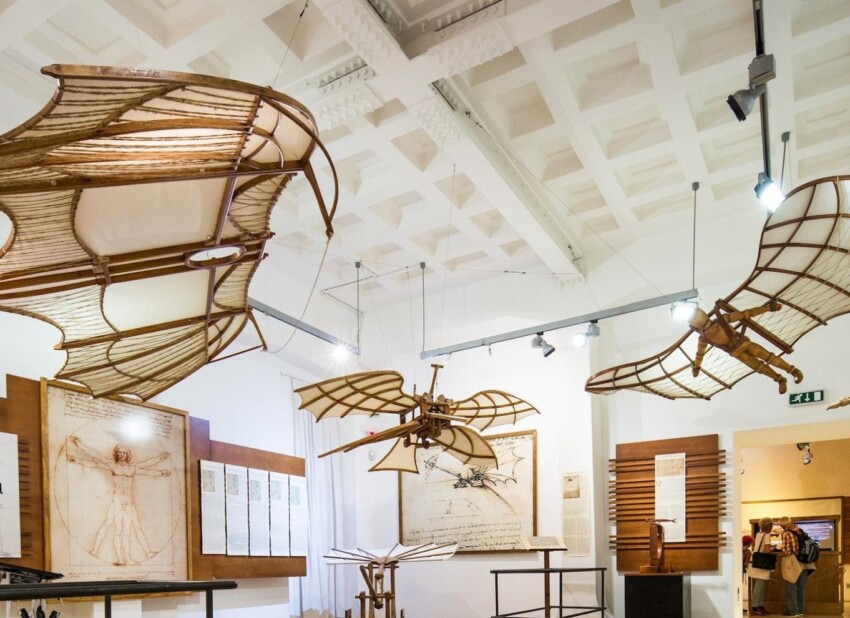
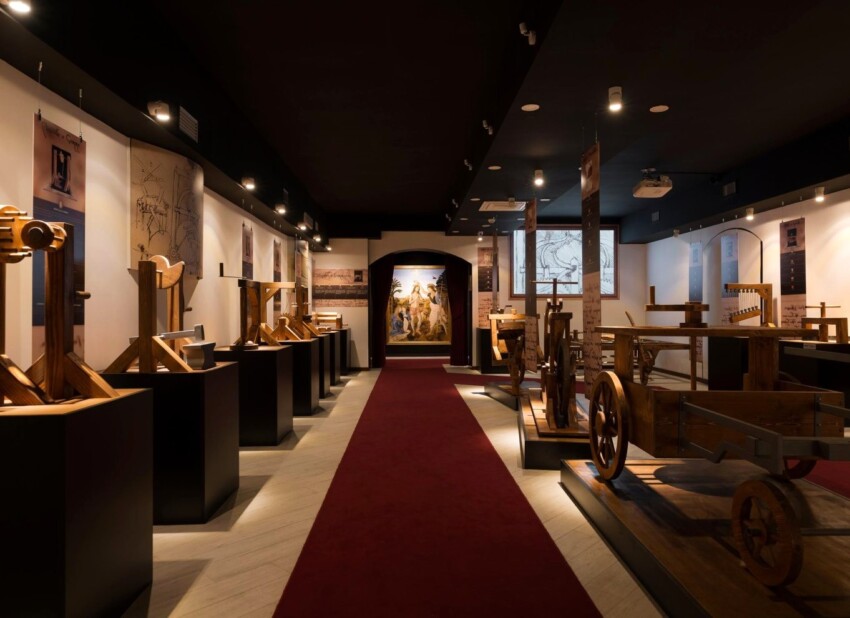
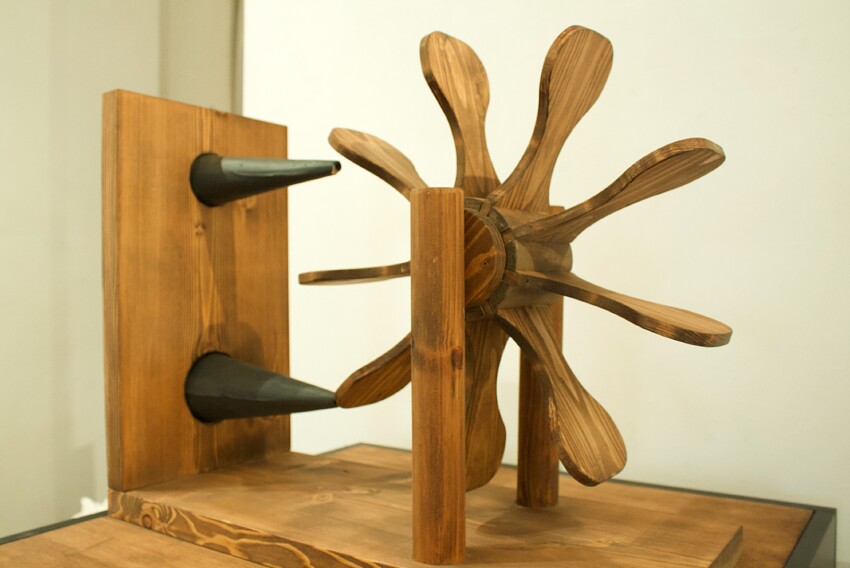
The Leonardo Exhibition museum is a genuinely fascinating attraction for anyone visiting Rome. It offers visitors a unique sensory experience, where you can see and touch authentic machines recreated from Leonardo’s codices. All fully functional, large-scale and constructed using cutting-edge technology whilst respecting the original designs, they are crafted in wood and are far more than mere models.
The Leonardo Exhibition is therefore a multimedia and interactive museum that lets you get hands-on with 65 of his inventions. You can also examine his studies on water, air, earth and fire, giving you a comprehensive picture of his intellect and bringing you closer to understanding his ingenuity.
The museum has been replicated in several cities worldwide, including Barcelona, Vienna, Abu Dhabi, Dubai, Salzburg and Dublin.
The holograms
The Leonardo Exhibition features a truly innovative and fascinating section: holograms—nine in total—that bring some interactive machines to life.
The hologram projections float suspended in mid-air with hyper-realistic clarity, giving visitors the impression of encountering an actual three-dimensional object.
Treasure hunt
One of the most popular activities at the Leonardo Exhibition is undoubtedly the treasure hunt, an entertaining initiative for adults and children available with a special entrance ticket.
Should you decide to take part, you’ll be given a tablet and an interactive map of Rome upon arrival. You can then begin your treasure hunt by walking through the city streets and passing by monuments; as you do so, you’ll reach various checkpoints, at each of which you’ll accumulate points that can be converted into clues, needed to answer the final question.
Everyone who manages to solve the puzzle will receive a prize from the Leonardo Exhibition.
The treasure hunt lasts approximately 3 hours, is accessible to disabled visitors and includes use of the tablet and interactive city map. The treasure hunt package also includes a skip-the-line ticket for the Leonardo Exhibition.
Tickets and opening times
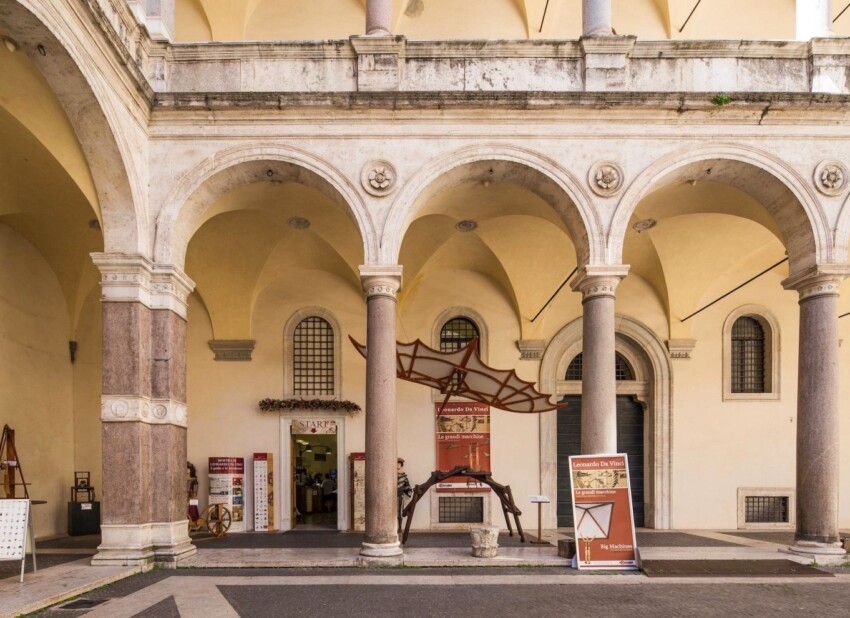
The Leonardo Exhibition museum is located at Piazza della Cancelleria 1. It’s open daily from 9.30am to 7.30pm.
Regarding entrance fees, there are three price brackets: full price for adults, a reduced rate for ages 13–18, over 65s, university students and lecturers, and a further reduced rate for children aged 5–12.
There’s also the option to purchase a family ticket, covering 2 adults and 2 children, 2 adults and 1 child and 1 teenager, or 2 adults and 2 teenagers.
2Via della Conciliazione, 19/21, 00193 Roma RM, Italy
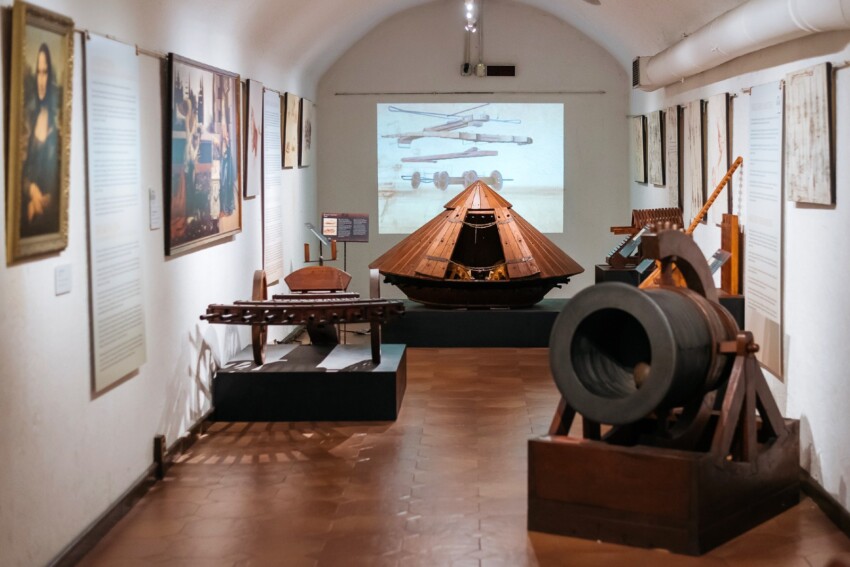
The Leonardo da Vinci Experience Museum houses more than 50 certified inventions, alongside a dedicated section featuring the paintings of the Florentine genius. Next to each machine on display, you’ll find projections and multilingual panels with information and 3D images. Specifically, the museum comprises 5 rooms:
Room of flying machines and the Last Supper
Room of war machines
Room of perspective
Room of principles
Room of painting
In this final room, the museum displays over 20 reproductions of Leonardo’s paintings, including the Mona Lisa, the Lady with an Ermine, Ecce Homo and many others, all created at 1:1 scale using the techniques typical of Renaissance workshops and the very same materials Leonardo used. The paintings are the work of master craftsmen from the Tifernate Artisan Workshop.
The Leonardo da Vinci Experience Museum also features a room called the Hall of Mirrors, where you can discover how Leonardo’s studies of light inspired the invention of photography and projection.
Tickets and opening times
The Leonardo da Vinci Experience Museum is located at Via della Conciliazione 19, just a stone’s throw from St Peter’s Basilica, and is open daily from 9.00am to 7.30pm.
You can purchase tickets on-site or online: in addition to full-price tickets for adults, reduced-price tickets are available for children aged 6–15 and students aged 15–26.
A five-minute walk from the Spanish Steps and Villa Borghese sits the fourth of Rome’s museums dedicated to Leonardo Da Vinci. Called the Leonardo Da Vinci Museum at Piazza del Popolo, it likewise allows you to discover the machines invented by the Florentine genius in an interactive way, reconstructed based on his famous codices.
Additionally, the museum showcases the artistic studies he conducted whilst in Rome, anatomical sketches, and enlarged-scale animations of the Last Supper and the Vitruvian Man.
The Leonardo da Vinci Museum at Piazza del Popolo is open daily from 10am.
At Via dei Portoghesi 6 you’ll find the Museum of Leonardo da Vinci’s Machines, which displays 50 life-size machines in perfect working order—detailed and hyper-realistic reproductions of the Florentine genius’s inventions.
The museum is housed within the gallery of the Portuguese Institute of St Anthony, situated between Piazza Navona, Piazza del Pantheon and Piazza Augusto Imperatore.
The exhibition route winds through the machines, allowing you to understand their mechanics and discover historical background and interesting facts in 7 different languages. Furthermore, at the end of your tour of Leonardo da Vinci’s machines, you can visit the Church of St Anthony in Campo Marzio.
The Museum of Leonardo da Vinci’s Machines is open daily from 9.30am to 7pm.
Map
In the following map you can see the location of the main places of interest mentioned in this article.
How to save on transport and entrance fees
City Card allow you to save on public transport and / or on the entrances to the main tourist attractions.
 Hotel
Hotel  Budget accommodations
  Apartments
  Family Hotel
  Luxury Hotel
  Resorts