Bestseller
Castel Sant'Angelo Entry Ticket & Audioguide
From 29,05 €
Buy the ticket
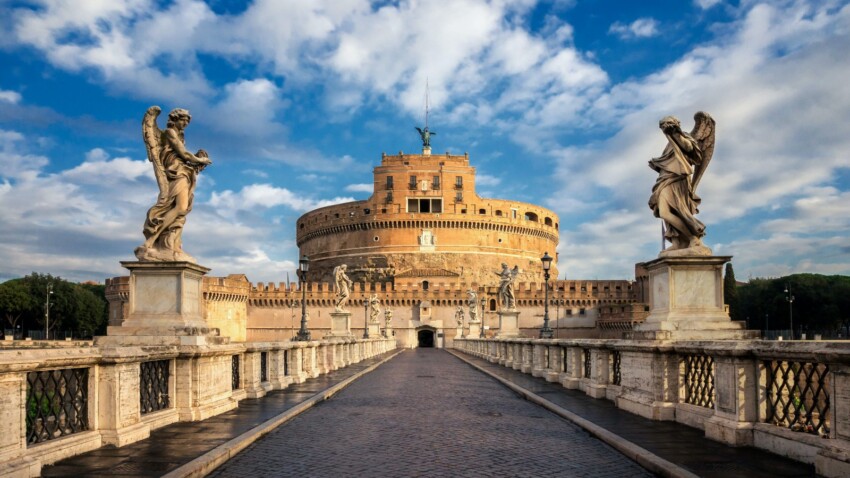
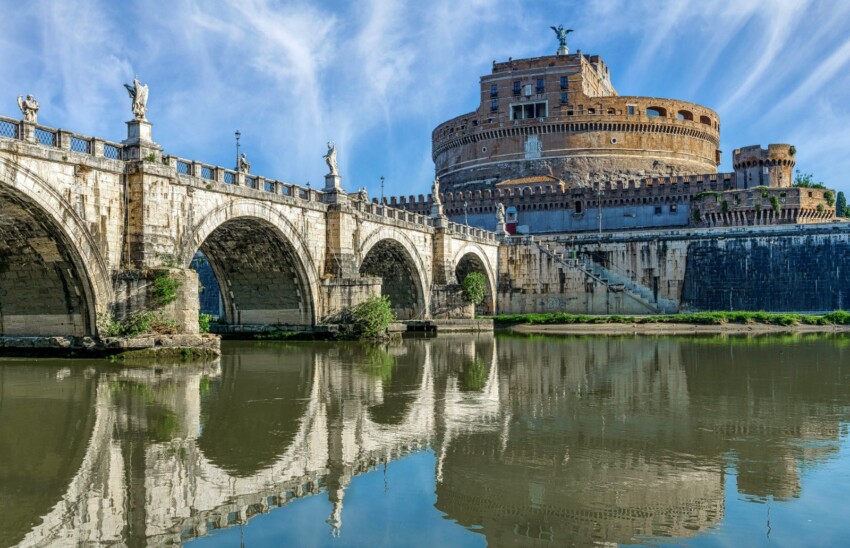
One of Rome’s most beautiful and iconic landmarks is undoubtedly Castel Sant’Angelo. The castle’s imposing silhouette, rising beyond the Tiber just after the Sant’Angelo Bridge, is an absolute must-see for anyone visiting the capital. Its beauty and striking appearance have made it a filming location for countless films and TV series, from the 1960s to the present day. And when Rome’s history merges with cinema history, there’s no stopping you: visit Castel Sant’Angelo and you won’t regret it.
You might initially think it’s not worth your time, especially if your stay in the city is brief – there may be other more important attractions to see in Rome. However, its location in the heart of the city, conveniently within walking distance of both the Vatican and Piazza Navona, makes Castel Sant’Angelo an essential stop during a city visit.
Once you arrive here, you’ll be surprised to learn that Castel Sant’Angelo is not just a monument, but also an archaeological site and, above all, a museum. During your visit, you can admire not only the castle’s interiors, loggias, courtyards and corridors, but also several rooms set up as a proper museum displaying paintings, ceramics, medieval and modern sculptures and an arms chamber.
Moreover, the history of Castel Sant’Angelo is long and complex: it was built around 123 AD by the Emperor Hadrian as a mausoleum for himself and his family; consequently, its original purpose was as a funeral monument. Over the centuries it was never destroyed, but only rebuilt, redesigned and refurbished. It has been a fortress, prison, castle, noble residence, papal seat and barracks, until becoming, in the twentieth century, the museum that you can still visit today.
The Castel Sant’Angelo visit follows a route comprising 7 levels, with the first – the lowest – being where the visit begins. To be precise, Castel Sant’Angelo is a museum whose collections are divided fairly evenly across four categories: ceramics, sculptures, paintings and weapons, in addition to the castle’s own rooms and the ancient papal apartments. Most of the objects on display come from private donations, while other artefacts were already part of the castle.
On the first level of Castel Sant’Angelo, after passing through the main entrance, you emerge into a ring-shaped corridor that runs along the walls. The work was commissioned by Pope Boniface IX in the fifteenth century, and on that occasion numerous remains from the Roman era were brought to light.
On the first level, it’s also worth visiting the Courtyard of Executions, named so because according to some accounts this was where capital punishments that were not to be made public were carried out, onto which the Chapel of the Condemned opens – a former gunpowder magazine converted into a chapel in the eighteenth century.
The second level of Castel Sant’Angelo is also located near the main entrance. It begins with the Ramp of Paul III, a staircase dating from 1545 with two fine Roman-era statues in its niches, and continues with the so-called rond march, a passageway representing the perimeter of Hadrian’s ancient mausoleum foundation, which stood here before the complex took its current form. The rond march connects the castle’s four bastions, named after the 4 evangelists Mark, Matthew, Luke and John.
Adjoining the Bastione di San Luca is a small building, the Armoury of Clement X, with a beautiful entrance featuring a curved pediment with two lateral scrolls, topped by an inscription celebrating the works commissioned by Pope Clement X.
On the third level of Castel Sant’Angelo are the historic prisons, a series of underground rooms created under Alexander VI Borgia. After ascending the access staircase, you reach a large room called the Parlatoio, beyond which you enter a ring-shaped corridor with three cells on either side; two more cells follow, one of which housed the Florentine sculptor Benvenuto Cellini for almost a year, before his escape on the night of Corpus Domini in 1538 when he descended with a rope made of knotted sheets.
Beside the historic prisons are the rooms of the oil storage, that is, the cellar where oil jars were kept, used both for food and as fuel for lamps, necessary to light the rooms.
As you ascend to the fourth level of Castel Sant’Angelo, you’ll notice something has changed: these are no longer cramped, dark rooms for prisoners or storing materials, but grand reception spaces and access to the papal apartments. This is the case with the Courtyard of the Angel, or courtyard of honour, built in the sixteenth century with a rectangular layout and featuring the statue of Archangel Michael at its centre.
On the sides of the Courtyard of the Angel are numerous buildings and rooms, including the armouries, the hall of justice, the beautiful Hall of Apollo and the rooms of Clement VIII.
Completing the fourth level is a series of rooms and spaces dedicated to certain popes of the era, such as the small courtyard of Leo X, the little bathroom of Clement VII, the courtyard of Alexander VI and the small rooms of Alexander VI.
On the fifth level stands one of the finest rooms in Castel Sant’Angelo. It is the Sala Paolina, the reception hall of the residence of Pope Paul III Farnese. It dates from the mid-sixteenth century and is distinguished by a barrel-vaulted ceiling completely decorated with frescoes and gilded stuccos, which extend to the walls.
Access to the Sala Paolina is via the Loggia of Julius II, which overlooks the Tiber and from which you can enjoy a beautiful panoramic view of Rome. The loggia is richly decorated on the ceiling, also barrel-vaulted.
Also on the fifth level are some beautiful private rooms from the papal apartments, named after the paintings they house. This is the case, for example, with the Room of Perseus, Paul III’s study, and the room of Cupid and Psyche, bedroom of the same pope.
The visit to the level concludes with the Upper Armoury, a set of 4 interconnecting rooms displaying part of the collection of weapons, armours and relics from Castel Sant’Angelo’s national museum.
From the Sala Paolina on level 5, you can ascend to level 6 via the Pompeian corridor, characterised by fascinating grotesque decoration. It’s a very narrow corridor, less than a metre wide, with a barrel-vaulted ceiling completely frescoed.
The sixth level of Castel Sant’Angelo continues with a series of beautiful rooms, including the Library room, richly decorated on the ceiling, the Adrianeo room, with its beautiful wall paintings, the room of Festoons where you can admire dancing tritons and nereids on the walls, and especially the Treasury room, which formerly served the dual purpose of being the seat of the exchequer and a place for keeping precious documents and objects. It is circular in form and originally formed a single space with the room above it, the Rotonda room, located on level 7.
The seventh represents the final level of Castel Sant’Angelo. Here you’ll find two rooms, the Rotonda room and the room of Columns, and the magnificent Angel terrace, one of Rome’s finest viewing points, with a splendid 360-degree panorama; it takes its name from the statue of Archangel Michael, a work by Flemish sculptor Peter Anton van Verschaffelt. Beside the statue you can admire the Mercy bell.
You can purchase a ticket to visit Castel Sant’Angelo directly at the ticket office on site, or book online in advance – the latter option allows you to skip queues at the box office and choose your preferred visit time and date. Discounts are available for visitors aged 18-25, and admission is free for those under 18. Furthermore, like all Rome’s museums, admission is free on the first Sunday of the month.
For information and bookings, you can call +39-0632810, open Monday to Friday from 9:30 to 18:00.
Castel Sant’Angelo is open Tuesday to Sunday from 9:00 to 19:30, with last admission at 18:30. It’s closed on Mondays and on New Year’s Day, Christmas Day and May Day.
In the courtyard of Alexander VI you’ll find the museum shop, where you can purchase castle guides in various languages, as well as art publications, postcards and souvenirs inspired by the collections. Opening hours are 9:00 to 19:00 Tuesday to Sunday. For further information, you can call +39-0668191197.
Castel Sant’Angelo is essentially open for individual visits and the average visit duration is around 1-2 hours, though there’s nothing stopping you from being accompanied by a private guide. There are many available in the city, and you can contact them in advance online to plan your visit better. You can also take part in private or group tours of Rome that include a stop at Castel Sant’Angelo. In this case, however, find out whether the stop includes only an exterior viewing of the building with a few minutes for photos, or also an in-depth museum visit.
The best time to visit Castel Sant’Angelo is from early September to late March: since much of the visit takes place indoors you’ll have no problems if it rains, and at the same time you can enjoy the cool climate. Remember that, especially in winter, in the evening there tends to be fewer crowds. If instead you want to admire the sunset from the terrace on level 7, you’ll need to plan your visit to arrive at the entrance 1-2 hours before sunset.
Castel Sant’Angelo is located right in the heart of Rome, at Lungotevere Castello 50, and therefore most tourists reach it on foot. From St Peter’s Square, for example, it takes less than 10 minutes walking along Via della Conciliazione, roughly the same time for those coming from Piazza Navona, walking along Via dei Coronari.
As for Rome’s other attractions, the Pantheon is 15 minutes’ walk away, whilst the Spanish Steps and the Trevi Fountain are about 20 minutes away. The Colosseum and the Roman Forum are slightly further, about 35 minutes away, but the walk passes through several attractions and monuments.
If you prefer to use public transport, there are several options. By bus you can use lines 23, 280, 62, 64 or 982, which stop at Piazza Pia, just 5 minutes’ walk from the building. By tram you can use line 19, which stops at Risorgimento/S. Pietro, 12 minutes’ walk from Castel Sant’Angelo. Finally, if travelling by underground (Metro), it’s best to use line A, getting off at Lepanto and then walking for just over 15 minutes.
City Card allow you to save on public transport and / or on the entrances to the main tourist attractions.


 Hotel
Hotel  Budget accommodations
  Apartments
  Family Hotel
  Luxury Hotel
  Resorts