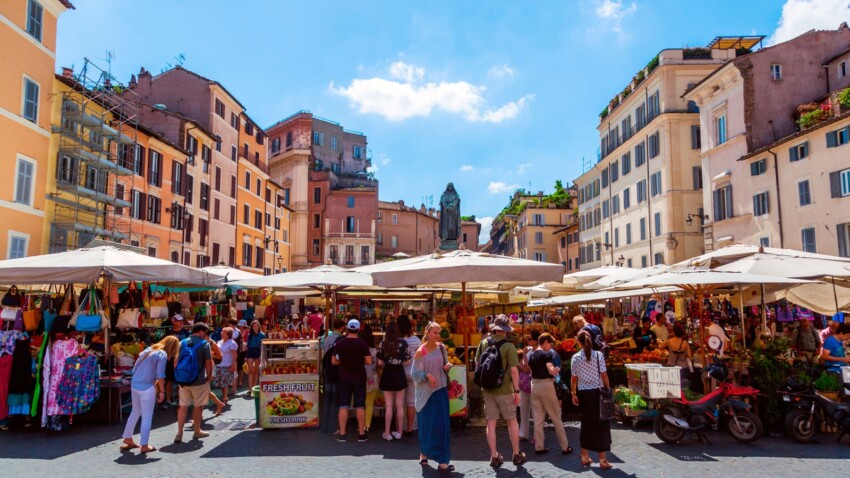
On the border between the Parione and Regola districts, in the heart of Rome, lies Campo dè Fiori, one of the city’s most vibrant squares. Since the 19th century, a neighbourhood market has been held here, which became particularly famous thanks to the 1943 film Campo dè Fiori, which tells the love story between two street vendors: fruit seller Elide, played by Anna Magnani, and fishmonger Peppino, played by Aldo Fabrizi.
An icon of Italian dolce vita, in the current century the square has become the preferred night-time hangout for young people, both Italian and foreign, also thanks to the numerous pubs and bars that have opened here and in the immediate vicinity, staying open until dawn.
The square thus has a dual character: a place for entertainment during the evening hours and a typical neighbourhood market during the day. It is precisely this duality that makes it truly unique among Rome’s squares: visit it in the morning and in the evening and you’ll feel as though you’re in two entirely different places!
Campo dè Fiori takes its name from the flower meadow that once stood here before the square was constructed in the 15th century. It only assumed its present-day perimeter in 1858, when several houses were demolished and the Fountain of the Terrina was removed and relocated to Piazza della Chiesa Nuova.
The square is historically famous because this is where Giordano Bruno, a Dominican friar and philosopher accused of heresy, was burnt at the stake in 1600—he is now commemorated by a monument here. Moreover, from an architectural standpoint, it is unique as the only historic square in Rome with no church overlooking it.
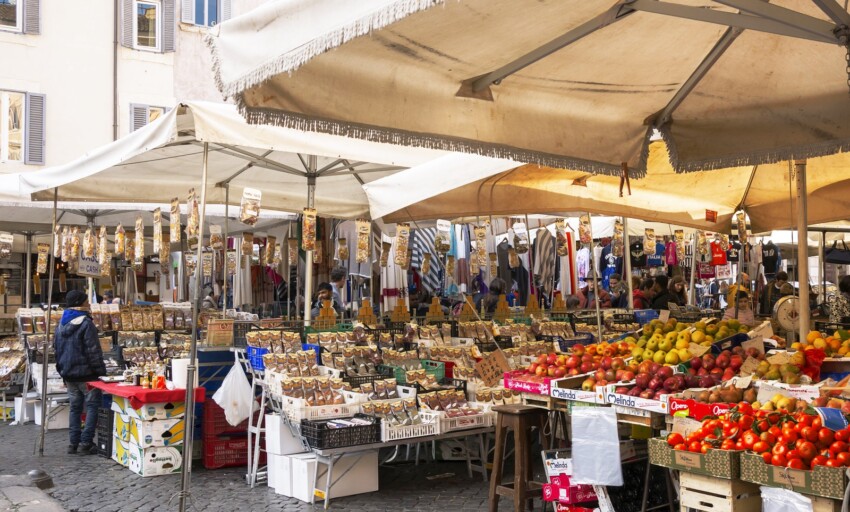
The Campo dè Fiori market is the square’s most famous and unmissable attraction: it runs every day, Monday to Saturday, from 7.00 am to 2.00 pm. It’s a must-see during a visit to Rome, as it offers a genuine slice of daily life that’s increasingly hard to find in the centre of such a tourist-heavy city.
Beyond flowers, you’ll find every type of foodstuff, from fruit and vegetables to fish and meat. Broadly speaking, the Campo dè Fiori market can be divided into two main areas: a central hub where historic stalls symbolising neighbourhood Rome are found, and newer stalls that cater more to tourists, selling gadgets, souvenirs and t-shirts.
Among the many market traders, some have become genuine stars, largely thanks to the media exposure they’ve gained from the internet: this is the case with Mustafà, a famous street vendor of Moroccan origin who entertains his customers in person and is also the star of numerous videos uploaded to YouTube. Another unmissable market character is Franca, who has run a fruit and vegetable stall for decades—one that has belonged to her family for over 50 years.
Watch out! Don’t fall into tourist traps by buying obviously fake products, so-called “traditional” handicrafts that aren’t authentic, or worse, items like limoncello or various sweets that have nothing to do with Rome and its gastronomy. That said, some vendors do sell fresh ingredients for carbonara, amatriciana or puttanesca. Much better!
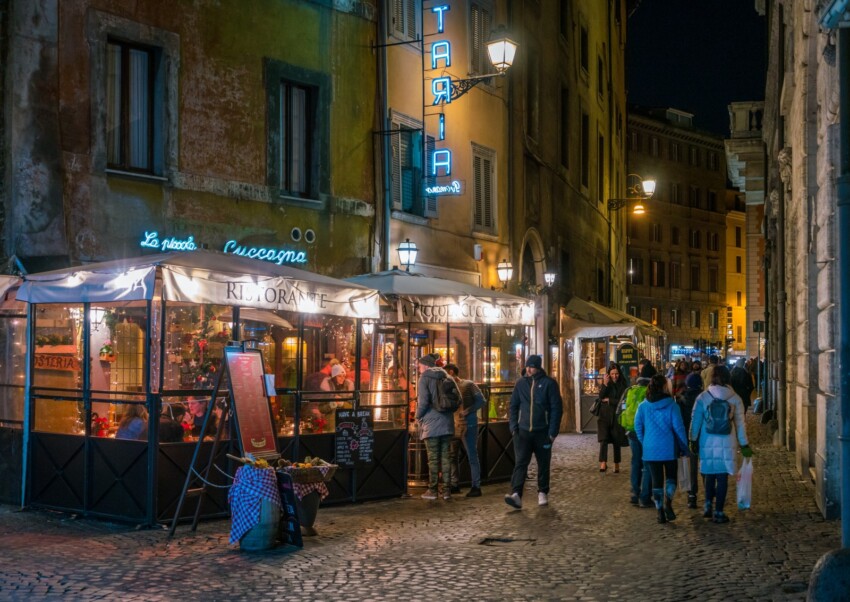
Campo dè Fiori is a popular destination for young people who love nighttime entertainment. Perhaps due to its significant media presence, in recent years Romans have somewhat abandoned the square in favour of tourists, many of them foreign. Nevertheless, the bars overlooking the square remain. There’s a wide choice, depending on what time of day you visit: the evening begins with aperitivo, continues with dinner and ends with a beer or cocktail to sip at one of the many late-night bars, which during the warmer months extend their seating with outdoor tables.
However, many people flock to Campo dè Fiori without a specific destination or bar in mind: plenty of young people spend their evenings outdoors in the square, standing or sitting beneath the statue of Giordano Bruno. Moreover, the streets and alleyways in the immediate vicinity are full of alternatives for nightlife, from nightclubs to pubs, wine bars and breweries.
Among the popular venues in Campo dè Fiori’s nightlife scene are the disco pub Drunken Ship, popular with foreign visitors, the pub Black and White and Primo, a must for aperitivo. In summer, it’s a must to start your evening with ice cream on Via dei Baullari, where you’ll find some of Rome’s best gelaterias. The square and surrounding area also have several spots serving typical Roman street food for street-food enthusiasts.
Note: The Campo dè Fiori nightlife scene has developed in an entirely unregulated manner, with police patrolling the area almost every evening.
By contacting a tour guide, either locally or online, you can take part in numerous Campo dè Fiori tours, which are held especially in the evening around dinner time. They focus on gastronomy or entertainment, so they’re perfect for those looking to enjoy an evening out or experience authentic Roman dining.
For those keen to learn how to cook local signature recipes, cooking workshops are also available at many of the restaurants in the surrounding area.
The Farnese Cinema, located at Campo dè Fiori, number 56, deserves special mention. It is one of Rome’s oldest cinemas and has always been a landmark for lovers of quality films. Since the 1970s, its programme has mainly featured niche screenings—true cinematographic masterpieces shown in Italian or English.
For more information on times and screenings, you can contact the telephone number +39-066864395 or email info@cinemafarnese.it.
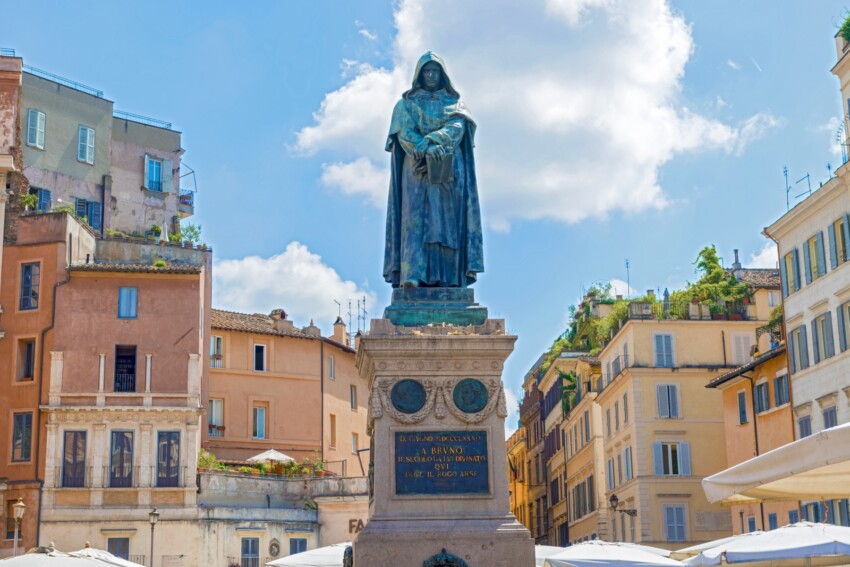
At the site of the execution of the famous philosopher Giordano Bruno, which took place on 17 February 1600, stands a commemorative statue created by sculptor Ettore Ferrari and unveiled in 1889. The monument’s history has been turbulent, as its placement in the square was heavily criticised by the Church; this has given it a dual significance today: on one hand it commemorates Giordano Bruno and his tragic fate, whilst on the other it has become a symbol of free thought and a challenge to the Church and the papacy.
Made of bronze, the monument depicts Giordano Bruno hooded in his Dominican habit, in a seemingly static pose, his gaze directed towards the Vatican, his accuser, while his hands are crossed over a book. The statue stands on a base of pink granite from Baveno, adorned with 8 medallions depicting intellectuals who over the centuries challenged the Church’s power.
This statue is not actually the first commemoration of Giordano Bruno: an earlier statue was erected in his memory in 1849, but was destroyed shortly afterwards at the behest of Pope Pius IX. In 1876, some university students set up a committee to rebuild it, and finally in 1889, after various political discussions, the monument was unveiled at Campo dè Fiori. In protest, Pope Leo XIII fasted for an entire day kneeling before the statue of St Peter after the inauguration, whilst shortly before he had threatened to flee to Austria.
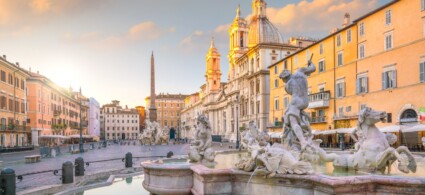
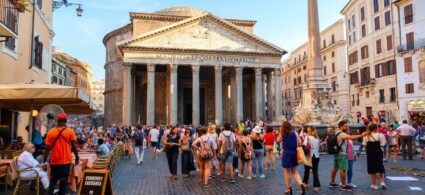
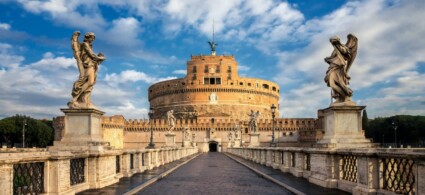
Campo dè Fiori is easily accessible on foot from some of Rome’s main attractions. It is just a 5-minute walk from Piazza Navona, a 10-minute walk from the Pantheon, and about a 15-minute walk from both the Altare della Patria and Castel Sant’Angelo.
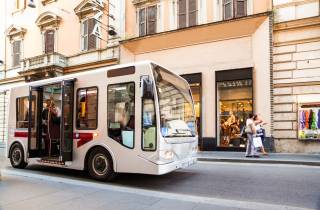
A short distance from Campo dè Fiori, on the north side across Piazza della Cancelleria, you’ll find Corso Vittorio Emanuele, where buses on lines 46, 62, 64, 916 and 916F run, as well as night buses n46, n98 and n904.
The bus is by far the most convenient public transport option to reach Campo dè Fiori: the square is some distance from underground (metro) stops. The nearest is Colosseo, on line B; once you get off, you’ll need to walk for 25 minutes, or take bus 87, which stops near the square on Corso del Rinascimento.
City Card allow you to save on public transport and / or on the entrances to the main tourist attractions.
 Hotel
Hotel  Budget accommodations
  Apartments
  Family Hotel
  Luxury Hotel
  Resorts