Bestseller
Rome: Borghese Gallery and Gardens Guided Small-Group Tour
From 99,00 €
Buy the ticket
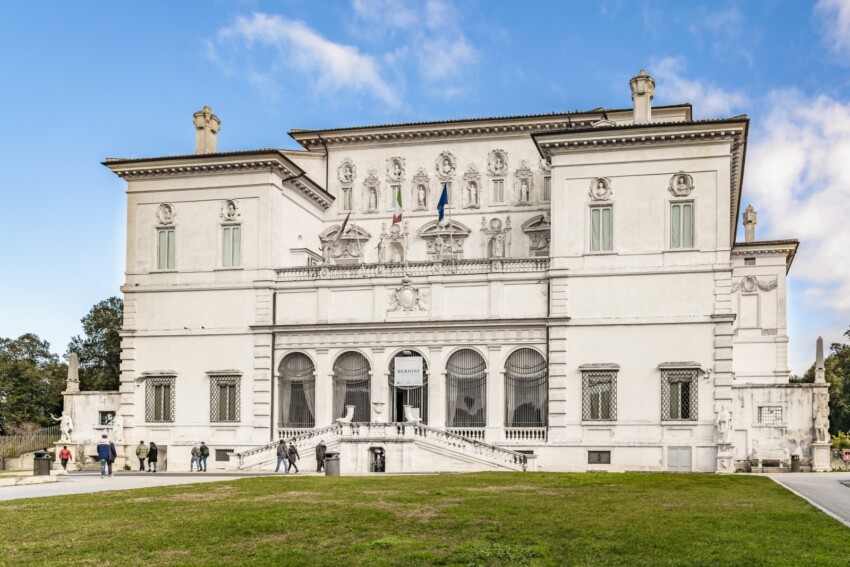
In Piazzale Scipione Borghese, within the expansive Villa Borghese park, you’ll find the Galleria Borghese, one of Rome’s finest art museums, where you can admire sculptures, mosaics and paintings by world-renowned artists including Caravaggio, Raphael, Titian, Bernini and Canova.
The museum comprises 20 rooms, each named after its ceiling decoration. This is precisely what makes the Galleria unique: every ceiling is lavishly adorned with paintings, frescoes or bas-reliefs depicting one or more tales from antiquity. It’s truly a museum within a museum, well worth exploring with the full appreciation of witnessing something truly extraordinary.
Furthermore, don’t miss the so-called secret gardens, which grace this striking neoclassical building on both sides: after an immersion in art, a pleasant stroll through the greenery provides the perfect end to your visit.
The collection at the Borghese Gallery museum spans an remarkably broad historical period, ranging from before Christ’s birth through to the nineteenth century. The original and most substantial body of works dates back to Cardinal Scipione, nephew of Pope Paul V, who lived across the sixteenth and seventeenth centuries.
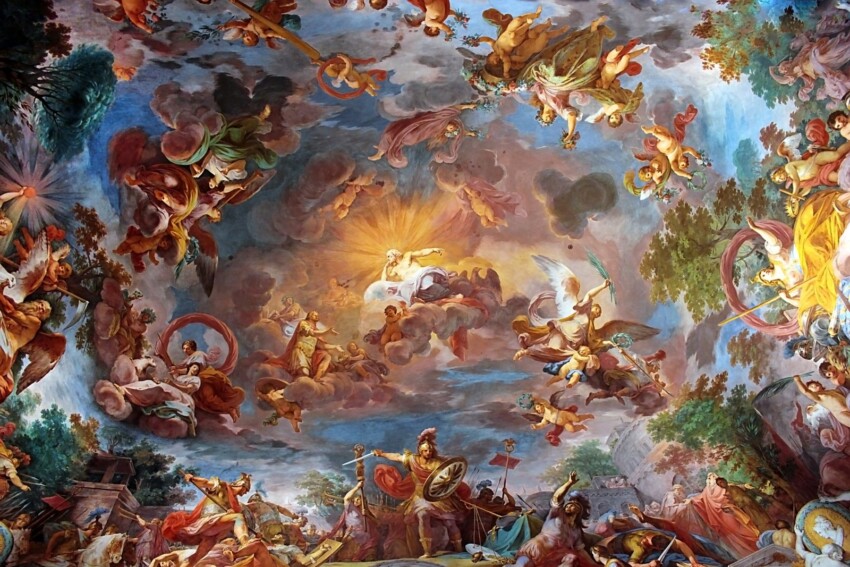
Entry to the Gallery is through the Mariano Rossi hall, an eighteenth-century artist who decorated the ceiling vault with a magnificent fresco depicting Romulus, who according to the allegory was welcomed to Mount Olympus by Jupiter to ensure Furius Camillus’s victory over Brennus, king of the Gauls. From here, the museum’s 20 rooms unfold, each boasting beautiful ceiling frescoes and naturally, the remarkable artworks within.
The Paulina Room is the first gallery room. It takes its name from one of the museum’s most famous sculptures, the portrait-bust of Paulina Borghese Bonaparte, a work by Antonio Canova. The ceiling is by Domenico de Angelis, featuring paintings dedicated to the stories of Venus and Aeneas.
The Paulina Room was once called the Vase Room, after an ancient vase that was moved to the Louvre during the Napoleonic sales. Other notable works in the room include Luigi Valadier’s Herma of Bacchus, Leda and the Swan and Eros dating to the 3rd century AD, and a 1st-century BC relief depicting Ajax and Cassandra.
The star of the second gallery room is undoubtedly the David by Gian Lorenzo Bernini, created in 1623. Flanking it are several fine paintings, including Annibale Carracci’s Samson in Prison, David with the Head of Goliath by Battistello Caracciolo, and Rutilio Manetti’s Andromeda.
Along the walls are various ancient sculptures, plus a sarcophagus slab and two columned sarcophagus sides depicting the Labours of Hercules, dating to 160 AD.
Designed by Antonio Asprucci, the ceiling’s main theme shows Cupid striking Apollo with the arrow of love, whilst Daphne is struck by another with the opposite effect. Apollo and Daphne also appear in a statue within the room, a work by Gian Lorenzo Bernini created between 1622 and 1625.
Apollo and Daphne are again the subjects of a canvas by the same name, painted by Dosso Dossi, who also created Melissa, a work inspired by Ariosto’s Orlando Furioso.
The fourth gallery room, also known as the Gallery, is dedicated to the Roman emperors: eighteen porphyry and alabaster busts line the walls, placed there in the early 1800s. The ceiling, painted by Domenico de Angelis, is equally striking, with scenes inspired by Ovid’s Metamorphoses.
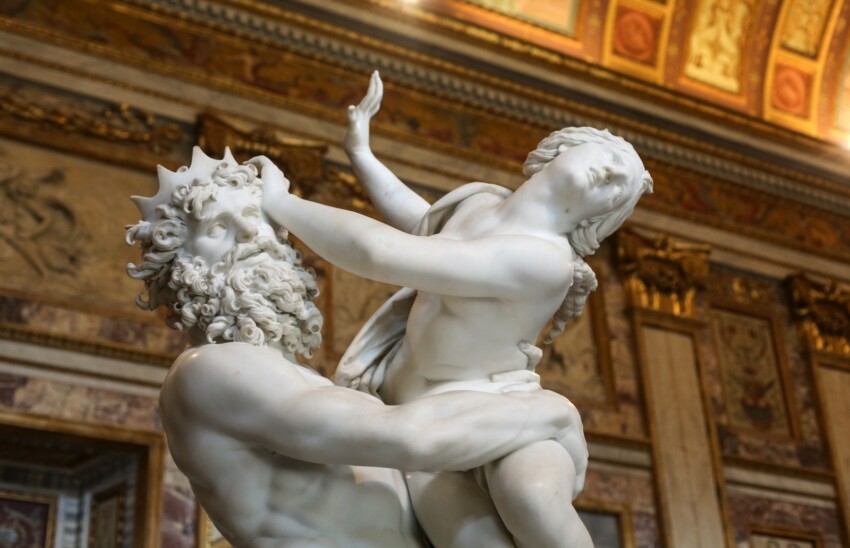
The walls are beautifully decorated with mosaic panels featuring grotesques and marble pilasters. Niches set into the walls house classical sculptures. But the room’s centrepiece is the Abduction of Proserpina, Gian Lorenzo Bernini’s first authenticated work, completed in 1622.
The fifth gallery room takes its name from the Hermaphroditus sculpture, a copy dating to the 2nd century AD, whilst Polycletus’s original resides at the Louvre. Of unknown authorship, the work was discovered during excavations for the Church of Santa Maria della Vittoria and was restored in 1620 by Gian Lorenzo Bernini. Above the statue sits the exquisite alabaster tortoise vase, a work by Antoine Guillaume Grandjacquet.
The ceiling depicts the myth of Hermaphroditus, son of Hermes and Aphrodite, whilst the room also houses other fascinating pieces, including a 4th-century BC head of Kore, a 2nd-3rd-century AD porphyry basin, and four sixteenth-century oil paintings by Paul Brill and Frederick van Valckenborch.
At the centre of the Aeneas and Anchises Room stands a splendid marble sculpture depicting the protagonists of the Aeneid fleeing burning Troy, a work by Gian Lorenzo Bernini and his father Pietro. The room also contains a second Bernini sculpture, Truth, an allegorical work left incomplete following the artist’s death in 1680.
Other notable artworks include stucco bas-reliefs by Vincenzo Pacetti and Costantino Mazzoni, columns and pilasters by Luca Cardelli, and paintings by Jean Baptiste Tierce depicting victorious athletes from the Olympic Games, who became victims of their own strength.
The seventh gallery room showcases examples of Egyptian art. The ceiling depicts the story of the Nile River with its offspring, the beneficial floods, and the goddess Cybele, whilst the walls display statues of Egyptian, Oriental and Greek deities.
Particularly striking is the Priestess of Isis, as is the Satyr on a Dolphin positioned at the room’s centre. The Oriental alabaster vases, created in the late eighteenth century, are also exceptionally fine.
The last ground-floor room of the Borghese Gallery is the Silenus Room. Named after the sculpture Silenus and Bacchus, which was originally displayed here until Napoleon ordered its transfer to the Louvre in 1807, the room remains exceptionally beautiful. Bertel Thorvaldsen’s Dancing Satyr graces the space, whilst the real highlight is the collection of Caravaggio paintings, including Youth with a Fruit Basket, David with the Head of Goliath, and Self-Portrait as Bacchus, or Sick Bacchus.
The ceiling depicts various moments from Silenus’s life: at the centre is Tommaso Maria Conca’s Sacrifice to Silenus, flanked by two smaller paintings titled Drunken Silenus and Silenus Returns Bacchus to King Midas.
The first room you encounter on the first floor of the Borghese Gallery is the Dido Room, named after the ceiling paintings depicting stories and episodes from the lives of Aeneas and Dido.
The artworks on display are breathtaking, featuring magnificent paintings by Perugino, Botticelli, Del Sarto, Pinturicchio and Raphael, representing a veritable compendium of Umbrian and Tuscan Renaissance art. Raphael dominates, however, with three works: the Deposition of Christ, Portrait of a Man, and the Lady with a Unicorn.
The room takes its name from the ceiling frescoes depicting Hercules. Also striking is the Brescianino’s Venus with Two Cupids, a student of Andrea Del Sarto, and Niccolò dell’Abate’s Stag Hunt.
The true masterpiece is the Danae by Correggio, dating to 1530 and purchased by Prince Camillo in Paris in 1827. At the room’s centre stands a white marble statue with gilded bronze inlays, depicting a Gypsy Girl, a work by Nicolas Cordier.
This intimate gallery room is dedicated to sixteenth-century Ferrarese painting: after Ferrara became part of the Papal States in 1598, Scipione Borghese acquired numerous works by local artists.
There are fine pieces such as Vincenzo Berrettini’s Fable of Ganymede on the ceiling, or Ortolano’s Lamentation over the Dead Christ. There are also a series of small panels by Mazzolino, created around the first half of the 1500s.
This too is a small room, its name deriving from the Bacchantes, three dancing maidens entwined in ivy garlands depicted in the ceiling fresco, a work by Felice Giani from the late eighteenth century, inspired by the Domus Aurea and Hadrian’s Villa.
The room displays works by Northern European artists alongside those of Lombard and Venetian masters, including Lorenzo Lotto’s Portrait of a Gentleman, and a copy of Leonardo da Vinci’s Leda.
The Fame Room, the thirteenth in the museum’s sequence, takes its name from the allegory of Fame depicted on the ceiling, flanked by the Borghese heraldic emblem. Within this intimate space, you can view a series of Florentine and Bolognese school paintings from the late fifteenth century, including Francesco Ubertini’s Stories of Joseph, Giovanni di Lorenzo Larciani’s panels of the Madonna and Child, Saint Joseph and Saint John the Baptist, and the Spanish artist Alonso Berruguete’s intriguing Madonna and Child with Saint John the Baptist.
Room 14 contains two undisputed masterpieces: the busts of Scipione Borghese, works by Gian Lorenzo Bernini. Also by Bernini are the sculptures of the bust of Pope Paul V Borghese and the Amalthea Goat, with three additional paintings on display, including a portrait and two self-portraits.
The room’s curious name comes from the fact that it was originally an open loggia, only later receiving a roof that Giovanni Lanfranco painted with scenes and frescoes centred on the Council of the Gods.
The ceiling is the Aurora Room’s main attraction, created by Domenico Corvi and comprising three enormous canvases depicting Aurora and the twilights of Dawn and Dusk. The walls feature zodiac medallions, busts of philosophers, and trompe-l’oeil bas-reliefs.
The artworks within were created by Italian masters during the first half of the sixteenth century, including Jacopo Bassano, Giovanni Girolamo Savoldo and Dosso Dossi, whilst at the centre stands a beautiful statue by Alessandro Algardi in black ancient marble, depicting the allegory of Sleep.
Flora, goddess of plants and flowers, gives her name to room 16. The subject appears in the circular painting at the vault’s centre, a work by Domenico De Angelis dating to 1785.
The room otherwise displays sixteenth-century paintings, including Marcello Venusti’s Christ Laid to Rest with the Magdalene and Two Angels, Pellegrino Tibaldi’s Adoration of the Child, and two small copper allegories by Jacopo Zucchi, a student of Giorgio Vasari.
Continuing through the Borghese Gallery, you reach intimate room 17, dedicated to the Count of Anjou. It is indeed Walter, Count of Anjou, who is depicted on the ceiling, painted by Giuseppe Cades. The scene represents the eighth novella of the second day of Boccaccio’s Decameron.
The paintings on display are from the seventeenth century, mostly of Flemish and Dutch origin, purchased in 1783 at the behest of Marcantonio IV Borghese. Also noteworthy is Pompeo Batoni’s Madonna and Child, an eighteenth-century work acquired by the Italian state in 1909.
The Ovidian myth of Jupiter and Antiope names room 18, depicted on the ceiling canvas by Benigne Gagneraux. In the scene, the god assumes the form of a satyr and approaches the nymph. Surrounding the painting is an elaborate decorative scheme by Vincenzo Berrettini.
The star of this small gallery room is the celebrated Lamentation over the Dead Christ by Peter Paul Rubens; the Flemish painter’s Susanna and the Elders is also on display, both works dating to the early seventeenth century, created during the artist’s time in Rome.
Originally, the Helen and Paris Room enjoyed considerable critical acclaim, thanks to the beauty of its wall decorations, its furnishings, and the fact that the statue of Paulina Bonaparte as Venus, a masterpiece by Antonio Canova, was displayed here for nearly fifty years.
Today the statue no longer graces this space and the room has perhaps lost some of its original allure, yet it’s worth admiring the beautiful ceiling decoration by Scottish artist Gavin Hamilton, the ancient yellow marble fireplace decorated with bronze by Vincenzo Pacetti, and some exceptional paintings including Domenichino’s Hunt of Diana, the same artist’s Sibyl, and Federico Barocci’s Saint Jerome.
The Psyche Room is number 20 and concludes the museum tour. Here you’ll find several Venetian Renaissance paintings, whilst the ceiling is the work of Pietro Antonio Novelli, who depicted the key moments from the fable of Cupid and Psyche.
The wall paintings are particularly striking, such as Giovanni Bellini’s Madonna and Child, and four canvases by Titian: Sacred and Profane Love, Saint Dominic, Christ at the Column, and Venus Blindfolding Cupid. There is also a painting by Paolo Veronese, the Preaching of Saint John the Baptist.
Finally, before leaving this room – and the museum – take time to admire the beautiful fireplace, the oldest of the six ornamental fireplaces within the Borghese Gallery, complete with its decorative front and internal tile lining.
Tickets for entry to Galleria Borghese must be booked in advance. Young people aged 18–25 are entitled to reduced-price admission, whilst under-18s enter free. Entry is also free for students and lecturers from archaeology, art history and architecture departments and courses, students and staff from fine arts academies, Italian citizens registered with AIRE, Italian school teachers, disabled visitors, tour guides and journalists.
Remember that even those entitled to free admission must book ahead.
You also have the option to become a gallery member, receiving a membership card that provides unlimited museum access for one year, as well as the right to take part in events, cultural initiatives and exclusive exhibition previews.
At Galleria Borghese, you can join guided tours in both Italian and English for an additional fee. Booking is mandatory for guided tours, and there is a maximum of 8 people per slot.
Italian tours run Tuesday to Saturday at 11.00, 15.00 and 17.00, and on Sundays at 09.00, 11.00, 15.00 and 17.00. English tours take place Tuesday to Thursday at 09.00, and Friday to Sunday at 09.00, 11.00, 15.00 and 17.00.
Below are some useful details for your visit to Galleria Borghese.
Galleria Borghese is open Tuesday to Sunday from 09.00 to 19.00, with last entry at 17.45. It closes on Christmas Day and New Year’s Day. The ticket office opens at 08.30 and closes at 18.00.
A visit to Galleria Borghese lasts two hours and operates on timed slots: entry is every hour from 09.00; the final slot is an exception, as entry is at 17.45 and exit at 19.00. For this reason, the final slot ticket is slightly cheaper.
For security reasons, you are not permitted to bring medium-sized bags and rucksacks into Galleria Borghese, including shopping bags and luggage. Small bags are allowed provided they are no larger than 21x15cm. If you have a larger bag or rucksack, you can leave it at the cloakroom located at the museum entrance.
Umbrellas and selfie sticks are also prohibited; these must also be left at the cloakroom. Pushchairs for children under 2 years of age are permitted.
There is a cloakroom at the gallery entrance where you can leave bulky items or coats. You are also required to deposit large bags and rucksacks here, as they are not permitted inside the museum.
The official souvenir shop of Galleria Borghese sells art books related to the exhibitions and small gift items. It is run by Artem SRL and is open during the museum’s opening hours from 08.30 to 19.00.
Galleria Borghese also offers an educational programme for families called “Rileggiamo le storie” (Rereading the Stories), running every Saturday and Sunday at 16.00. To book, simply contact +39-0632810 or book online.
The educational programme is organised by the museum’s education service and features readings of sculptures from the collection, telling their stories or the myths they depict, and showing children how artists represented them in marble. The workshop lasts 80 minutes and is designed for families with children aged 5–10.
Additionally, during temporary exhibitions held at the gallery’s spaces, further educational workshops and learning experiences are organised for children and young people, as well as their parents.
Galleria Borghese is located north of Rome’s historic centre, within the vast Villa Borghese park, on its north-eastern side. It is rather out of the way compared to the city’s main attractions, so it is not convenient to walk there: from the Vatican it takes almost an hour, from the Pantheon over half an hour, and from the Colosseum 40 minutes. It is 25 minutes on foot from Termini station, a reasonable time and accessible to most.
The main access point is Viale dell’Uccelliera, a pedestrian path within Villa Borghese park, which can be accessed from Via Pinciana. Nearby is a bus stop served by lines 52, 53, 63, 83, 92, 223, 360 and 910. This is by far the best way to arrive by public transport, as the nearest metro station is Barberini, 20 minutes on foot away.
Alternatively, you can reach Galleria Borghese using the Villa Borghese tourist train, which makes a loop around the vast park in 25–30 minutes and also stops on the opposite side, facing Piazza del Popolo, conveniently served by the Flaminio metro station.
City Card allow you to save on public transport and / or on the entrances to the main tourist attractions.
 Hotel
Hotel  Budget accommodations
  Apartments
  Family Hotel
  Luxury Hotel
  Resorts