Bestseller
Rome: Caracalla Baths & Circus Maximus — Private or Shared
From 65,00 €
Buy the ticket
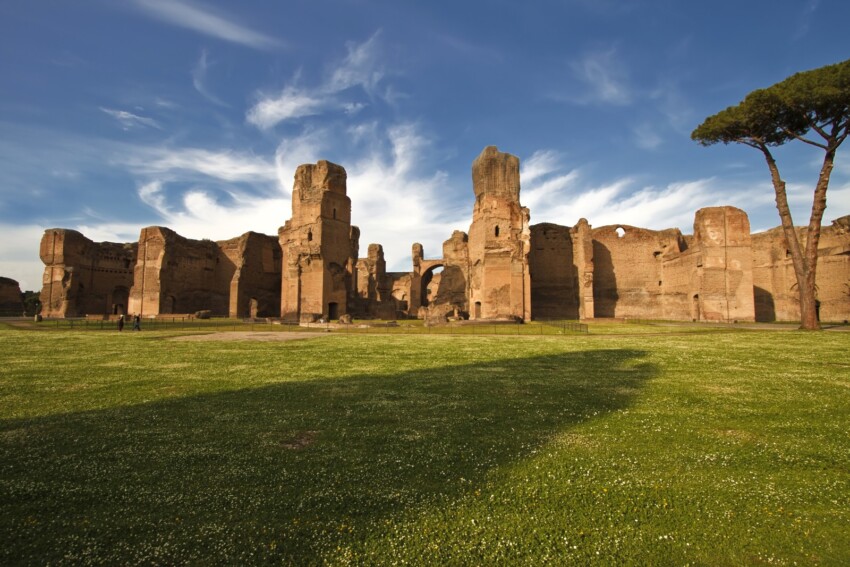
Emperor Marcus Aurelius Severus Antoninus Pius Augustus, known as Caracalla, a member of the Severan dynasty, left Rome with a magnificent legacy in the form of an enormous complex of imperial baths built between AD 212 and 216 on the Aventine Hill, in an area not far from the Circus Maximus. These are the Baths of Caracalla, the most imposing bathing structures ever constructed in the Roman Empire until the Baths of Diocletian nearly a century later.
Restored several times and abandoned in AD 537 when the Goth king Vitige cut off the aqueducts, the Baths of Caracalla are today a truly fascinating attraction for all tourists visiting Rome: they offer a glimpse into the everyday life of ancient Romans, and it’s fascinating to admire the remains of an activity that was so popular back then as it is today.
The Baths of Caracalla are administered by the Special Superintendency for Archaeology, Fine Arts and Landscape of Rome, a peripheral body of the Ministry for Cultural Heritage and Activities. They also hosted concerts and theatrical performances throughout the second half of the twentieth century, and were home to the opera season of the Rome Opera House. However, the performance facilities were removed in 2000.
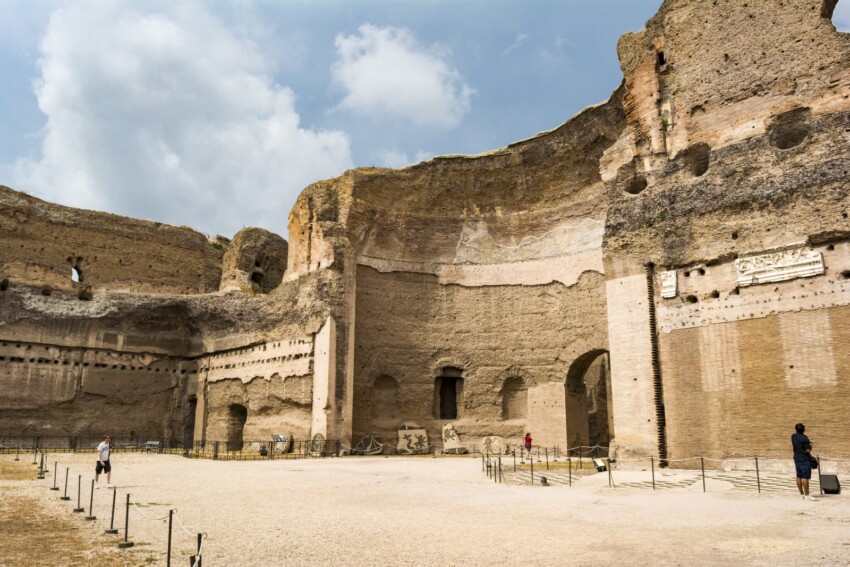
The Baths of Caracalla, in excellent condition, represent a true step back into the history of Ancient Rome. Originally capable of accommodating up to 1,600 people, the baths received renewed attention from 1824 onwards, when a massive excavation campaign began that lasted until the 1990s. Today, the enormous walls, up to 30 metres high, are perfectly visible, as are all the interior spaces.
Also known as the Thermae Antoninianae, within this enormous rectangular complex it is possible to walk through areas dedicated to health care and relaxation: the rooms are arranged symmetrically around the centre, where the basilica stands—the grand central hall, covered by three barrel vaults; in sequence you pass through the caldarium, the tepidarium, the frigidarium and the natatio, which is the large open-air swimming pool 50 metres long and 19 metres wide.
On either side of these areas, also arranged symmetrically, are additional enclosed rooms, a clear sign that the baths were not merely a place for bathing and treatments, but also for leisure and study, so much so that two apsidal halls served as libraries.
The dimensions of the Baths of Caracalla are truly impressive: the rectangular plan measures approximately 400 metres in length and 320 metres in width. To supply water to the baths, the Aqua Marcia aqueduct was extended with a special branch, called the Aqua Antoniniana: its construction necessitated the demolition of existing buildings and the excavation of a large section of the hill.
At the Baths of Caracalla, it was possible to reconstruct the original decorations thanks to written accounts, which described columns and marble floors, mosaics, stucco work and areas decorated with statues. During excavations and over the centuries, several works of art were discovered at the Baths of Caracalla, including the Punishment of Dirce (called the Farnese Bull), the Resting Hercules (or Farnese Hercules) and Flora (or Farnese Flora). All three sculptures left Rome to become part of the Farnese collection at the National Museum of Naples.
Finally, special mention must be made of the underground chambers of the baths, a dense network of service rooms and warehouses connected by galleries up to six metres wide, wide enough for carts drawn by mules to pass through. In the underground chambers of the baths is also Rome’s largest Mithraeum, a large dark chamber dedicated to the worship of the god Mithras, accessible only for special events or particular occasions.
You can purchase a ticket for the Baths of Caracalla on site or online; the latter is the best solution to avoid queues at the ticket office and to be certain of entry at your desired time and date. In addition to the standard ticket, you can purchase add-ons such as an audio guide or virtual video guide.
The entrance ticket allows you to enter at any time of day and grants access to all sections open to visitors as well as any temporary exhibitions. With your ticket you will also receive a digital guide to the baths and a site map.
Entry is free for children under 18.
It is also possible to purchase the combined ticket Via Appia Antica, which in addition to the Baths of Caracalla allows access to the Tomb of Cecilia Metella and the Villa of the Quintilii.
The Baths of Caracalla are open every day of the year from Tuesday to Sunday, except for Christmas and New Year’s Day. Opening times vary according to the season as per the following schedule:
The site ticket office closes one hour earlier. The visit lasts approximately 30–60 minutes.
The Baths of Caracalla are located at the centre of a triangle with the Colosseum, the Circus Maximus and Roma Ostiense railway station at its corners. We are a few kilometres south of the historic centre, straddling the Celio (Rione XIX) and Testaccio (Rione XX) districts. Despite their somewhat out-of-the-way location, they are nonetheless easily accessible by Rome’s public transport.
In particular, the Circo Massimo metro B stop is about a 10-minute walk away along Viale delle Terme di Caracalla, whilst if you wish to arrive by metro A, the nearest stop is San Giovanni, along Via Appia Nuova. From there, it’s about a 20-minute walk to your destination.
It is also convenient to walk here from the Colosseum (approximately 20 minutes) and from the Circus Maximus (approximately 15 minutes), whilst if you are in a distant area of Rome not served by the metro, you can rely on buses: lines 671, 714 and 792 stop along the adjacent Via Antoniniana, whilst on Viale delle Terme di Caracalla there is a stop for bus number 118.
Finally, if you are near Termini station, a convenient option might be to take a train that stops at Ostiense and continue on foot heading north towards the baths.
City Card allow you to save on public transport and / or on the entrances to the main tourist attractions.
 Hotel
Hotel  Budget accommodations
  Apartments
  Family Hotel
  Luxury Hotel
  Resorts