Amongst medieval beauties and elegant Renaissance palaces, Viterbo is the perfect day trip from Rome: close by, convenient and packed with things to see.
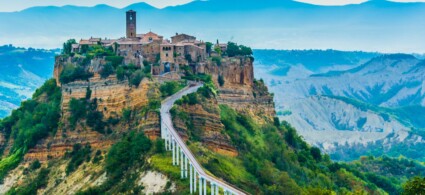
Viterbo has long been an underrated tourist destination. Fortunately, things have been changing in recent years, and this city in northern Lazio, halfway between Rome and Tuscany, is gradually gaining the recognition it deserves. It’s worth noting that much of its appeal comes from the stunning attractions in its surrounding area, including Lake Bolsena, the remarkable village of Civita di Bagnoregio and the much-photographed and Instagram-famous Monster Park at Bomarzo.
That said, many tourists who find themselves in the area for various reasons naturally stop off in the main city, and it’s during these visits that they discover the hidden treasures within, including Renaissance palaces and medieval squares. Moreover, let’s not forget that Viterbo, like Rome, served as a papal seat, albeit for just 24 years – a short period, yet long enough to leave a significant mark on the city from a Christian religious perspective.
Given its reasonable proximity to Rome, Viterbo makes for a perfect day trip if you’re in the capital: you’ll discover a human-scaled city with numerous attractions easily accessible on foot, excellent food and genuine hospitality. Visit it and you won’t regret it!
Things to do in Viterbo
Viterbo is genuinely packed with attractions, concentrated within just a few square kilometres. Here are the main ones to make the most of your time in the city.
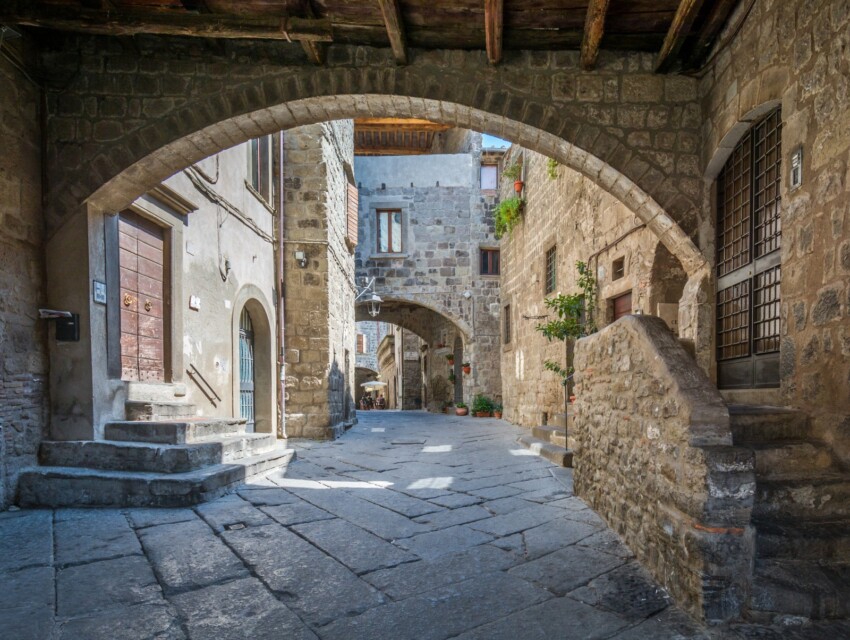
Begin your visit to Viterbo with the San Pellegrino quarter, which represents the city’s historic centre. It lies along the route of the Via Francigena, and by walking through its centuries-old streets you can discover some of the city’s most important landmarks, from Piazza San Carluccio to Palazzo degli Alessandri.
Wandering aimlessly through the streets of the San Pellegrino quarter will allow you to relive the medieval atmosphere of an era when Viterbo was actually more populous than Rome. The quarter, located within the city walls, showcases buildings with consistent urban and architectural character, extending along Via San Pellegrino, which forms its main spine.
Visit the quarter’s main square, Piazza San Pellegrino, and the small Church of San Pellegrino, built around the year 1000 and remodelled several times over the centuries; the last major work was after World War II, when it was damaged by bombing.
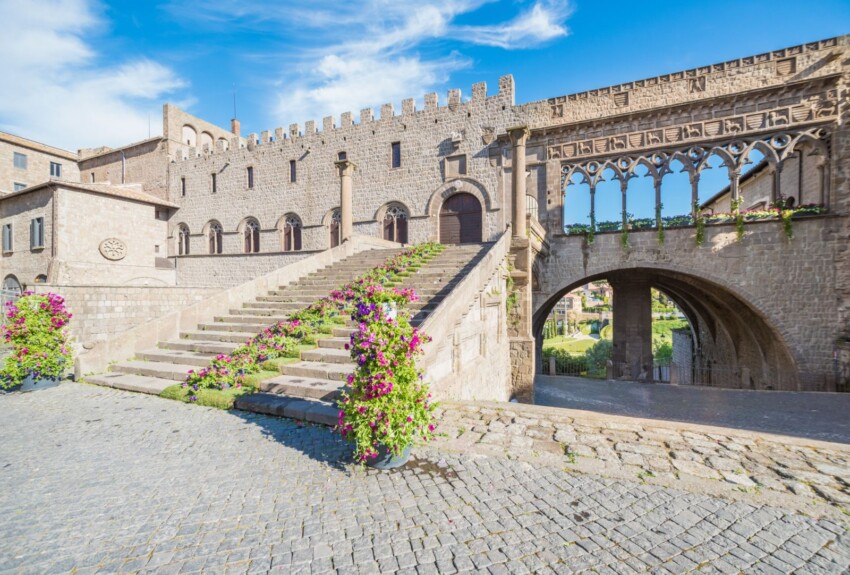
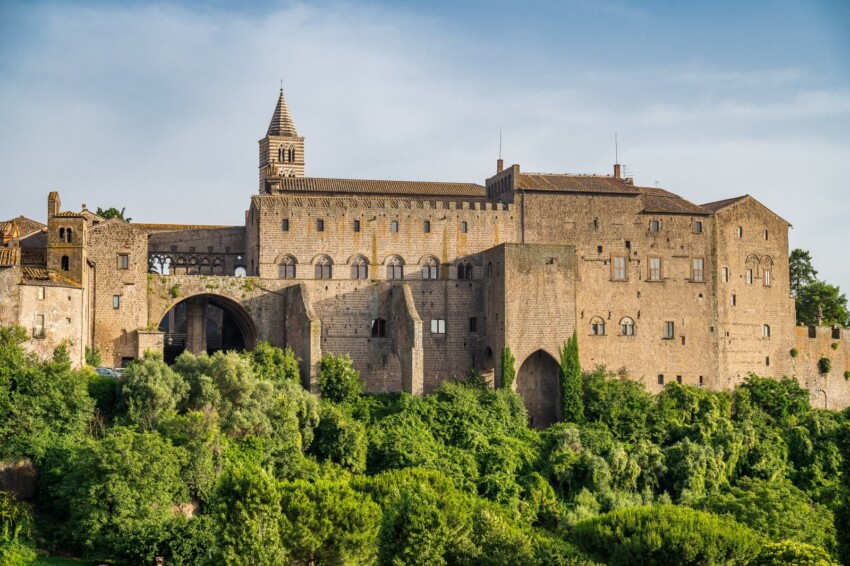
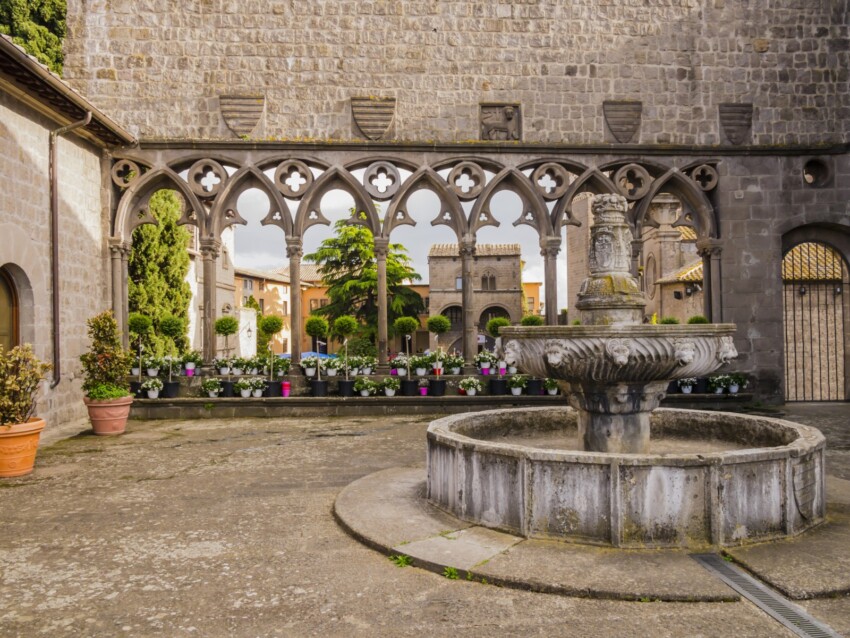
The Palazzo dei Papi is perhaps Viterbo’s most important attraction. It forms part of the monumental complex on the hill of Viterbo Cathedral and is located in Piazza San Lorenzo. It was built at the behest of Pope Alexander IV, one of the principal architects of the shift of the papal seat from Rome to Viterbo.
Visiting the Palazzo dei Papi is a timeless experience: during your tour you can admire the Conclave Hall, famous for hosting the longest conclave in history, lasting an incredible 1,006 days, and the Loggia of the Popes, officially the Loggia of Blessings, built by the Captain of the People Andrea Gatti in 1267, used by the Pope upon leaving the Conclave Hall.
Entry to the Palazzo dei Papi in Viterbo is via a ticket to the Colle del Duomo monumental complex, so your admission fee also includes the Cathedral sacristy and the Colle del Duomo museum. A convenient audio guide is available to help you discover all the building’s secrets.
The Palazzo dei Papi in Viterbo is open daily from 1 April to 6 November. From 7 November to 31 March it closes on Tuesdays; opening hours also vary by day of the week during this period: Monday to Friday it’s open from 10:00 to 13:00 and from 15:00 to 18:00, whilst on Saturdays and Sundays it operates continuously from 10:00 to 18:00.
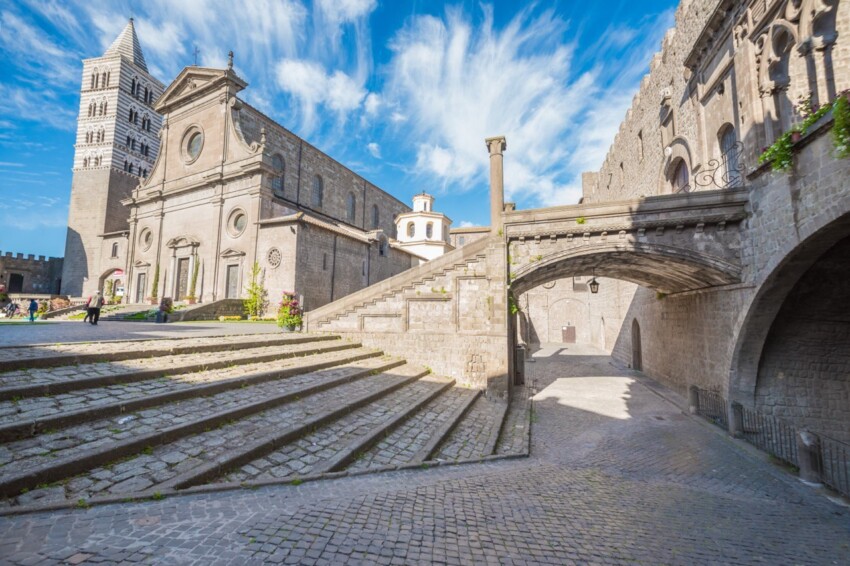
The Cathedral of San Lorenzo, commonly known simply as the Viterbo Cathedral, is the principal church of this Lazio city. It dates back to the 12th century and was designed in the Romanesque style, although subsequent alterations have partly changed its appearance to the classical Renaissance style.
The interior has a structure of three naves with 10 chapels facing onto them: their construction in the 16th century unfortunately resulted in the destruction of the frescoes that adorned the walls. Furthermore, the cathedral fell victim to bombing during World War II. On this occasion damage was extensive, but the reconstruction provided an opportunity to partially restore the interiors to the original Romanesque style.
Among the sacred art works that can still be admired today, it’s worth mentioning the fresco of the Madonna and Child presenting the ring of mystical marriage to Saint Catherine, a work by Antonio del Massaro da Viterbo, known as Il Pastura, the 19th-century bust of Letizia Cristina Bonaparte by Duprè, and a 12th-century Byzantine panel depicting the Madonna della Carbonara, an early version of the more famous one found in the Basilica of Santa Maria Maggiore in Rome.
The cathedral also served as a papal residence during the period when Viterbo was the papal seat. Two popes from that era are buried here: Alexander IV and John XXI, who died as a result of a collapse in part of the Papal Palace.
This small Romanesque church is actually of great importance, as it is one of Viterbo’s oldest. It dates back to 1080 and its interior contains numerous paintings from the Viterbo school, spanning over 200 years between the 14th and 16th centuries. Also worthy of note is the beautiful Byzantine triptych from 1180 and the ceiling of the side naves, supported by wooden roof trusses and decorated with ceramic tiles.
On the side of the high altar there is an entrance to an ancient early Christian crypt, whilst outside the apse a staircase leads to a cloister, which remained unknown until the 1980s, when it was brought to light following a collapse.
Viterbo City Walls
The medieval past of Viterbo can still be admired today by walking along the city’s encircling walls, which extend for approximately 4 kilometres.
The oldest section dates back to 1095 and the entire circuit is almost completely intact; entry to the city was via a series of gates that are still clearly visible today: the two main ones are Porta Romana5 and Porta Fiorentina6, whilst the smaller ones are San Pietro, Fiorita, del Carmine, San Lorenzo, di Valle, Faul, Bove, Murata, San Marco, della Verità, and San Leonardo.
Also worth visiting is the intricate network of underground tunnels that run beneath Viterbo, carved into the tufa rock. They connect various buildings in the historic centre, creating an extensive network of passages and walkways; historical and archaeological finds have been discovered here, evidence that they were heavily used in centuries past.
During World War II, Viterbo’s underground galleries were used by the local population as shelter to protect themselves from bombing in 1943-1944.
For archaeology and history enthusiasts, Viterbo’s Etruscan museum is an absolute must-visit. It is housed within the Rocca Albornoziana, a defensive complex dating from 1354 that was restored between the 1960s and 1980s following damage from World War II.
The museum layout extends over 4 levels: on the ground floor you’ll find an extensive section on Etruscan architecture, with objects, terracottas, furnishings and utensils; the mezzanine level usually hosts temporary exhibitions; the first floor focuses on the Etruscan centres of Musarna and Ferento, with finds from these areas, whilst the second floor displays archaeological remains from southern Etruria.
The National Etruscan Museum Rocca Albornoz is open Tuesday to Sunday from 8.30 to 19.30, with last admission at 18.30. It is closed on Mondays, 1 January and 25 December. You can purchase admission tickets directly at the ticket office; discounts are available for visitors aged 18 to 25, and various concessionary rates allow free entry. For further information, you can contact (+39)-0761325929.
The Colle del Duomo museum in Viterbo is an important city museum, established during the 2000 Jubilee. It is housed in several previously unused rooms within the Cathedral of San Lorenzo and is divided into three sections: an archaeological section, which features ceramic artefacts, a historical and artistic section, where you can admire artworks by Viterbo artists spanning an extensive period from the 12th to the 20th century, and a sacred art section showcasing liturgical vestments, reliquaries, chalices and other objects used in religious ceremonies.
You can purchase your ticket directly at the ticket office, and it’s possible to buy an additional option that also includes entry to the Palazzo dei Papi. Each ticket includes an audio guide, which also provides information about the church complex.
The museum is open daily except for 24 and 25 December. From 1 April to 6 November opening hours are 10.00 to 19.00, whilst from 7 November to 31 March hours vary by day of the week: it closes on Tuesdays, Monday to Friday it’s open from 10.00 to 13.00 and from 15.00 to 18.00, and on Saturdays and Sundays from 10.00 to 18.00.
Last admission is one hour before the ticket office closes. For information, call (+39)-3207911328 or email info@museodelcolledelduomo.it.
For a wellness break in Viterbo, or to relax after a day spent exploring the city’s attractions, there’s nothing better than a visit to the Terme dei Papi thermal complex. It’s located at Strada Bagni 12, a few kilometres west of the centre, and is easily accessible via the Orte-Viterbo dual carriageway thanks to the Viterbo Terme exit.
The Terme dei Papi offers plenty of relaxation opportunities, including massages and wellness areas, but the highlight of the facility is undoubtedly the monumental swimming pool, which covers an area of 2,000 square metres and is fed by hyperthermal water from the Bullicame spring at 58 degrees, entering the pool through beautiful stone fountains.
The natural grotto is also impressive – a cavity that transforms into a natural Turkish bath thanks to the hyperthermal water that heats it to 48 degrees, filling it with beneficial vapours for the entire body.
The Terme dei Papi also has three restaurants, open for lunch and dinner: these are the Italian Restaurant, open in summer poolside, the La Terrazza Restaurant, with views of the monumental thermal pool, and the Gregorio IX Restaurant, elegant and refined.
The Terme dei Papi are open every day of the year from 9.00 in the morning to 19.00, with Saturday closing at 1.00 in the morning. Various types of entry options are available, including a special reduced-rate ticket valid for 3 hours, a day pass and an evening entry. Note that the monumental pool is closed on Tuesdays for routine maintenance.
Map
In the following map you can see the location of the main places of interest mentioned in this article.
Visiting the city with the Viterbo Pass
The Viterbo Pass is the official city card that allows skip-the-line entry to the city’s main attractions at a really good price. In particular, it includes:
Entry to the Palazzo dei Priori
Entry to the Rossi Danielli Civic Museum
Entry to the Ceramics Museum
Entry to the Teatro dell’Unione
Entry to the Museum of the Sodality of Porters of Santa Rosa
Entry to the Colle del Duomo Monumental Complex
Additionally, you’ll have an audio guide included at every attraction. Once you’ve purchased it online, simply show your ticket at the Palazzo dei Priori office to obtain your Viterbo Pass and gain entry to all the attractions listed.
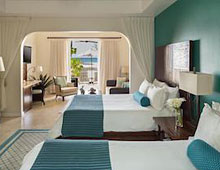
Viterbo, despite its wealth of attractions, is rather small and can be easily explored on foot. This is why the historic centre is undoubtedly the best area to base yourself: here you’ll find plenty of accommodation options, particularly bed and breakfasts, guest houses and small apartments, often presented as charming properties. That said, there’s no shortage of hotels, though they tend to be smaller establishments, some of which are nonetheless quite elegant.
If you prefer greater comfort, including easier parking, public transport access, and proximity to services, supermarkets and shops, we’d recommend heading out of the historic centre towards the north, where you’ll find the railway station. Here and in the surrounding area there are several larger hotels, some even with swimming pools, and others belonging to major international chains: decidedly more modern facilities with excellent amenities, though certainly less charming than the small boutique hotels in the centre.
Finally, just beyond Viterbo’s urban boundaries, you’ll find a wide choice of agritourism properties, country estates and farms, where you can enjoy the Tuscia countryside whilst remaining just a stone’s throw from the city. You’ll be able to sleep surrounded by complete relaxation, in characterful properties in direct contact with nature.
We offer best rates If you find it cheaper we refund the price difference.
Free cancellation Most properties allow cancellation without penalty.
We're available 24 hours a day For any problem call Booking.com.
Viterbo is easily accessible by car from Rome. Once you arrive in the city, it’s best to leave your car at the Valle Faul car park, from where you can reach the centre via a convenient lift that takes you directly to Piazza San Lorenzo.
To reach Viterbo from Rome’s city centre, there are two possible routes, both taking roughly the same amount of time. One, longer in distance but more direct, uses the A1 motorway; you’ll exit at the Orte junction and then continue on the SS675 following the signs. The other route avoids the motorway altogether, instead using state and regional roads; the journey follows the SS2 state road via Formello and Ronciglione.
In either case, under normal traffic conditions, it takes approximately one hour and 15 minutes from Rome’s centre to Viterbo’s centre; bear in mind, however, that this time may be longer due to traffic leaving the capital.
If you don’t have a car, or prefer to use public transport, you can reach Viterbo in two ways: by train to Orte and then by bus to Viterbo, or by two train journeys, first to Orte and then from Orte to Viterbo. Either way, the journey takes between 90 and 150 minutes, depending on the necessary connections.
Viterbo Weather
What's the weather at Viterbo? Below are the temperatures and the weather forecast at Viterbo for the next few days.
 Hotel
Hotel  Budget accommodations
  Apartments
  Family Hotel
  Luxury Hotel
  Resorts