Bestseller
From Rome: Villa D'Este and Hadrian's Villa Tivoli Day Tour
From 65,00 €
Buy the ticket
The Renaissance Villa d’Este is one of the easiest and equally exciting day trips you can make from Rome. It’s located in Tivoli, a town in the province just over an hour away to the east, where you’ll also find two other marvellous attractions not to be missed: Villa Adriana and Villa Gregoriana.
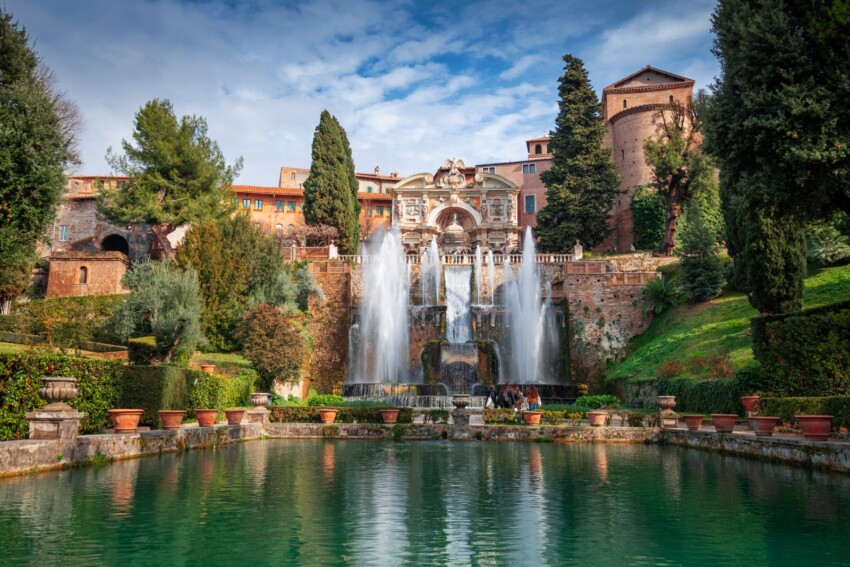
The villa, declared a UNESCO World Heritage Site, dates back to the 16th century and was built at the behest of Ippolito II d’Este, cardinal and archbishop and son of Lucrezia Borgia. Today, Villa d’Este in Tivoli is one of the most prominent images of the Italian Renaissance, and is particularly renowned for its magnificent garden filled with fountains, which attracts visitors from across Italy and beyond.
The villa’s origins
The history of Villa d’Este is intriguing: when Ippolito II was appointed lifetime governor of Tivoli by Pope Julius III, upon his triumphant entry into the city he discovered he would have to stay in an old convent that had been only partially converted into a residence. Accustomed to far better, he nonetheless decided to remain in Tivoli as he appreciated the surroundings, but he also resolved to transform the convent into a villa.
Villa d’Este is beautiful inside, but it’s the exterior, particularly the garden that extends over 4 hectares, that represents its most significant feature. For many it’s the finest Italian-style garden in Europe, and looking at the countless fountains that create water displays of every kind, it’s not hard to understand why.
You enter the residential palace through the main entrance, which you reach by walking along the so-called Vialone; once inside you’ll immediately admire the beautiful staircase that leads to a grand reception hall, from which you reach the frescoes of the Noble Apartment.
The palace spans three floors, and amongst the numerous rooms and spaces there are some truly noteworthy ones, such as the Old Apartment, the Hall of Stories of Solomon, the Fontanina Salon with Ercole Sassano’s fresco and the double loggia.
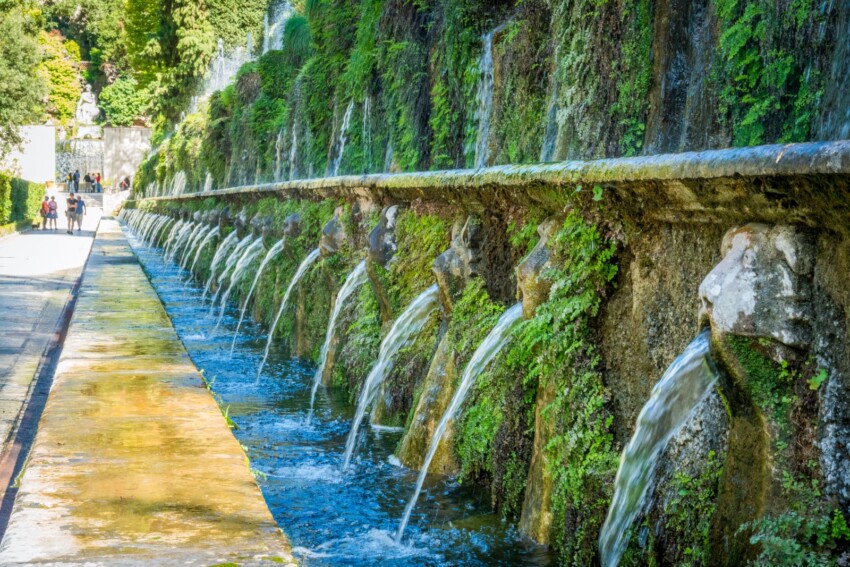
The Avenue of the Hundred Fountains is the postcard of Villa d’Este and its most photographed location. Unsurprisingly, it takes its name from the countless fountains lining one side of it. In reality, it’s a single enormous fountain with a series of jets, designed to connect from east to west the area of the Oval Fountain (representing Tivoli) with the Fountain of Rome (representing Rome), in an iconic connection between the two cities. Halfway along the avenue is the vantage point for the Fountain of Dragons, located at a lower level.
The entire structure consists of two overlapping rows of water jets: in the upper part water comes from spouts, whilst in the lower part it emerges from mouths or figures of various kinds.
The Fountain of the Goblet, easily reached directly from the Avenue of the Hundred Fountains, takes its name from its curious shape – a chalice. It sits just below the palace façade and was created by Gian Lorenzo Bernini in 1660.
Originally made of mortar and brick, it was later faced with stone and ancient marble. In 2008 the Fountain of the Goblet underwent major restoration, as water damage had taken its toll over the centuries. Today, the Fountain of the Goblet has regained its original beauty.
Another fountain at Villa d’Este that deserves special mention is the Fountain of the Organ, the only Baroque work in an otherwise Renaissance complex. It takes its name from a hydraulic mechanism inside it, designed to reproduce sounds similar to those of an organ. A true masterpiece of engineering, created between the late 16th and early 17th centuries.
Beyond the complexity of its mechanism, the Fountain of the Organ also stands out for the beauty of its façade, with floral decorations adorning a large central niche, where four large statues are positioned in front of which a balustrade emerges, as if the fountain’s body were born from the waters.
The hydraulic organ in the Fountain of the Organ is activated every 2 hours, every day, starting from 10.30 in the morning.
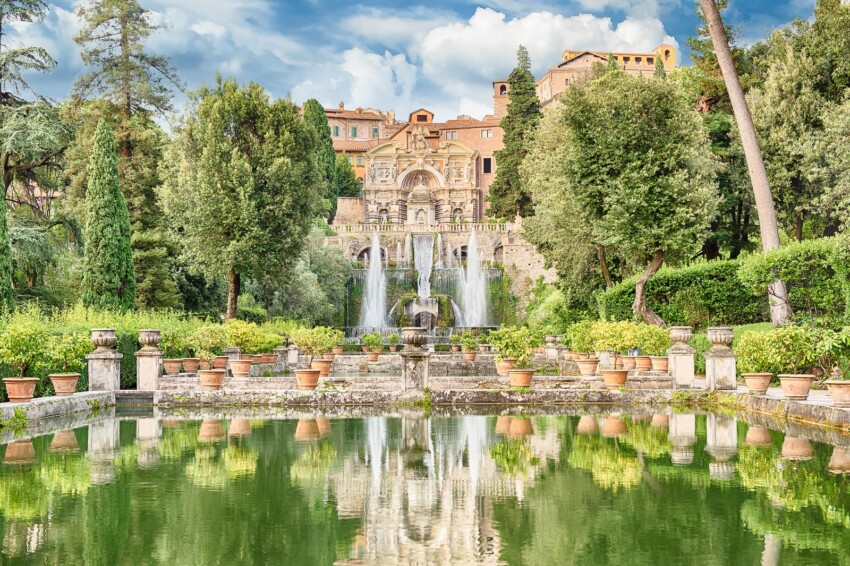
The Neptune Fountain, located beneath the Fountain of the Organ, is one of the most spectacular at Villa d’Este. Built by Bernini, it was subsequently abandoned for two centuries, and finally completely restored by Attilio Rossi in 1927.
The composition of the Neptune Fountain is truly unique: above, the balustrade separates it from the square where the Fountain of the Organ stands, whilst below are the Sibyl Grottos, with three nymphaea connected to one another. At the centre is the long cascade from Bernini’s work, whilst below the water is divided into three cascades that lead to the two lower basins.
The Villa d’Este ticket office is located at Piazza Trento 5: tickets can be purchased on site or online.
A full-price ticket is available for adults; discounts are available for young people, and there is a wide range of free ticket beneficiaries, including all young people under 18 years old. In the case of exhibitions or events, standard tickets are available with a surcharge.
It’s also possible to purchase the special Villae Pass ticket which lasts 3 days and includes entry to Villa d’Este, Villa Adriana and the Sanctuary of Hercules the Conqueror, whilst a second special ticket is available, which allows entry to the villa and the nearby Sanctuary of Hercules the Conqueror only.
Remember that on the first Sunday of each month Villa d’Este is open to all with free entry. Naturally, on occasions like these you’ll encounter a considerably larger crowd.
Additionally, at the ticket counter you can hire an audioguide to support your visit to the villa and gardens, for an additional fee.
There is also the possibility of purchasing a combined ticket that allows entry to three of Tivoli’s main attractions: Villa Adriana, Villa d’Este and the Sanctuary of Hercules the Conqueror. This special ticket is called the Villae Pass and includes one entry to each site, access to current exhibitions and discounts on guided tours and audioguides. The Villae Pass lasts 3 days and is activated upon entry to the first site.
It’s possible to visit Villa d’Este entirely independently, but you can also use the services provided by local tour guides. You can contact an official guide to take you on a private tour of the villa and gardens, or take part in a group tour.
From Rome there are numerous day trips departing to discover Tivoli and its attractions; practically all include a visit to Villa d’Este. Choose the one that suits you best by finding out about the duration of the visit at the villa, so you don’t have to rush off or – conversely – waste too much time.
Villa d’Este is open every day of the year except 1 January and 25 December, with hours varying depending on the season. Opening is always at 8.45 am, whilst closing – with last entry one hour before – varies between 5.00 pm in winter, 6.45 pm in spring and 7.45 pm from late March to mid-September. On Mondays opening is always at 2.00 pm except when it falls on a public holiday, in which case it opens normally at 8.45 am. On the first Sundays of the winter months, closing is at 6.00 pm. Given the significant variability of opening hours, we recommend checking the official website a few days before your visit.
Inside the villa there are two souvenir and gift shops, a multimedia room and a projection room showing a film about Villa d’Este in 4 languages.
Villa d’Este is located in Tivoli, approximately 35 kilometres from Rome to the east. You can reach it easily with your own car or a rental, leaving the city centre and heading towards the A24 motorway, which you follow to the Tivoli exit and continue along the SP51A Maremmana Inferiore provincial road until you join the SR5, which you follow to your destination following the signs. Journey times are unfortunately unpredictable, as they vary enormously depending on the distance from your starting point to the Grande Raccordo Anulare ring road, and of course depending on what time you decide to depart, increasing or decreasing the likelihood of getting stuck in the capital’s traffic.
Tivoli is also accessible by train from Rome, with direct services or changes at Bagni di Tivoli. The journey takes between 50 and 70 minutes, and once you get off the train you’ll need to walk for about 15 minutes before reaching Villa d’Este.
Entry to the villa is from Piazza Trento, located practically in the historic centre of Tivoli. There is no parking in the immediate vicinity, with the exception of the small car park in front of Tivoli’s panoramic viewpoint, which is almost always full. It’s much easier to leave your car at the Piazza Matteotti car park south of the centre, then continue on foot for about 5-10 minutes.
City Card allow you to save on public transport and / or on the entrances to the main tourist attractions.



 Hotel
Hotel  Budget accommodations
  Apartments
  Family Hotel
  Luxury Hotel
  Resorts