Tivoli: Villa Gregoriana Entrance Ticket
151 reviews
Buy now
From 10,00€ per person
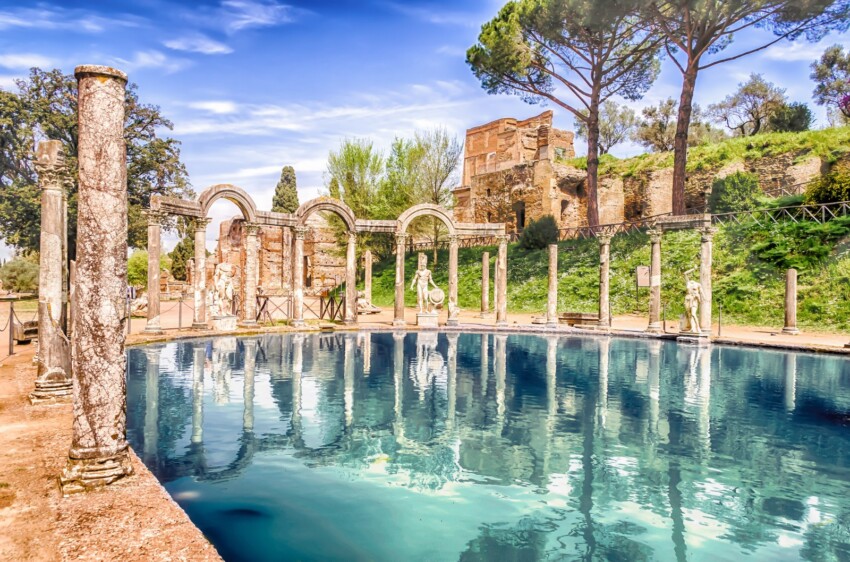
Tivoli, the ancient Tibur of the Romans, is a town of around 50,000 inhabitants located in the heart of Lazio, in the province of Rome, which proudly claims to be older than Rome itself. According to a blend of history and legend, it was founded in 1215 BC on the left bank of the River Aniene.
Today Tivoli is an unmissable stop on any trip to Rome, and deserves far more than the classic quick day trip. The town is home to three world-class attractions that make up what’s known as Tivoli’s villa circuit: Villa Adriana, Villa d’Este and Villa Gregoriana. These are complemented by other monuments and buildings of lesser significance perhaps, but still well worth visiting.
The main things to see in Tivoli are undoubtedly the three villas, alongside various civil and religious buildings, plus a number of archaeological sites. Don’t overlook a visit to the historic centre either – if nothing else, to rest between attractions and enjoy excellent local cuisine.
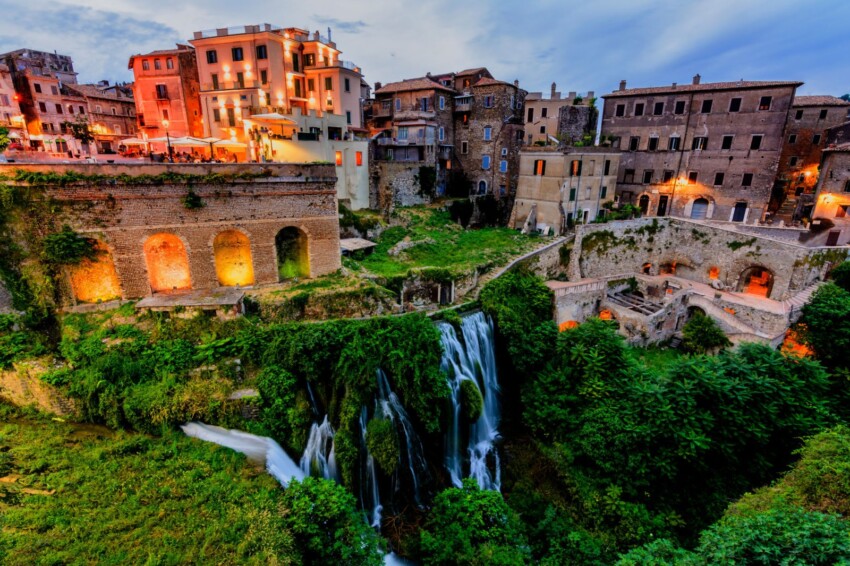
Villa Gregoriana is one of Tivoli‘s main attractions, situated roughly 50 kilometres south-east of Rome. Don’t be fooled by the name: it’s not a villa but a magnificent park that slopes downhill along the side of a hillside overlooking the River Aniene.
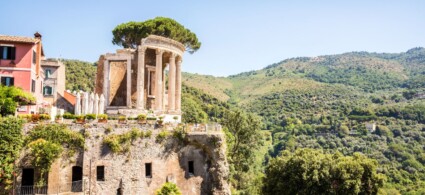
It was created at the behest of Pope Gregory XVI, from whom it takes its name, and since its opening in the early 19th century has been a magnet for artists and writers. Walking through the park along the marked trail, you’ll encounter several beautiful attractions, including the impressive Aniene waterfall, Italy’s second highest after the Cascata delle Marmore, nestled beside several late imperial structures, including the remains of the Villa of Manius Vopiscus and the Temple of Vesta, which later inspired Palladio in some of his works.
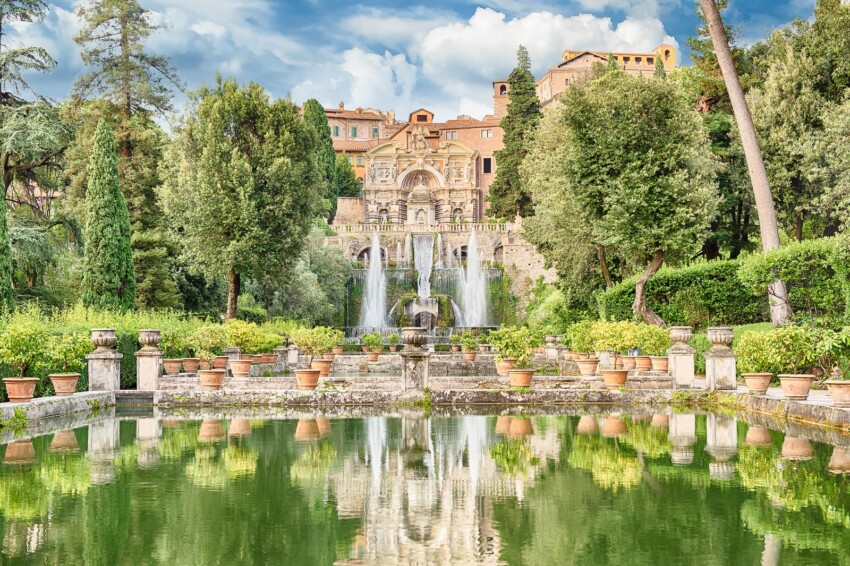
Among Tivoli‘s main attractions is undoubtedly Villa d’Este, designated a UNESCO World Heritage Site. It’s a 16th-century villa with captivating interiors, but it’s really the gardens that steal the show, their beauty enhanced above all by the magnificent fountains.
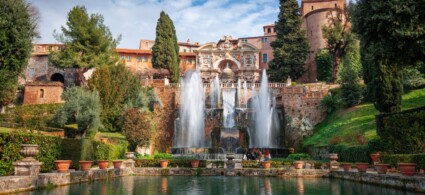
Speaking of fountains, Villa d’Este’s gardens centre around a long avenue, the Avenue of the Hundred Fountains, alongside which stand other stunning masterpieces including the Fountain of the Cup, created by Gian Lorenzo Bernini, the Organ Fountain, the only Baroque work within this Renaissance villa, and the Neptune Fountain, also by Bernini but only completed two hundred years later.
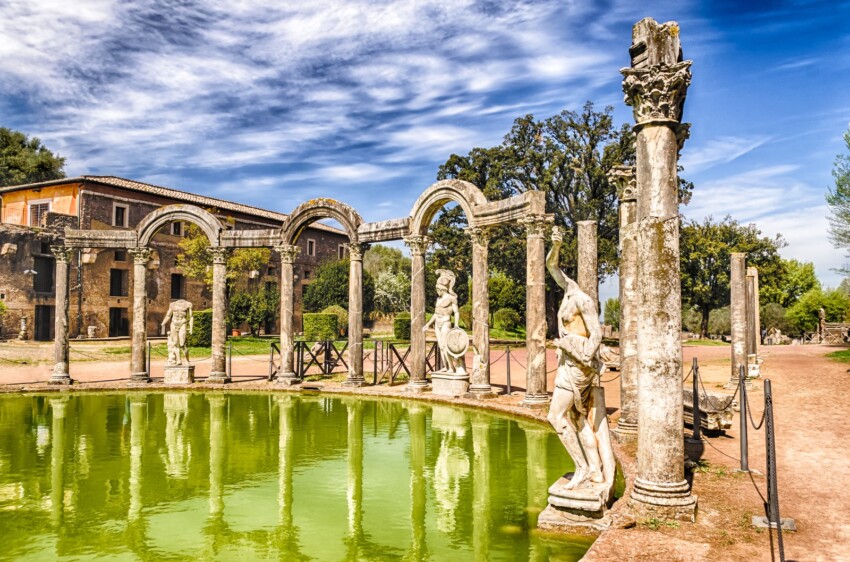
The third top attraction of a trip to Tivoli (though hardly a ranking!) is Villa Adriana. This is a classic imperial residence, which could easily sit alongside Rome’s Imperial Fora in the heart of the city. Designated a UNESCO World Heritage Site in 1999, it’s a truly unmissable destination.
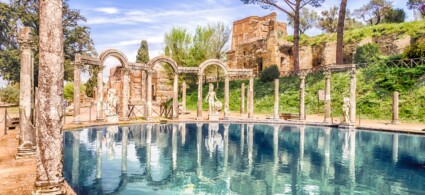
What strikes you most about Villa Adriana are its sheer dimensions, as its remains spread across 120 hectares, of which 40 are open to the public. It was the residence of Emperor Hadrian, who had it built in 117 AD; today it ranks among Italy’s most important archaeological sites, and is so vast that exploring it all can easily take a full day. Highlights include the Canopus, a 120-metre-long pool-canal, two thermal complexes and the Antinoeion, a complex of two temples built to venerate Antinous, Hadrian’s lover, who was deified upon his death.
The Rocca Pia of Tivoli is one of the town’s symbols. It’s a medieval fortress dating from the 15th century, built at the behest of Pope Pius II Piccolomini in a strategic elevated position to protect the town from external threats. It’s built from tufa stone and comprises four towers connected by tall curtain walls, enclosing a spacious inner courtyard.
For many years, despite restoration work, Rocca Pia remained closed to the public – a paradoxical situation that was finally resolved at the end of 2018 when it opened to visitors. It’s open Saturdays and Sundays from 10.00 to 16.00, with guided visits departing every half hour, each limited to a maximum of 20 people. Visits are booked at the entrance on a first-come, first-served basis.
Tivoli’s cathedral, dedicated to Saint Lawrence the Martyr, is the town’s main church. Located on Cathedral Square, it’s a large church built in Baroque style with a Romanesque bell tower. Extensively modified throughout its existence, it is believed to have been founded by Emperor Constantine himself, who reigned from 306 AD.
The present façade dates to 1650, with the bell tower, nearly 50 metres tall, positioned to one side. The interior features a single nave with four chapels on each side, beautifully adorned with numerous frescoes and works of sacred art painted or sculpted by 17th-century Italian and international masters.
Right in the town centre, next to Rocca Pia, you’ll find the Amphitheatre of Bleso, dating from the 2nd century of the imperial era. It’s not normally open to the public, but opens its doors for concerts, exhibitions or historical re-enactments featuring ancient gladiatorial combats.
The amphitheatre has never been fully excavated, and part of it was destroyed in the 15th century to make way for Rocca Pia. It’s a truly vast structure – it’s believed to have housed a gladiator training school. Built on a slope, exploiting the natural gradient, it’s oval in shape with a major axis of 90 metres. It’s estimated it could hold up to 2,000 spectators.
The Mausoleum of the Plautii is a monumental tomb dating from the 1st century AD, presumably the resting place of the consul Manius Plautius Silvanus, who held office in 2 BC under Emperor Augustus.
The monument is a large cylindrical tower with a circular floor plan, though its current form is the result of a 15th-century redesign that transformed it into a defensive tower to protect the Lucano Bridge over the Aniene. Today, following meticulous restoration work, the Mausoleum of the Plautii is overseen by the Villa Adriana and Villa d’Este Institute. To visit, head to the Villa Adriana area, at the junction of Via Tiburtina Valeria and Provincial Road SP51, near the River Aniene.
The Sanctuary of Hercules Victor is a Hellenistic sanctuary dating from the 1st-2nd century BC, located west of Tivoli’s town centre. It’s the second-largest sanctuary dedicated to Hercules in the Mediterranean after the one at Gades in Spain, and served as the temple of the god protector of ancient Tibur.
Originally, the sanctuary covered a vast area of 3,000 square metres, which included a theatre and a large plaza serving as sacred space. The intention was to impress visitors arriving in Tivoli from Rome.
The Sanctuary of Hercules Victor is located at Via degli Stabilimenti 5, and is open every day of the year except Christmas and New Year’s Day. Opening hours vary between 10.00 and 11.00, while closing times range from 17.00 to 19.00, depending on the time of year. For more information, you can contact the ticket office on (+39)-0774382733
Finally, don’t leave Tivoli without indulging in some thermal spa relaxation. The thermal complex is called Terme di Roma Acque Albule, and consists of the spa itself plus the Victoria Terme hotel, a 4-star property with access to the thermal pool.
The centre offers a range of wellness packages and thermal treatments designed to naturally treat various conditions. Guests have access to a thermal spa for relaxation enthusiasts, complete with a sauna, Turkish bath and relaxation area, plus a full range of rehabilitation, physiotherapy, massage and aesthetic medicine services, some available through the NHS.
In the following map you can see the location of the main places of interest mentioned in this article.
If you want to ensure a visit to the villa circuit, purchase your entrance tickets in advance directly online.
However, the most convenient and comprehensive way to visit Tivoli and its villas is certainly via a day trip from Rome. Numerous tours are organised daily that include visits to the Villas and Tivoli’s town centre: choose the one that suits you best.
There are plenty of areas where it’s worth considering a stay in Tivoli, particularly depending on what type of visit you’re planning. Assuming you’ve already visited Rome and aren’t just making a quick day trip, we’d recommend staying in the historic centre to be close to the main monuments, including Villa d’Este and Villa Gregoriana. You’ll find plenty of privately-run houses and apartments, plus a number of bed and breakfasts; hotels are almost entirely absent.
Head west of the historic centre if you want to be near two of Tivoli’s most important attractions: Villa Adriana and the thermal baths. To visit the former, make for the Villa Adriana area, where you’ll find a couple of hotels (even in their names) plus the usual handful of apartments and bed and breakfasts, perfectly positioned to get there early in the morning and beat the day-trippers, especially if you’ve pre-booked your ticket online. If your Tivoli holiday is centred around the thermal baths, head straight to the Tivoli Terme area, where you’ll find plenty of decent hotels.
Tivoli is located east of Rome, and is easily reached by taking the A24 Rome-L’Aquila motorway. The distance is only 30-40 kilometres, but journey times vary enormously depending on traffic leaving the city, anywhere from half an hour to over an hour. The A24 is accessed via the Tiburtina Ring Road, near Casal Bertone, and you exit at the Tivoli junction or the next one, Castel Madama: choose the latter if there’s traffic on the SP51a, which leads directly to Tivoli from the exit.
If you don’t have a car, or prefer to avoid traffic, you can reach Tivoli by public transport, specifically the regional train departing from Roma Tiburtina. The journey takes around 40 minutes, with 5 intermediate stops. Tivoli railway station is located east of the historic centre, on the far side of the Aniene, but it’s perfectly convenient for reaching Villa Gregoriana, just over 200 metres away; to reach the historic centre, cross the Ponte della Pace bridge over the Aniene, a pleasant 10-minute walk.
What's the weather at Tivoli? Below are the temperatures and the weather forecast at Tivoli for the next few days.
Tivoli is located in the province of Rome, approximately 35 kilometres east of the city centre, along the road that leads towards Abruzzo.
 Hotel
Hotel  Budget accommodations
  Apartments
  Family Hotel
  Luxury Hotel
  Resorts