La Locanda Del Pontefice
Castel Gandolfo - Via Dei Laghi 24 S.P. 217
Book now
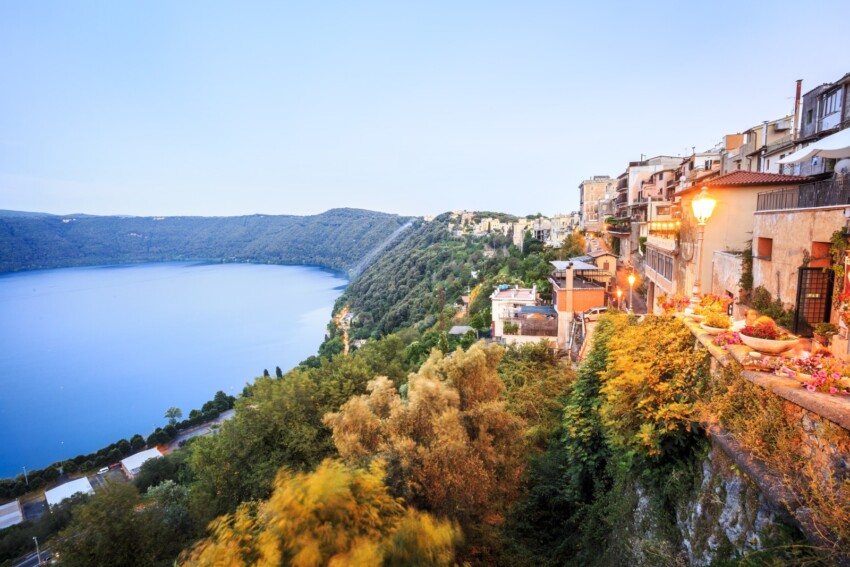
Castel Gandolfo is one of the most popular day trips for tourists visiting the capital. This town of around 10,000 inhabitants, located in the province of Rome, has art, culture and history on its side, plus a fairytale setting on the shores of Lake Albano and a historic centre that is part of the association of Italy’s most beautiful villages.
The town is best known as the home of the Pope’s summer residence, and for this reason it is dotted with villas and prestigious 17th and 18th-century palaces. But there is much more to Castel Gandolfo and its surroundings, starting with the remains of Domitian’s Alban Villa and the collegiate church of San Tommaso da Villanova, a work by Gian Lorenzo Bernini, along with archaeological sites on the shores of Lake Albano.
Moreover, Castel Gandolfo lies within the Castelli Romani regional park, making it the perfect base for exploring the entire area and the wonderful villages that surround it.
Castel Gandolfo is small but packed with things to see, some located right in the centre, others in its immediate surroundings or on the shores of Lake Albano. Here are the most important ones, so you won’t miss any and can make the most of your stay in this delightful Roman location.
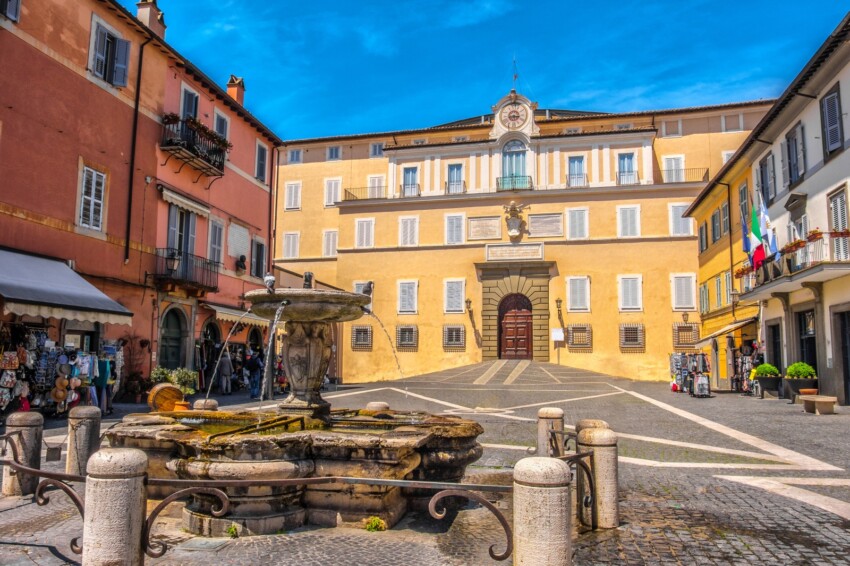
Together with Villa Cybo and Villa Barberini, the Papal Palace – also known as the Apostolic Palace – forms the complex of Castel Gandolfo’s Pontifical Villas.
It was Pope Urban VIII who was the first pontiff to stay in Castel Gandolfo, in 1628, in a villa that had been built for him by a cardinal. From then until 2016, the building became the summer residence of the popes, naturally with a series of modifications made over the centuries to make it even more grand, elegant and impressive.
Today the Papal Palace is a museum, run by the Holy See, but it is no longer used by the Pope as a summer residence following a decision by Benedict XVI. The land on which it stands has been a Vatican extraterritorial zone since 1871, a fact confirmed by the Lateran Treaty of 1929, which regulated relations between Italy and the Holy See.
The Papal Palace has a large and austere façade, on which three commemorative inscriptions honouring three popes – Paul V, Urban VIII and Alexander VII – are displayed. Beyond the entrance lies the Courtyard of Audiences, from which the Grand Staircase leads to the first floor, where reception halls and art exhibitions are located.
Several spaces are particularly noteworthy, such as Urban VIII’s chapel, which features frescoes by Simone Lagi, and the Bernini Gallery, frescoed by Pier Leone Ghezzi. Inside the palace you can also visit Clement XIV’s dining room, the Throne Room with its tapestries, and the Scalco Room, which displays some paintings by Salvator Rosa.
A visit to the Apostolic Palace must be booked in advance online to ensure you have a place on your chosen day. It is also possible to buy tickets on the day of your visit at the main entrance located in Piazza della Libertà.
Various ticket prices are available: full price, reduced price, school rates, pilgrim rates, and a special family ticket that offers discounts for mum, dad and one child. Children aged 0 to 5 enter free of charge.
Your entrance ticket includes access to the Apostolic Palace with free admission and a multilingual audio guide, available in Italian, English, Spanish, German, French or Russian.
Bear in mind that the Papal Palace is a place of Christian worship, so visitors are only admitted if dressed appropriately, without sleeveless or low-cut clothing, shorts or miniskirts. Bags or suitcases and large umbrellas are not permitted. You cannot use a selfie stick or tripod, consume food or drinks, smoke, or bring animals.
Photography is permitted, but without flash. Please note that the Papal Palace has no cloakroom, so plan accordingly.
The sumptuous Villa Cybo was designed in 1717 by Roman architect Francesco Fontana, commissioned by Cardinal Camillo Cybo. Inside, the rooms are magnificently decorated and display paintings and other artworks, but the villa’s main attraction is its garden, covering over 3 hectares. Cardinal Cybo was passionate about gardening, so he installed groves, fountains and water features. Today the gardens of Villa Cybo are part of the gardens of the Pontifical Villas complex.
It was Bernini who oversaw the construction of this magnificent Castel Gandolfo villa, commissioned by Taddeo Barberini. Inside, however, the villa conceals a genuine surprise: it is in fact possible to see a small part of what remains of the monumental Domitian’s Alban Villa, a palace built by an emperor of ancient Rome. The villa was indeed built on a section of its ruins and adapted into a baroque dwelling, and today seven rooms of the villa, collectively known as the Antiquarium, house ancient artefacts and beautiful statues.
To visit Villa Barberini, you need a separate ticket from the Papal Palace. Admission also includes access to the villa’s garden.
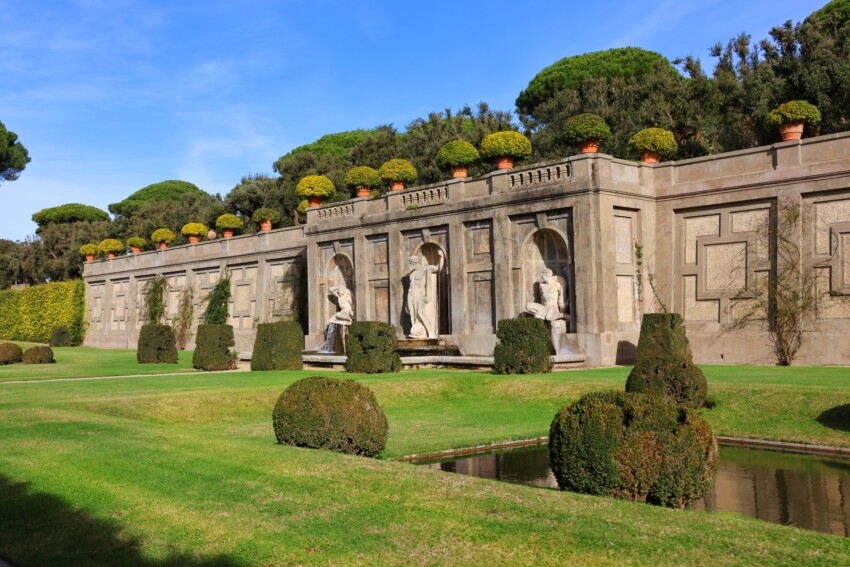
The three gardens of the Papal Palace, Villa Cybo and Villa Barberini form a single park, called the Park of the Pontifical Villas; it is a beautifully maintained green space within which you will find the Vatican Observatory4, the astronomical observatory of the small city-state. This is where samples of meteorites and lunar rock collected by the Apollo XVII mission and donated by former US President Nixon to Pope Paul VI are preserved.
Domitian’s Alban Villa was built by Emperor Flavius Titus Domitianus between AD 81 and 96 on a vast area that today spans the municipalities of Castel Gandolfo and Albano Laziale. He wanted an enormous villa in a scenic location, equipped with structures such as a hippodrome and a theatre. Unfortunately, after the emperor’s death, the sumptuous villa was never used by the emperors who succeeded him, so just a few years after his death it began a long and steady decline.
It was only from the 17th century onwards that the remains of Domitian’s villa were carefully incorporated into villas built by the local bourgeoisie. For example, in 1631 Taddeo Barberini purchased Scipione Visconti’s villa, which included numerous areas of Domitian’s ancient villa. Today, this residence has become Villa Barberini.
In essence, what remains of Domitian’s Alban Villa today are only scattered ruins spread across much of Castel Gandolfo’s municipal territory (and a part in Albano Laziale), on which other buildings have been constructed, especially villas, from the 17th to the 19th century. This alone speaks to how enormous it must have been; in fact, 4 aqueducts are connected to the villa, some of which are still in use today.
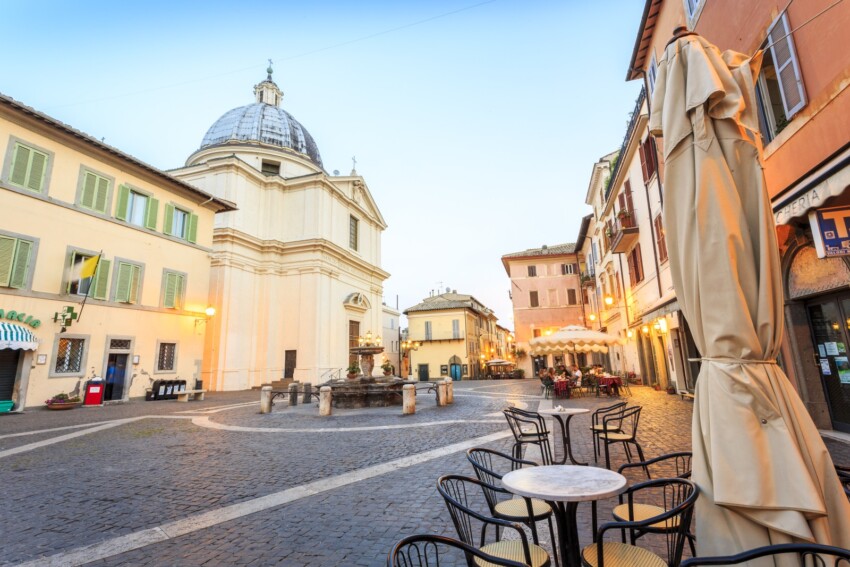
The most important church in Castel Gandolfo is the pontifical collegiate church of San Tommaso da Villanova, designed by none other than Gian Lorenzo Bernini on the commission of Pope Alexander VII. Built in the baroque style between 1658 and 1661, the church was originally intended to serve as a palatine chapel for the Papal Palace.
On the exterior you can admire the gabled façade, with a portal topped by a semicircular pediment and above it a rectangular window. Inside, the church has a Greek cross floor plan, with a dome decorated with 8 stucco roundels depicting scenes from the life of Saint Tommaso da Villanova.
The church, situated in Piazza della Libertà, is one of the town’s main places of worship; masses are held on weekdays at 8.30 am and 5.30 pm, and on Sundays at 8.30 am, 10.00 am, 11.30 am, 12.30 pm (when baptisms are also celebrated) and 5.30 pm. The parish office of the pontifical collegiate church of San Tommaso da Villanova can be reached at parrocchias.tommasodavillanova@gmail.com or by telephone at (+39)-069361915 on Tuesdays and Fridays from 4.00 pm to 6.00 pm.
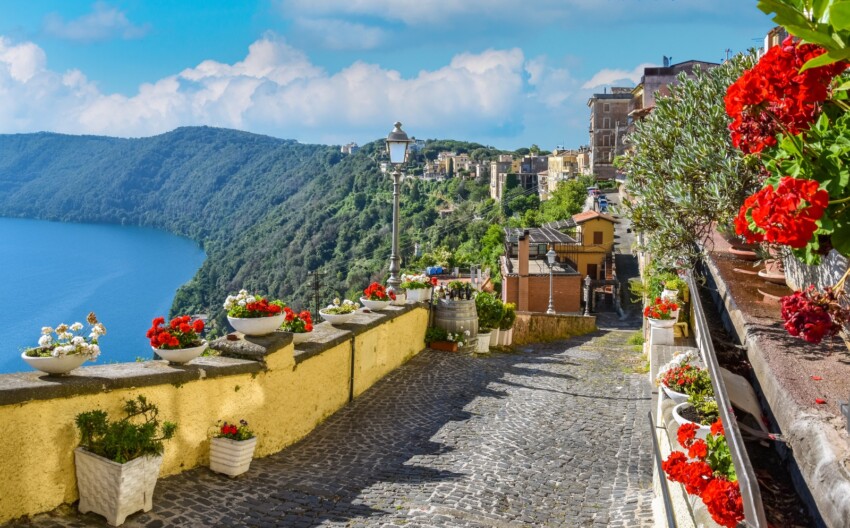
Lake Albano is divided between the municipalities of Castel Gandolfo and Albano Laziale, and is also known as Lake Castel Gandolfo. It was here that the rowing events of the 1960 Rome Olympics took place, and it is also here that the archaeological remains of the Villaggio delle Macine and the Nymphaeum of Bergantino are located.
Nearly circular in shape, the lake experienced significant development from the early 20th century onwards, when the area began to become a popular holiday destination for Rome residents. For this reason, especially on the northern shore, there are many villas and holiday homes; however, no proper residential centres overlook the lake shores, although Castel Gandolfo is very close.
On the shores of Lake Albano you can enjoy water sports such as canoeing or pedal boating, or walk or cycle along the shore: there is in fact a path that runs almost entirely in the shade of the woodland, circumnavigating almost the entire perimeter of the lake, starting from the lower part of Castel Gandolfo.
On the northern shore of Lake Albano stands Villaggio delle Macine, a pile-dwelling settlement dating to the Bronze Age, extending over an area of about one hectare. Considered Italy’s largest pile-dwelling archaeological site, Villaggio delle Macine was discovered in 1984 after a local resident found a bronze axe.
The village has been dated to approximately 4,000 years ago, and it is thought to have been abandoned around 3,500 years ago after the lake rose due to underground movements of an ancient volcano, the Latial Volcano, which is little known to most because its period of dormancy between eruptions lasts about 30,000 to 40,000 years. For the record, the last eruption is estimated to have occurred around 36,000 years ago, so in the next 4,000 years it is possible it could erupt; this situation could even endanger Rome and its inhabitants.
The Nymphaeum of Bergantino, also known as Diana’s Baths, is an archaeological site also located on the shores of Lake Albano. It is a nymphaeum, that is, a sacred building dedicated to a nymph, created within a natural cave dating to the 1st century AD, and for this reason attributable to Domitian’s Alban Villa.
The name of the site derives either from an ancient landowner or alternatively from a variant of “brigantine”, meaning a sailing vessel, as the cave could have been used as a boat shed.
The Nymphaeum of Bergantino is located inside a grotto with a diameter of 17 metres, while the entrance arch is over 50 metres high. The basin, 25 metres deep, also features a spillway channel towards the lake.
In the following map you can see the location of the main places of interest mentioned in this article.
For accommodation in Castel Gandolfo, you essentially have two alternatives.
The first option is to stay in the small historic centre, which consists of four streets: Via Vigna di Corte, Corso della Repubblica, Via Roma and Via Saponara. In doing so you’ll be a stone’s throw from the Papal Palace, which you can easily reach on foot and be among the first to visit in the morning. Among the options are an elegant hotel and a number of small apartments and bed and breakfasts.
The second alternative is to stay near the lake, for a completely different holiday experience: you won’t be able to walk to the Papal Palace, but you can enjoy relaxing walks along the lakeside, practise water sports, and during the warmer months also take advantage of beach facilities to sunbathe and swim.
Castel Gandolfo is located in the province of Rome, approximately 20 kilometres to the south-west. It’s easily accessible by regional train to Albano Laziale, departing from Rome Termini several times daily; the journey takes around 40-50 minutes depending on the number of intermediate stops.
By car, the journey time varies from 30 to 90 minutes, depending on traffic. Leaving central Rome is notoriously challenging, especially during rush hours; once you’ve reached the Grande Raccordo Anulare, take exit 23 towards the SS7 Appia, in the direction of Albano Laziale, then continue for approximately another 12 kilometres until you reach Castel Gandolfo.
Additionally, every Saturday morning at 10.45, a special train called the papal villas train departs from the Vatican station, located within Vatican City State, arriving directly at Castel Gandolfo station. The return journey departs from Castel Gandolfo at 17.24. Online booking is required to travel on the papal villas train.
What's the weather at Castel Gandolfo? Below are the temperatures and the weather forecast at Castel Gandolfo for the next few days.
 Hotel
Hotel 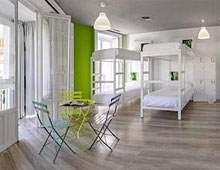 Budget accommodations
 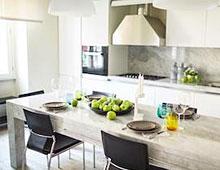 Apartments
  Family Hotel
 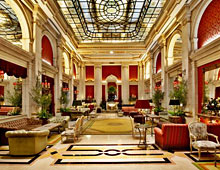 Luxury Hotel
 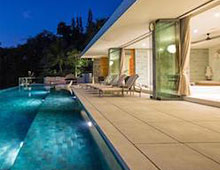 Resorts