Bestseller
Ostia Antica Archaeological Park: Entry Ticket
From 18,00 €
Buy the ticket
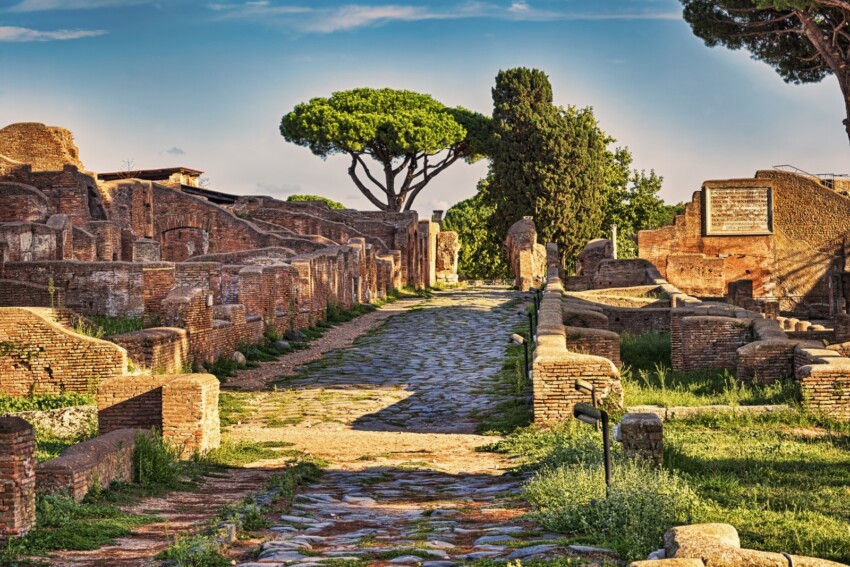
Everyone knows Ostia as Rome’s seaside district, the perfect escape from the summer heat of the capital. However, not everyone realises that in antiquity, Ostia was an important commercial port centre, essential to Rome’s economy as it was from here that grain arrived by sea. Ostia’s economy flourished to such an extent that at its height it boasted over 75,000 inhabitants.
Ancient Ostia subsequently experienced mixed fortunes—it was besieged by the Goths and plundered by the Saracens, and was later fortified during the Middle Ages. Ostia Antica therefore refers to two important places: the archaeological site of the old imperial Ostia, and the historic village of medieval Ostia. To add a bit more confusion for those unfamiliar with Rome and its surroundings, Ostia Antica is also the name of one of the capital’s districts—specifically district number 35—which naturally includes both the archaeological excavations and the medieval village within its boundaries.
From a tourism perspective, the Ostia Antica archaeological park is one vast attraction, centred on the Ostia Antica excavations. However, alongside these lie other fascinating monuments and ruins, such as the imperial ports of Claudius and Trajan, the Museum of Ancient Ships in Fiumicino and the necropolis of Porto on Isola Sacra.
The entire Ostia Antica archaeological park, as mentioned, encompasses numerous attractions. Furthermore, whilst you’re in the area, it’s worth exploring the medieval village, bounded by Giulio II Castle.
According to tradition, the ancient city of Ostia was founded by King Ancus Marcius in 620 BC. However, the remains currently visible date from after its foundation, specifically from the 4th century BC. The area is truly vast, yet equally fascinating.
The Ostia Antica excavations form the main attraction of the entire archaeological area. Access is provided through three gates: Porta Romana, Porta Laurentina and Porta Marina, whilst necropolises were located outside. In front of the ancient beach, however, lay the richest and most powerful inhabitants, whose sepulchral monuments have been discovered.
The most important necropolis of Ostia Antica is the Laurentina necropolis, whose excavations lasted throughout the 19th century. The Tombs of the Claudii are particularly noteworthy—these housed the liberti (slaves freed by Emperor Claudius), whose decorations are now displayed in the Vatican Museums.
A visit to the remains of the ancient horrea is equally intriguing—these were storage facilities and warehouses for various goods unloaded from the dock, and were also used as salt deposits during the Middle Ages and Renaissance.
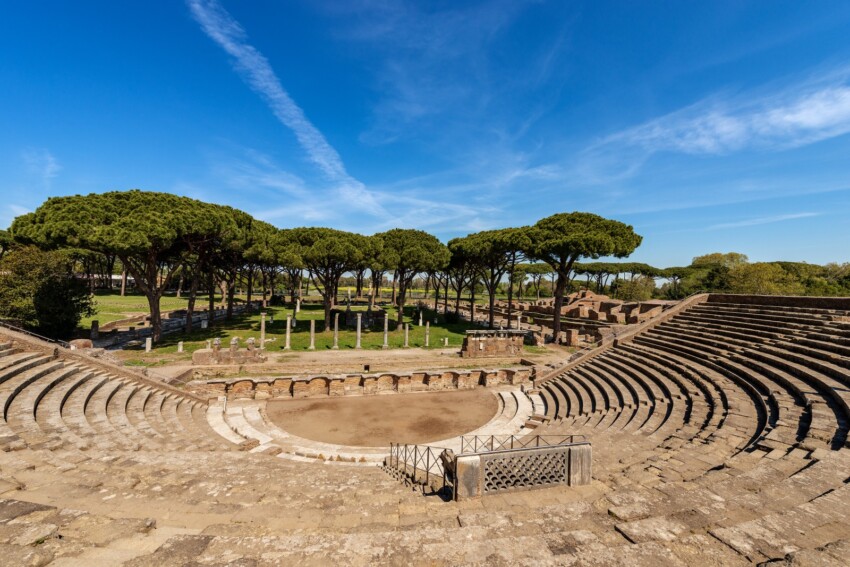
Not to be missed is a stop at the Roman theatre of Ostia Antica, arguably the most celebrated attraction in the entire archaeological area, dating from the 2nd century AD. It continues to be used today for open-air concerts and major events, in a truly unique setting.
Along the ancient coastline are the remains of a system of elegant coastal villas, contained within what is known as the Procoio area. Here you’ll also find the remains of an ancient thermal complex and a large seaside villa dating from the 1st–4th century AD, complete with a bath complex heated with a swimming pool and a two-storey cistern that supplied water to both the baths and the villa itself. The villa is bounded towards the coast by a wall stretching 160 metres, which also served as a monumental façade.
The path through the Ostia Antica excavations is rocky and uneven, so comfortable footwear is recommended. Small dogs are permitted entry, though they must be kept on a lead.
Be aware that the archaeological area is a no-drone zone due to its proximity to Fiumicino Airport. The use of drones is therefore prohibited, even for low-altitude flights.
Within the Ostia Antica archaeological area, there is a café called the Café degli Scavi.
In 42 AD, Emperor Claudius began constructing a large maritime port located north of the mouth of the Tiber. Dominated by a large multi-storey lighthouse, Claudius’s port was, however, not particularly fortunate, as the action of the sea and tides resulted in slow but constant silting.
It was precisely for this reason that, approximately 60 years later, a new port was built, known as Trajan’s port, which partly reused the structures of Claudius’s port that had remained safe on dry land.
Today, nearly two thousand years later, the sea has retreated by approximately three kilometres, making it possible to visit the ruins of these two masterpieces of ancient Roman engineering on dry land. They are located within an archaeological area that is partly within the property of the Sforza-Cesarini family, owners of the Trajan basin.
Access to the archaeological area of the imperial ports of Claudius and Trajan is via the entrance at Via Portuense 2360, opposite number 2329, beneath the Fiumicino Airport road viaduct. The site is open according to the following schedule:
Last admission is one hour before closure.
The Museum of Ancient Ships in Fiumicino is located on Via Alessandro Guidoni and houses one of Europe’s most important collections of ancient vessels.
The five main wrecks on display comprise three river boats used to transport goods along the Tiber to Rome, one maritime cargo ship and one fishing boat with a central aquarium to keep the catch alive.
The Museum of Ancient Ships was created within the port basin of Claudius and Trajan, which is the very location where the ships were discovered.
The museum is open to the public Tuesday to Sunday from 10:00 to 16:00, with last admission at 15:30.
Admission tickets can be purchased directly at the ticket office, paying by credit card, debit card or cash, or online.
The necropolis of Porto developed between the 3rd and 4th centuries AD. Here you can see over 200 funerary buildings, many of which consist of one or two-storey square-plan cells. The façades often feature Latin or Greek inscriptions, which have enabled scholars to reconstruct the society of the ancient city of Portus, which was largely inhabited by merchants, small business owners and liberti (slaves freed by imperial decree).
The necropolis of Porto was brought to light during excavations conducted during the 1920s. It can be reached via Fiumicino Airport Road, which you follow until Via Cima Cristallo, then turn onto Via Pal Piccolo.
The archaeological area of the necropolis of Porto on Isola Sacra is open Tuesday to Sunday from 10:30 to 16:30, with last admission at 16:00.
The Ostia Antica village, of medieval-Renaissance character, is found by leaving the archaeological area towards Via dei Romagnoli. Originally, the area housed the necropolis of Ostia’s Christian community, but around 830 AD it was transformed into a fortified citadel by Pope Gregory IV, called Gregoriopolis.
Over subsequent centuries, further defensive elements were added, such as the tower surrounded by a moat dating from 1400, while the old walls of Gregoriopolis were restored towards the end of the century. On this occasion, three rows of terraced houses were built within it, still inhabited today.
Among the monuments not to be missed in the Ostia Antica village stands the Giulio II Castle, dating from the 16th century, a perfect example of Renaissance military architecture. The monumental staircase is particularly striking, decorated with frescoes by Baldassare Peruzzi, but the entire visit is fascinating, during which you can discover some anecdotes about the castle, including details of the period when it became a prison and inmates were assigned to forced labour on the archaeological excavations of Ostia Antica.
Giulio II Castle is open Tuesday to Sunday with the following hours:
Close to the Museum of Ancient Ships stands a small hill, namely Monte Giulio, formed over the centuries above an old wharf that marked the northern boundary of Claudius’s port.
Today, the Monte Giulio complex showcases a series of archaeological ruins including a large cistern and a small thermal complex. The Harbour Authority building is also of interest, dating from the 2nd–4th centuries, which housed administrative offices and reception areas for port traffic managers. Among numerous rooms, one is decorated with frescoes.
The remains of the Monte Giulio complex are not open to visitors as they do not meet minimum safety requirements.
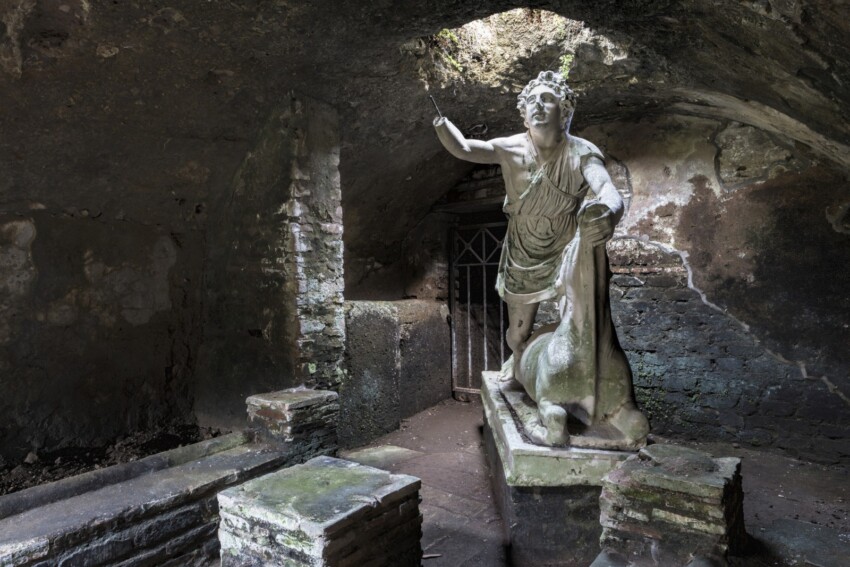
Some of the artefacts discovered within the Ostia Antica archaeological park are housed in the Ostiense Museum, created in 1865 by archaeologist Pietro Ercole Visconti and expanded several times in subsequent years.
The museum tour is spread across 12 rooms, of which the first two (history of excavations) and the last (paintings) are closed to the public. Of the remaining nine rooms, it’s worth visiting the most significant pieces, such as the statue of Mithras Tauroctone, the relief depicting stories of Athena and Hephaestus dating from the 3rd century AD, the Minerva in room six and the beautiful funerary portrait of Giulia Procula, discovered at the Necropolis of Porto on Isola Sacra.
Particularly notable is the Sarcophagus of the Muses, displayed in room 11, recently acquired by the museum following a seizure by the Financial Police.
Tickets for Ostia Antica park can be purchased at the on-site ticket office by paying in cash or by card, or online to avoid queuing at the entrances.
Tickets are available at full price or reduced rate for young people aged 18 to 25. Admission is free for those under 18 years of age, for disabled visitors and one accompanying person, for EU-licensed tour guides, for Ministry of Culture personnel, for tourist interpreters and for various university course members.
Should there be exhibitions or events at Ostia Antica, the ticket price may increase.
Basically, the ticket allows access to the excavation area, but you can also purchase one of several combined ticket types, which allow visits to two or more sites. These are:
Additionally, three loyalty cards are available: for the entire park, for the Ostia excavations or for the imperial ports of Claudius and Trajan. Upon purchase, these allow the holder unlimited access to the relevant sections of the park for 365 consecutive days from the date of purchase.
The Ostia Antica archaeological park can be easily explored independently. However, there’s nothing preventing you from contacting a tour guide for a private or group tour. By choosing online in advance, you can find a tour that suits your pace and interests.
Furthermore, Ostia Antica Park is one of the attractions included in the Roma Pass, the tourist card dedicated to Rome’s main monuments. With this card, you can enter Ostia Antica park for free.
Ostia Antica, its excavations and associated monuments are open to visitors every day from Tuesday to Sunday, with the exception of Christmas Day. Opening time is 08:30, whilst closing time varies depending on the time of year, according to the following schedule:
For public holidays falling on a Monday, Tuesday will be observed as the weekly closing day.
From the time of last admission, you will have one hour before the site closes.
The Ostia Antica archaeological site is accessed via the entrance located at Viale dei Romagnoli 717. You can reach it from Rome either by car or public transport.
By car, head south-west from central Rome onto the SP8 provincial road in the Ostiense/EUR area towards your destination. In optimal traffic conditions, the journey takes around 30 minutes, though during rush hour you can easily expect this to double.
If you prefer public transport, you can take the train from Termini Station towards Fiumicino Airport, then continue on city buses, or alternatively use a combination of metro and bus – though this option will take considerably longer.
City Card allow you to save on public transport and / or on the entrances to the main tourist attractions.



 Hotel
Hotel  Budget accommodations
  Apartments
  Family Hotel
  Luxury Hotel
  Resorts