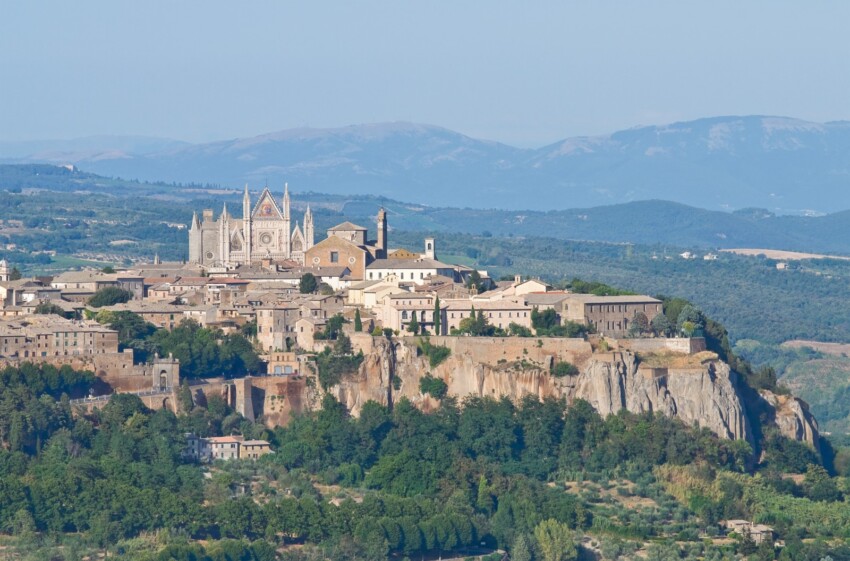
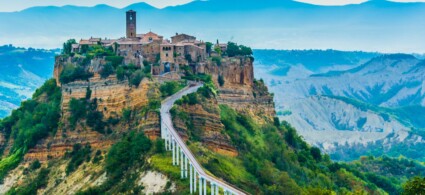
Orvieto is a charming town in Umbria, located in the province of Terni. Built atop a tufa cliff, it rises dramatically above the surrounding countryside and can be spotted from several kilometres away. The town’s defining symbols are its magnificent Gothic cathedral, dedicated to Santa Maria Assunta, and the Well of Saint Patrick, two unmissable attractions during a visit.
Orvieto is roughly 120 kilometres from Rome; not particularly close, but a day trip is highly recommended, both for the town’s beauty and because it lies just a few kilometres from another fascinating attraction in the surroundings of Rome: Lake Bolsena.
During your stay in Rome, you can enjoy a real holiday within a holiday, exploring northern Lazio and venturing into Umbria – where Orvieto is located. You’ll discover stunning views, charming villages, excellent food and genuine hospitality.
Things to do in Orvieto
Despite its modest size, Orvieto is truly packed with things to see. Here are the absolute must-sees to make the most of your time in this splendid Umbrian town.
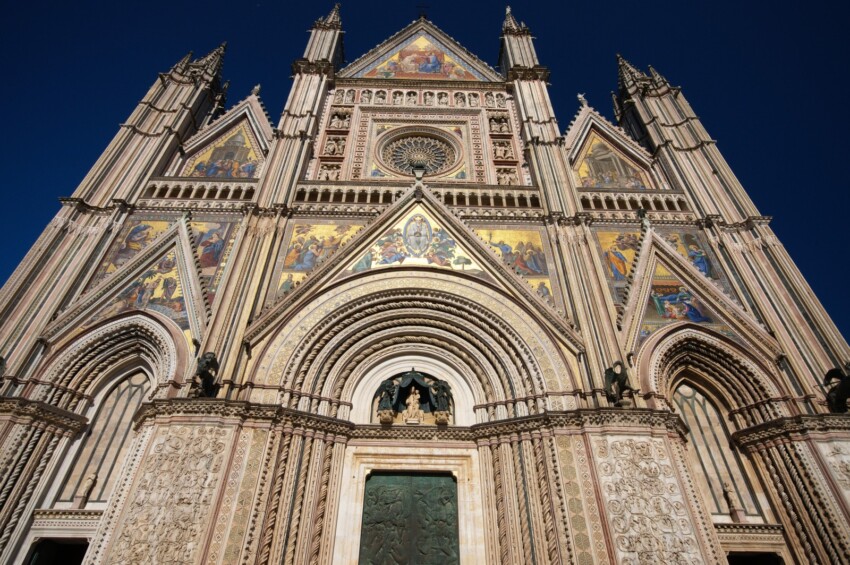
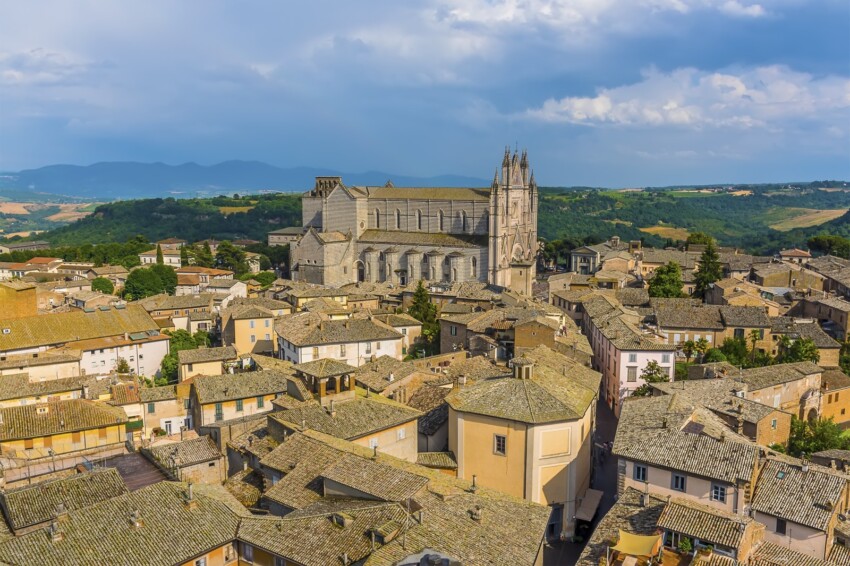
The Cathedral of Santa Maria Assunta is Orvieto’s cathedral. Located in the heart of the historic centre, it is the town’s most imposing and important building. Declared a national monument by the Italian State, construction began in 1290, though it wasn’t completed until 300 years later.
Its magnificent facade is undoubtedly the most iconic and impressive part: over 20 artists worked on it over the centuries, yet it remains balanced and uniform in style. The central rose window, a work by Orcagna, and its mosaics are particularly striking, creating a vibrant and colourful effect.
The cathedral’s interior features a beautiful wooden ceiling and is divided into six bays. There are numerous sacred artworks on display, including a fresco by Gentile da Fabriano depicting the Madonna and Child, and a Pietà by Ippolito Scalza that recalls Michelangelo’s famous work.
However, the real treasures lie within the lateral chapels, which are truly magnificent: foremost among them is the Chapel of San Brizio, or Cappella Nova, located in the right transept. It is renowned for housing the stunning fresco cycle depicting the Last Days of Humanity, created by Blessed Angelico, Benozzo Gozzoli and Luca Signorelli.
Another chapel worth visiting is the Chapel of the Corporal, built to house the sacred relic for which the cathedral was constructed: the bloodstained linen from the Miracle of Bolsena in 1263, when the Eucharist began to bleed during Mass.
The Orvieto Cathedral is open daily throughout the year according to the following hours:
November to February: 9.30am–5.00pm
March and October: 9.30am–6.00pm
April to September: 9.30am–7.00pm
Sundays and public holidays: 1.00pm–4.30pm (November to February), 1.00pm–5.30pm (March to October)
The last admission is 30 minutes before closing time. Please note that opening hours may vary for religious services.
To visit Orvieto Cathedral, you need to purchase an admission ticket, unless you are a resident within the Orvieto-Todi diocese. It is a combined ticket that covers the entire Cathedral Works museum system: the Cathedral, the Cathedral Works museum, the Papal palaces and the Emilio Greco museum.
The Orvieto Cathedral Works Museum, also known by its acronym MODO, is an essential stop for lovers of sacred art.
Admission to MODO is managed through a combined ticket that grants access to the entire Cathedral Works museum system of Orvieto, which includes the Cathedral, the Emilio Greco Museum and the Papal Palaces complex.
For this reason, the visit follows a set route, though you can explore freely: it winds through the Cathedral Works collections, displayed across three different locations: Palazzo Soliano, the Papal Palaces and the Church of Sant’Agostino, located on the other side of Orvieto.
However, Palazzo Soliano is the hub of the Cathedral Works Museum: it is home to the visitor centre, ticket office and educational services. Palazzo Soliano is located in Piazza Duomo, as are the Papal Palaces. The Church of Sant’Agostino, the museum’s third venue, is situated in Piazza San Giovenale; as a separate location, it typically hosts temporary exhibitions.
The museum is run by the Cathedral Works of Orvieto, also known as the Fabbriceria, an autonomous body responsible for maintaining and preserving the Cathedral and its treasures. It was established in the 13th century under Bishop Francesco Monaldeschi.
Papal Palaces
Right next to Orvieto Cathedral stand the Papal Palaces, also accessible with the Cathedral Works Museum combined ticket. In medieval times, they sat adjacent to the Cathedral and hosted popes elected in the second half of the 13th century: Urban IV, Gregory X and Martin IV.
Inside the Papal Palaces, the visit is laid out across two floors: on the ground floor is the splendid fresco gallery, featuring a series of wall paintings from the 14th–15th centuries attributed to Orvieto’s “great workshop”, while on the first floor, six rooms display numerous sculptures, paintings and artefacts arranged chronologically, spanning from the 13th century to the early 17th century.
Orvieto’s Papal Palaces are open according to the following schedule:
November to February: 10.00am to 4.00pm, closed Tuesdays
April to September: 9.30am to 7.00pm
October and March: 10.00am to 5.30pm, closed Tuesdays
Please note: the Papal Palaces, the Cathedral and the San Brizio Chapel have different opening hours, so if you wish to see the entire museum circuit, bear this in mind.
Without venturing far from the Cathedral, in Piazza Duomo you’ll also find the fascinating National Archaeological Museum of Orvieto; housed within a wing of the Papal Palaces, it is managed by the Ministry of Cultural Heritage and Activities through Umbria’s Museum Authority.
It preserves artefacts from the archaeological sites surrounding Orvieto, with the large Etruscan necropolis being particularly significant. Two of the museum’s rooms feature reconstructed frescoes from the tombs of the Settecamini necropolis, while finds such as pottery, bronzes and jewellery come from the two necropolises of the Crocifisso del Tufo and Cannicella, also located near the Orvieto cliff. The funerary assemblages on display are particularly impressive, rich with imported and locally-made objects.
The National Archaeological Museum of Orvieto is open Tuesday to Sunday from 8.30am to 7.30pm, with last admission at 7.00pm. Tickets are purchased on site; entry is free for children and young people under 18.
Beneath Orvieto runs an extensive underground network of tunnels, cavities and work chambers. The discovery was made in the 1970s when a group of speleologists found an access point, which has since revealed over 1,200 cavities – almost 50 years later.
The Orvieto Underground was used by the Etruscan civilisation, as well as during the Middle Ages and Renaissance; it served as a water management system (with wells, cisterns and silos) but also for tufa extraction and cellars – a function that fell away in modern times with advancing technology. Excavations continue today, managed by the Umbria Region and the Ministry of Cultural Heritage.
The visitable section of Orvieto’s underground is called Orvieto Underground, and through a guided tour lasting about an hour, you’ll discover the city’s subsoil and its hidden treasures. The route is accessible and suitable for all; tours run daily (except Christmas Day) at 11.00am, 12.15pm, 4.00pm and 5.15pm. During the summer season and peak times, booking at least a day in advance is advisable.
Tickets are purchased on site; discounts are available for students, seniors and groups of more than 20 people. If you wish, it’s possible to reserve part of the route to celebrate a civil wedding ceremony, in a unique and atmospheric setting.
The ticket office and access to the underground is from Piazza Duomo 23.
Among the most remarkable things to see in Orvieto is undoubtedly the Well of Saint Patrick, constructed during the first half of the 16th century on the orders of Pope Clement VII. Having fled to Orvieto after the Sack of Rome, the Pope was keen to ensure protection in case the city came under siege.
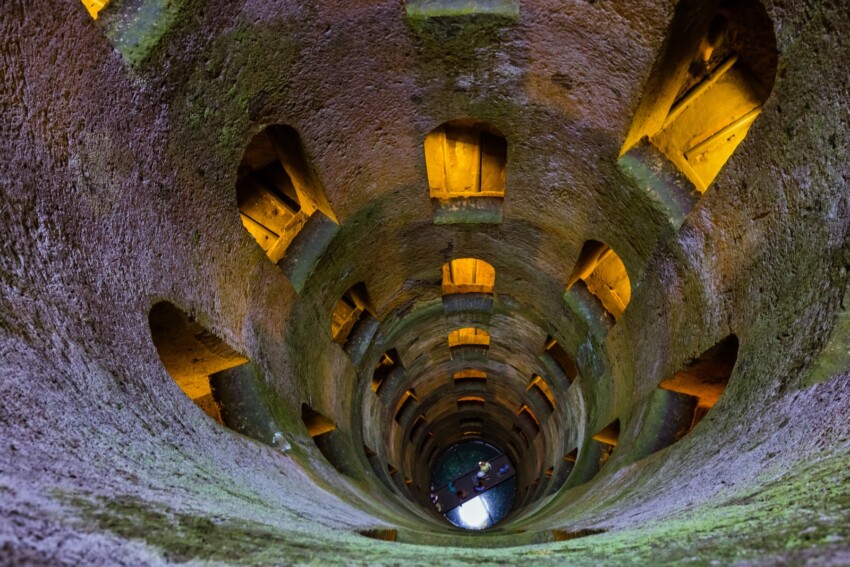
For precisely this reason, the Well of Saint Patrick was designed to supply water to the city in the event of disaster or siege. Access is via two helical ramps running one-way, completely separate from each other, so that water could be transported by mules without interference.
The well, 54 metres deep, was carved from tufa and has a cylindrical shape with a circular base 13 metres in diameter. To reach the bottom requires descending 248 steps; here the water level remains constant thanks to a natural spring.
Near the Well of Saint Patrick, don’t miss the Temple of Belvedere, the only Etruscan temple still visible above Orvieto’s cliff. Discovered by chance in 1828, it dates from the early 5th century BC and was in use until the 3rd century BC. The base, entrance staircase and the foundations of four columns are still clearly visible; however, it is unknown which deity was venerated inside the temple.
The Well of Saint Patrick is open daily according to the following schedule:
January, February, November and December: 10.00am to 4.45pm
March, April, September and October: 9.00am to 6.45pm
May, June, July and August: 9.00am to 7.45pm
Tickets can be purchased on site or online; entry is free for children under 6, disabled visitors and one companion, and working tour guides. Purchasing tickets online also serves as a booking, which is recommended but not mandatory. Dogs are also permitted, provided they are small and transported in bags or carriers.
The Well of the Quarry, now open to visitors, is an impressive hydraulic structure dating from the Etruscan period (6th–5th century BC), built to guarantee a supply of drinking water to the population in case of siege or water shortage.
It was Pope Clement VII, fleeing the Sack of Rome in 1527, who ordered the upgrading of the existing Etruscan structure to enable water from the spring to be accessed from above in case of future city sieges; the work was completed in 1530.
It is approximately 36 metres deep and cylindrical in shape; carved from the tufa rock on which Orvieto stands, it features a series of niches in the wall that served as footholds for people descending or ascending the well.
For a moment of peace and relaxation in Orvieto, head to the Albornoz Rocca, or Albornoz Fortress, the remains of a 14th-century military structure marking the entrance to the town’s public gardens. The setting is lovely, with the ruins – including the impressive tower and part of the fortified walls – set against the green parkland, offering beautiful views over the valley below where the Paglia River flows.
Inside Albornoz Rocca are displayed several bronze works by American sculptor Jack Zajac, along with the birthplace of journalist Luigi Barzini, born in Orvieto in 1874 and one of the most celebrated writers and journalists of the early 20th century.
Map
In the following map you can see the location of the main places of interest mentioned in this article.
Visiting the city with the Orvieto City Pass
By purchasing the Orvieto City Pass, you’ll have the opportunity to visit the city’s main monuments and attractions whilst saving on entrance fees. The included attractions are:
Orvieto Cathedral with the Chapel of San Brizio
Opera Museum of the Cathedral
Moro Tower
Well of the Cave
Faina Museum
Necropolis of the Crucifix of the Tufo
National Archaeological Museum
Underground Orvieto
Well of Saint Patrick
With the Orvieto City Pass you’ll also enjoy guaranteed access and priority entry without queues to the attractions listed above. The city card is always valid and never expires!
If you’re planning a holiday in Orvieto, we recommend staying in the historic centre, so you can reach the town’s main attractions on foot, such as the Cathedral, the Well of Saint Patrick and the papal palaces. The centre is quite extensive, and being a popular tourist destination, it’s literally filled with accommodation options. Unlike many medieval Umbrian villages, Orvieto also has plenty of hotels, nearly all three and four-star establishments, perfect if you’re after all the comforts. Alternatively, most of the accommodation consists of bed and breakfasts, apartments and guest houses, ideal if you want to spend a bit less and have complete independence during your stay.
If you prefer greater convenience, easy parking, proximity to transport links and access to services, don’t hesitate to stay in Orvieto Scalo, the area where the railway station is located. It’s still simple to reach the centre thanks to the funicular railway, and you’ll find several hotels here, mostly three-star establishments. In the immediate surroundings you’ll also find several farmhouses, where you can spend nights of absolute relaxation immersed in the Umbrian countryside, surrounded by nature and beautiful views.
We offer best rates If you find it cheaper we refund the price difference.
Free cancellation Most properties allow cancellation without penalty.
We're available 24 hours a day For any problem call Booking.com.
Rome and Orvieto are approximately 120 kilometres apart. The distance can be covered by car or by public transport.
Travelling in your own car, simply head north out of Rome along Via Salaria, join the Grande Raccordo Anulare at Settebagni and then follow the Roma Nord branch until you enter motorway A1. From here you continue to the Orvieto exit, located in the Orvieto Scalo area, just a few kilometres from the historic centre. This journey takes approximately an hour and a half, though you should factor in traffic leaving Rome, which can extend this to two hours or more.
Alternatively, you can reach Orvieto by train, using regional or regional express trains departing from Tiburtina station. The journey takes less than two hours in total; Orvieto station is also located in the Orvieto Scalo area, in Piazza Matteotti.
To travel from Orvieto Scalo up to Orvieto’s centre, you can use the funicular railway, a convenient and charming option that departs directly opposite the railway station and takes you straight to the centre, on the eastern side of the ridge, near the Well of Saint Patrick. It’s also worth considering if you arrive by car, as you can leave your vehicle in the convenient car park and avoid wasting time searching for a spot near the historic centre, which is entirely pedestrianised. If you prefer not to take the funicular and are travelling by car, there are several paid car parks of varying sizes at the edges of the centre, but be aware that during peak season they’re often full.
Orvieto Weather
What's the weather at Orvieto? Below are the temperatures and the weather forecast at Orvieto for the next few days.
 Hotel
Hotel  Budget accommodations
  Apartments
  Family Hotel
  Luxury Hotel
  Resorts