Bestseller
From Rome: Villa D'Este and Hadrian's Villa Tivoli Day Tour
From 65,00 €
Buy the ticket
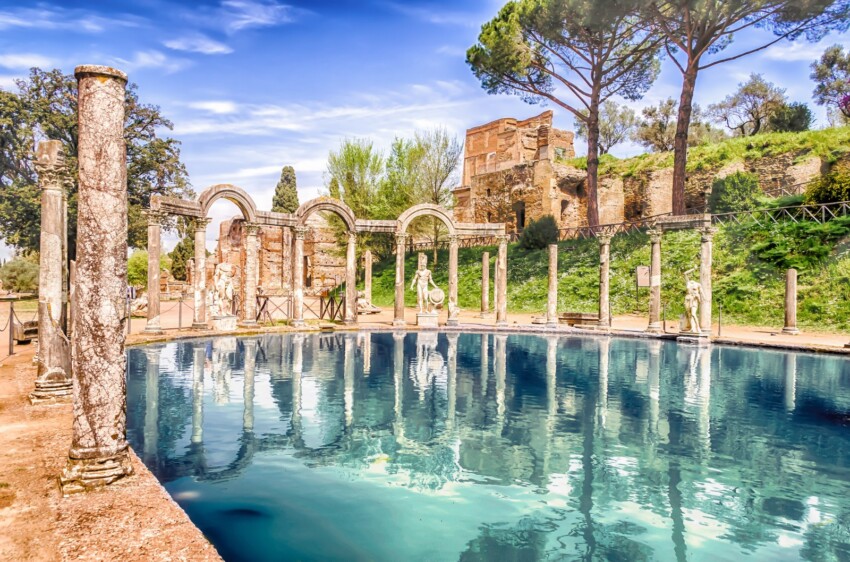
Among the imperial residences of ancient Rome’s emperors, Hadrian’s Villa in Tivoli is certainly one of the most important, both in terms of its construction in antiquity and today as an archaeological site capable of attracting millions of tourists from across Italy and beyond.
The villa’s remains spread across an area of 120 hectares, of which approximately 40 hectares are currently accessible to visitors; this magnificent palace was commissioned by Emperor Hadrian starting in 117 AD, the year he came to power. It is located in the Villa Adriana area, just a few kilometres from Tivoli, the ancient Tibur, approximately 30 kilometres from Rome.
Declared a UNESCO World Heritage Site in 1999, Hadrian’s Villa represents the perfect day trip from Rome: visiting it, you’ll have the opportunity to imagine the life of an emperor during periods he spent away from the city, as if in a holiday residence, surrounded by splendour and luxury.
The entire Hadrian’s Villa archaeological site is very vast, and visiting every detail could easily take up an entire day. Here are the key areas not to miss for at least a comprehensive overview.
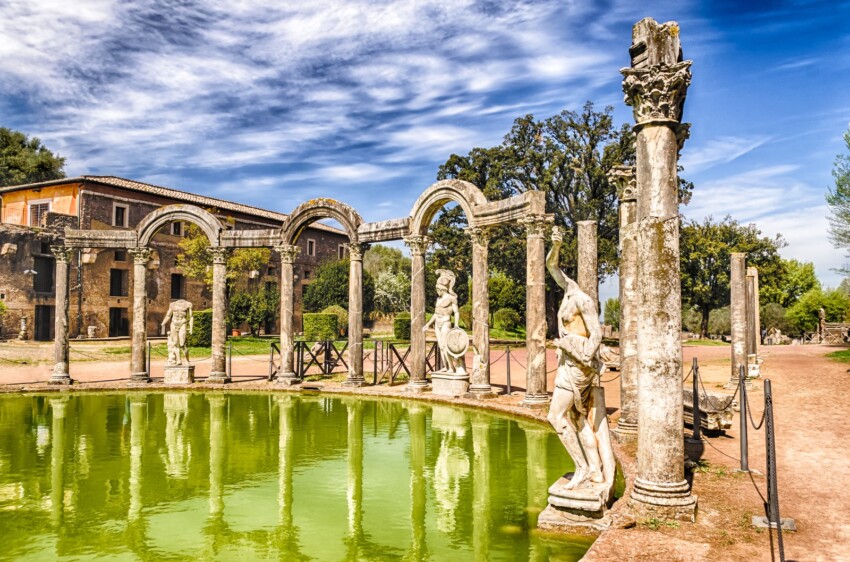
The Canopus area takes its name from an ancient Egyptian city on the Nile Delta. Thus, Hadrian’s Villa’s Canopus was created precisely to celebrate Emperor Hadrian’s journey to Egypt, from which he returned with materials and statues.
It is essentially a large canal-pool approximately 120 metres long and just under 20 metres wide, which in antiquity was surrounded by an impressive colonnade adorned with statues in Greek and Roman style. At the end of the basin is the triclinium, the villa’s dining area. Banquets were held here, so that whilst diners enjoyed the pleasures of the table, they could also appreciate the water features and fountains.
The enormous Piazza d’Oro is surrounded by gardens. Rectangular in layout, it is bordered by two buildings on the north and south sides, whilst the entire complex is lined with columns made of marble and Egyptian granite. Behind the portico on the north side lies the Casa Colonica, built before the Piazza, a series of modest rooms where the servants lived.
Within Hadrian’s Villa, the original nucleus is represented by the Maritime Theatre (the name was given to it only later), which served as Hadrian’s temporary residence whilst the rest of the villa was being constructed; subsequently, this area became the private section of the palace.
It has an original shape reminiscent of a theatre, single-storey, with a circular vaulted portico overlooking a canal with a small island of approximately 45 metres in diameter at its centre, accessible only by moveable bridges.
Hadrian’s Villa is equipped not with one, but two bath complexes, known as the large and small baths because of their size difference. Historians have concluded that the small baths, richly decorated, were intended for important guests and the imperial family, whilst the large baths were for the villa’s staff.
The large baths were far more elaborate: they included, for example, the “sudatio” hall, circular in shape with a domed ceiling, and two areas for hot baths, whilst in the centre stood the frigidarium, the cold-water bathing area.
Antinous was a young Greek man, the lover of Hadrian, who died prematurely during their journey together to Egypt when he was not yet twenty years old. Following his premature death under mysterious circumstances, the emperor deified him, and within his villa created a place of worship specifically designed for him. This is the Antinoeion, a complex consisting of the remains of two temples, positioned within a sacred enclosure. It was here that several statues of Egyptian deities and priests were also brought to light, confirming this was a place of worship.
Within the villa there is also a modern building, constructed in the 1950s, called the Model Building. It houses the Hadrian’s Villa model, a reconstructive model created by architect Italo Gismondi during the last century, after a series of excavations brought numerous rooms and important finds to light.
The model is made of plaster, with metal and natural fibre frameworks, composed of numerous sections placed side by side. Highly detailed, it allows visitors to understand the different levels at which the villa’s various buildings are situated.
The Hadrian’s Villa model represents the first stop on the visit route, making it a perfect introduction to what visitors can expect during their time at the site.
The attractions of Hadrian’s Villa don’t end there. During your guided tour, you’ll visit, for example, the Poecile, the large portico where there was a garden with a basin, the Hall of the Philosophers, with 7 niches that housed 7 statues of ancient Greek sages, the Greek and Latin libraries, which overlook the garden and are connected by a portico, and the imperial palace proper, the core of Hadrian’s ancient residence and his family home.
The visit to Hadrian’s Villa concludes with the museum, which displays a range of artefacts discovered within the archaeological area during excavations conducted since the 1950s. There are also replicas of 4 caryatids from the Erechtheion in Athens, originally positioned in the Canopus area.
Admission tickets to Hadrian’s Villa can be purchased directly at the ticket office or in advance online. The ticket office is located at Largo Marguerite Yourcenar 1, in the Villa Adriana district.
In addition to the standard full ticket, discounts are available for young people between 18 and 25 years old, for residents of Tivoli and neighbouring municipalities, and for those eligible for the Trenitalia agreement.
Admission is free for those under 18 years old, for teachers, for tour guides and interpreters, for students of architecture, cultural heritage or with an archaeological or art history focus, for disabled visitors and one accompanying person, for journalists and for a number of other categories. Additionally, on the first Sunday of the month, admission to Hadrian’s Villa is free for everyone.
When there are exhibitions or special events at the site, prices increase slightly.
There is also the option to purchase a combined ticket allowing entry to three of Tivoli’s main attractions: Hadrian’s Villa, Villa d’Este and the Sanctuary of Hercules the Conqueror. This special ticket is called the Villae Pass and includes one entry to each site, access to current exhibitions and discounts on guided tours and audio guides. The Villae Pass is valid for 3 days and is activated upon entry to the first site.
Admission to Hadrian’s Villa includes independent exploration of the site. However, there’s nothing stopping you from organising a private or group tour, by engaging an expert tour guide.
Among the various options, you can book the official guided tour, which allows you to discover the vast park of over 80 hectares, crossing the Maritime Theatre to reach the Canopus. The dates of the official Hadrian’s Villa tour are announced directly on the website; the meeting point is the site entrance at Largo Marguerite Yourcenar.
You can also find and book numerous tours online; remember to book your visit in advance to avoid finding there’s no availability on your chosen day.
Moreover, numerous guided day trips to Tivoli depart from Rome; the Hadrian’s Villa complex is an essential stop during a day trip to explore the area, and it’s common to find options in the city that, in addition to Hadrian’s Villa, allow you to visit Villa d’Este or the Sanctuary of Hercules the Conqueror.
Hadrian’s Villa is open every day of the year except for Christmas and New Year’s Day, with hours varying by season. Specifically:
The last entry is one and a half hours before closing time. There are also special opening times during winter public holidays and on the first Sundays of the month, when entry to Hadrian’s Villa is free.
Be aware that the route through the archaeological area involves walking on uneven paths with changes in elevation, and is therefore not recommended for those with mobility difficulties. Comfortable shoes are advised.
A visit to the entire site takes approximately two hours, which can easily extend to three or more hours if you stop to examine everything in detail.
Large rucksacks and bulky bags, as well as suitcases and trolleys, are not permitted inside Hadrian’s Villa.
Hadrian’s Villa is easily reached from Rome via the A24 motorway, exiting at the Tivoli toll booth. From the exit, take the Strada Maremmana Inferiore to the Villa Adriana district. From there, simply follow the road signs to your destination. A convenient paid car park is located in front of the villa entrance.
You can also reach Hadrian’s Villa by public transport. In particular, take the Co.Tra.L bus departing from Ponte Mammolo, which is accessible by Metro Line B. The bus stops approximately 300 metres from the villa entrance. Alternatively, you can take the Co.Tra.L bus from Rome to Tivoli, getting off at the Tivoli Villa Adriana district stop, from which the villa entrance is approximately 2 kilometres away.
Finally, for those arriving in Tivoli by train, the local bus CAT 4 or CAT 4X departs from the railway station and stops right in front of the site entrance.
City Card allow you to save on public transport and / or on the entrances to the main tourist attractions.


 Hotel
Hotel  Budget accommodations
  Apartments
  Family Hotel
  Luxury Hotel
  Resorts