Civita di Bagnoregio: 3-Hour Private Walking Tour
7 reviews
Buy now
From 235,00€ per person
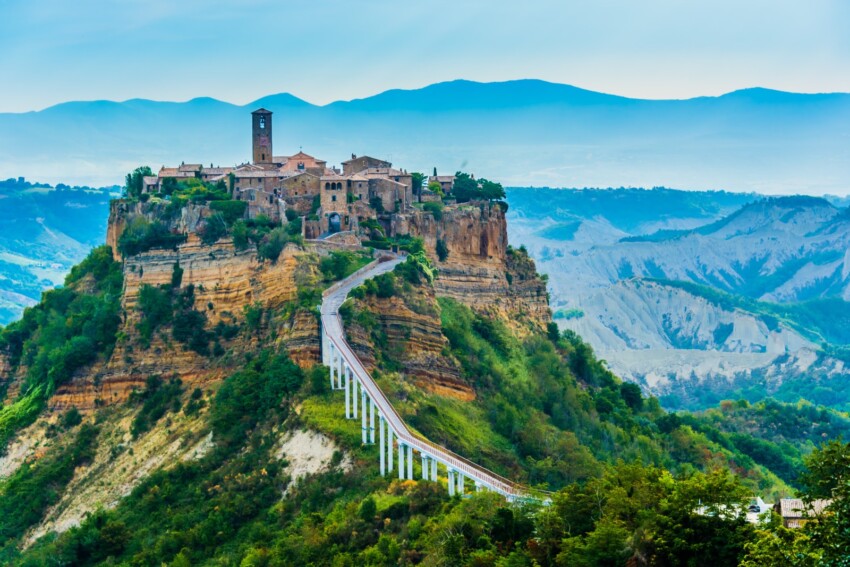
One of the most evocative day trips you can take from Rome is a visit to Civita di Bagnoregio, “the dying city”. This ancient village in Viterbo province lies roughly two hours’ drive from the capital, but the destination is well worth the journey: upon arrival, you’ll discover a settlement perched on a tufa ridge, accessible only via a pedestrian footbridge and set within truly marvellous natural surroundings that, whilst distinctly different, recall the Mont Saint-Michel abbey in northern France.
Civita di Bagnoregio is part of the association of Italy’s most beautiful villages, and although it’s home to fewer than 20 permanent residents, it’s a tourist destination that, particularly in recent years, has been gaining increasing recognition and appeal.
Its history is inextricably linked to tufa, the material upon which it stands: the hillside suffers from progressive erosion caused by streams and weather. This problem was well known even in Etruscan times, when they founded it over 2,500 years ago; both they and the Romans implemented various measures, including the construction of drainage channels and river embankments. However, these fell into neglect in subsequent centuries, and the landscape deteriorated to the point of the city’s abandonment.
It was precisely for this reason that writer Bonaventura Tecchi, who was born in Bagnoregio (the municipality of which Civita is a hamlet), dubbed it “the dying city”, a nickname that has stuck to the present day, though in reality it’s anything but dead – in fact, it has been reborn. Thanks to tourism, the village now boasts several bed and breakfasts and some restaurants, as well as museums and monuments that represent the main reasons to visit.
Finally, remember that near Civita di Bagnoregio you’ll find other interesting attractions in the Rome area, including Orvieto and Lake Bolsena.
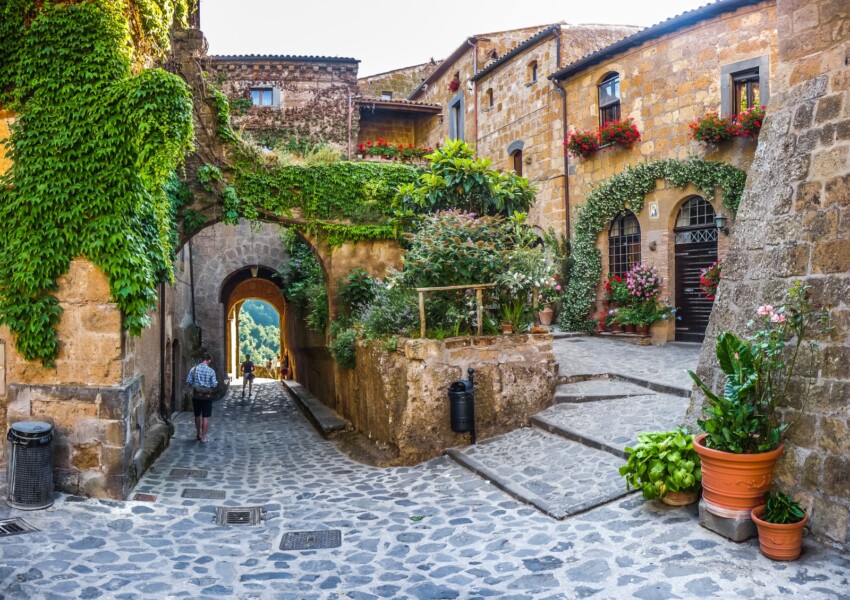
As the crow flies, Civita di Bagnoregio stretches less than 300 metres, making it a tiny village, yet it’s packed with plenty to see. Here are the most important sights – though we should stress that to truly savour Civita, you should simply wander aimlessly through the (few) narrow streets, pausing to admire the panoramas and vistas that unfold at every turn.
The Santa Maria gate marks the entrance to Civita di Bagnoregio. Located at the end of the footbridge, it’s an unavoidable stop for visitors.
Above the Santa Maria gate you can see sculptures of two lions holding a human head between their paws. This allegory commemorates a popular uprising by Civita’s inhabitants against the Monaldeschi, a powerful Orvietano family that ruled the town.
The Santa Maria gate is also known as Porta Cava because, before being adapted in the medieval period, it was constructed by quarrying into tufa during the Etruscan age.
To learn more about Civita di Bagnoregio’s history and its close connection with the surrounding landscape, visit the Geological and Landslide Museum. Located in Piazza San Donato, the village’s main square, it’s housed in the Palazzo Alemanni-Mazzocchi, built during the Renaissance at the behest of notary Ser Francesco Alemanni.
The museum’s layout spans four rooms:
Additionally, for enthusiasts, the museum organises guided tours, excursions, educational activities and geo-tastings of local wines.
The Geological and Landslide Museum is open from 1 June to 31 August, Tuesday to Sunday, from 9.30am to 1.30pm and from 2pm to 6.30pm. From 1 September to 31 May, it operates on reduced hours, Friday to Sunday, from 10am to 1.30pm and from 2pm to 5.30pm. Monday to Thursday it remains open for guided visits scheduled for a minimum of 15 people. Extraordinary openings are planned for 6 January, Easter Monday, 25 April, 1 May and 26 December. It remains closed on 24, 25 and 31 December and 1 January.
For further information, you can contact the email address info@museogeologicoedellefrane.it or call (+39)-3286657205.
Saint Bonaventure is Civita di Bagnoregio’s most illustrious figure. He was a bishop and minister of the Franciscan order, and is considered one of the most important biographers of Saint Francis of Assisi.
The house where he spent his youth, identifiable today by an iron effigy, sits at the southern edge of the village, overlooking the tufa ridge from which you can admire a beautiful landscape. In fact, it’s the landscape that’s the main draw of the house, as today only a staircase leading to an inaccessible underground chamber remains.
Part of the house was converted into a church in 1524, though there’s little information about it. The building was damaged many times throughout its history, especially by earthquakes in 1695 and 1764. It was definitively abandoned in 1826 following continuous landslides on the ridge.
At the north-eastern edge of Civita di Bagnoregio, as if concluding the village, lies the beautiful Poet’s Garden, which according to legend takes its name from a local who took possession of it and turned it into his own vegetable plot, also using it as inspiration for his poetry.
To access the garden, you must leave a donation, or purchase a product from the shop at the exit, such as honey, jams or legumes. The Poet’s Garden is beautifully maintained and offers a wonderful view, with a panorama that sweeps across the entire surrounding valley and the calanchi.
The Antica Civitas Museum is a magnificent museum of arts and crafts housed in an Etruscan-era cave, which allows you to discover the history of ancient Civita di Bagnoregio in Etruscan and Roman times. You can admire underground galleries, rooms that were once used as an oil mill and later as a warehouse, along with all the tools used for various crafts.
The museum spans various levels, all carved into tufa rock, and displays the various environments of daily life in antiquity, such as warming pans that were placed under blankets to warm the bed during cold winter nights. There’s also a small section dedicated to Pinocchio, as a Rai TV film about the famous Tuscan puppet was shot in Civita in 2009, directed by Alberto Sironi.
The main church of Civita di Bagnoregio is dedicated to San Donato. Situated in the piazza of the same name in the heart of the village, it’s also one of the largest buildings here. According to tradition, it dates back to the 5th century, though the façade is far more modern, having been restored during the Renaissance. The later period is especially evident when compared with the bell tower beside it, which is in a much more ancient style.
Inside the Church of San Donato are the remains of Saint Ildebrando, the city’s bishop in the 9th century; the rest of the furnishings are simple, but there are valuable pieces such as chandeliers, censers, a fresco from the school of Perugino and a wooden crucifix from the school of Donatello. Also noteworthy is the beautiful wooden coffered ceiling that covers part of the central nave.
Beneath Civita di Bagnoregio opens a splendid valley of enchanting landscapes, the Valle dei Calanchi. It’s made of sandy clay of marine origin, which is why the entire territory is at high risk of collapses, landslides and subsidence. Erosion is constant and ongoing, creating small vegetation-free valleys with steep slopes, separated from each other by thin ridges. Paradoxically, clays are more stable on steep slopes, which favours the development of calanchi and their persistence over time.
The area is very distinctive and evocative, and looks its best at sunset, when the white clay takes on pink hues. There are many vantage points at Civita – choose the one you prefer! The numerous ridges formed by the calanchi are among the most peculiar and extraordinary forms: some are undulating, others slender, with enormous towers and clay walls. It’s possible to go on hiking excursions to discover them up close, though some experience is needed.
Given the high number of tourist visits, Bagnoregio municipality has introduced an entrance ticket to visit Civita. You can purchase it before heading onto the footbridge, at the end of Via Bonaventura Tecchi, where you’ll also find toilets and an information point, or buy it in advance directly online.
Alternatively, you can visit Civita di Bagnoregio with an official guide who will accompany you, on foot or by bike, through the Lazio village.
Don’t be fooled by the nickname: the dying city is more alive than ever! In this tiny village, in fact, most of the original dwellings have been converted into holiday apartments, holiday homes, guest houses and charming residences. Many retain various medieval features in both architecture and furnishings, yet at the same time are equipped with all the comforts necessary for a pleasant stay.
If the idea of staying in Civita di Bagnoregio doesn’t appeal to you because it is – after all – a place somewhat removed from the world, you can choose other nearby locations, chief among them the municipal centre Bagnoregio, situated just a few kilometres away: a small village, but certainly far better supplied than Civita in terms of convenience, bars, restaurants, shops and services.
Finally, remember that in the surrounding area you’ll find numerous farmhouses, bed and breakfasts, relais and rural estates, ideal for adding a country chic touch to your holiday in the heart of Tuscia.
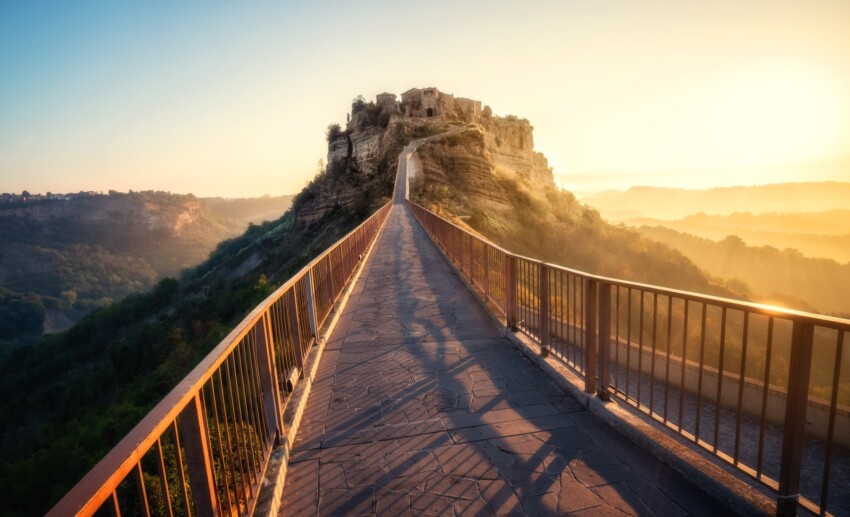
Civita di Bagnoregio is located in Viterbo province, roughly 125 kilometres north of Rome. It’s fairly easy to reach by car, but considerably more difficult using public transport.
By car, it takes less than two hours: simply leave Rome heading north on Via Salaria until Settebagni, then enter the A1 motorway, which you follow until the Orte exit. After exiting, follow the SS675 state road until you’re near Viterbo, then turn north onto the SP5 Teverina to reach your destination, passing the ancient Roman city of Ferento, the Infernaccio waterfall and the ghost village of Celleno – all potentially worthwhile stops, depending on how much time you have available.
Remember that Civita di Bagnoregio is entirely pedestrianised: even residents must leave their cars outside. They do, however, have a small reserved car park near the footbridge, whilst non-residents have access to the Ricci car park and the Agosti car park, both paid, around a kilometre’s walk from the village entrance, or there’s the option of parking on the road when possible.
If you want to attempt the challenge of visiting Civita di Bagnoregio by public transport from Rome, you have two options: you can take the train from Roma Tiburtina to Orvieto, or the train from Roma Aurelia or Roma San Pietro to Viterbo Porta Romana. Once you arrive, you need to take the intercity bus to Bagnoregio, whose stop is on Via Garibaldi. The final stretch, about 2 kilometres, you’ll need to complete on foot or by taxi. The entire journey will take roughly 3 hours, including waiting times for connections.
What's the weather at Civita di Bagnoregio? Below are the temperatures and the weather forecast at Civita di Bagnoregio for the next few days.
 Hotel
Hotel  Budget accommodations
  Apartments
  Family Hotel
  Luxury Hotel
  Resorts