Bestseller
Bomarzo: Sacred Woods Entry Ticket
From 19,00 €
Buy the ticket
Hidden among the hills of the Viterbo region in Tuscia, the Bomarzo Monster Park — also known as the Sacro Bosco — is one of Italy’s most extraordinary and mysterious locations. Commissioned around 1552 by prince Pier Francesco Orsini and designed by architect Pirro Ligorio, this monumental garden is home to over 30 colossal sculptures carved directly from the volcanic peperino stone that emerges from the ground. Giants locked in combat, mastodonic tortoises, dragons, ogres with gaping mouths: figures that defy every iconographic logic and escape any definitive interpretation.
The park is located in the town of Bomarzo, in the province of Viterbo, approximately 80 km north of Rome and 15 km from Viterbo. It’s reachable by car in less than an hour from the capital, making it one of the most fascinating excursions in the Rome area. The visit takes around two hours and takes place outdoors, along a path immersed in the woodland.
In this article you’ll find everything you need to plan your visit: the most important sculptures, the park’s history, tickets, opening hours, how to get there and answers to frequently asked questions.
Sacro Bosco di Bomarzo is not visited like a traditional museum: there is no mandatory route or imposed narrative sequence. The sculptures emerge among the trees in an almost random way, creating a continuous sense of discovery that makes every visit unique. Here are the main works you cannot miss.
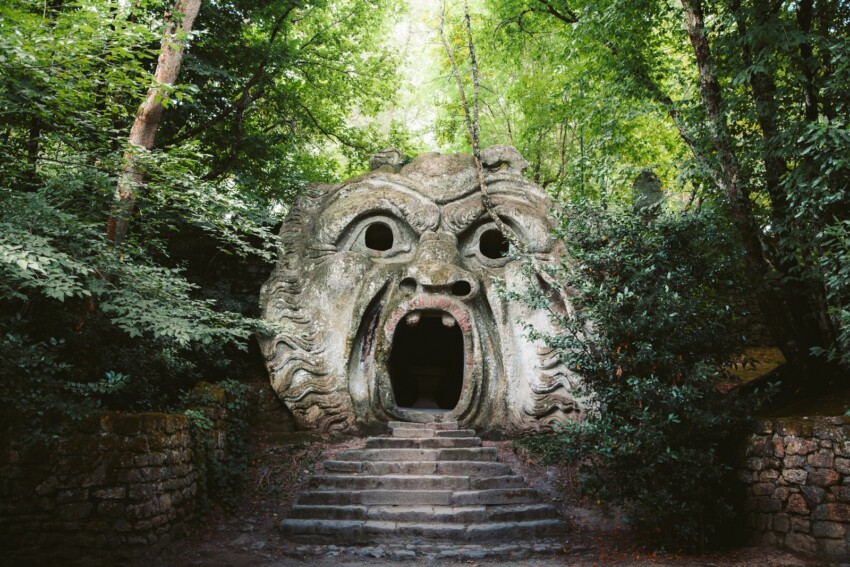
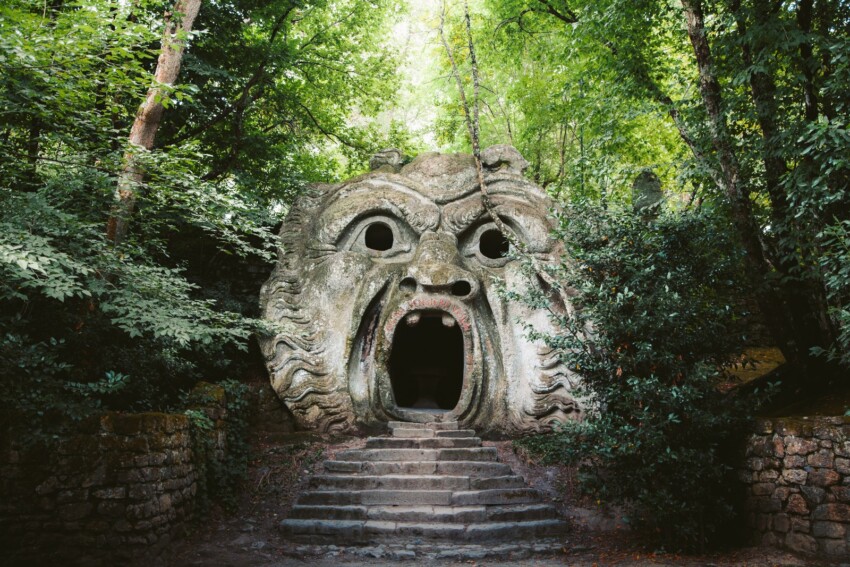
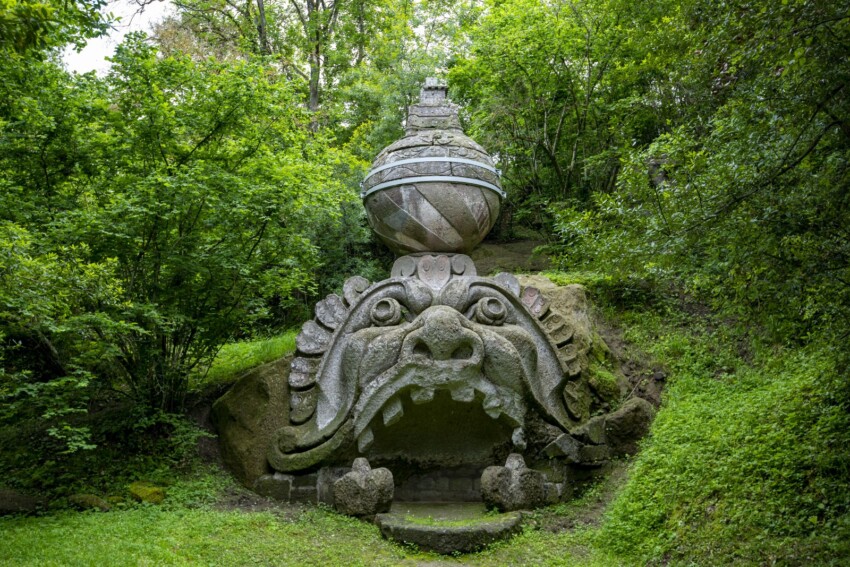
Without doubt, this is the park’s most iconic image. The Mouth of the Ogre — or Ogre Mask — is a monstrous head carved directly into the peperino, with its mouth wide open in a silent scream. Inside the mouth you can actually enter: the space is large enough to hold several people, and on the inner walls is inscribed the Latin phrase “Every thought takes flight”, which adds to the surreal and unsettling atmosphere of the place.
The face is that of Hades, god of the underworld in Greek mythology, according to the most widely accepted interpretation. The technique used is that of sculpture in exposed rock: the sculptors worked directly on the volcanic material of the ground without transporting separate blocks. This explains the imposing dimensions of many works. The Mouth of the Ogre is the park’s signature photographic subject: the morning light, when there are still few visitors, is the ideal time to capture it without crowds.
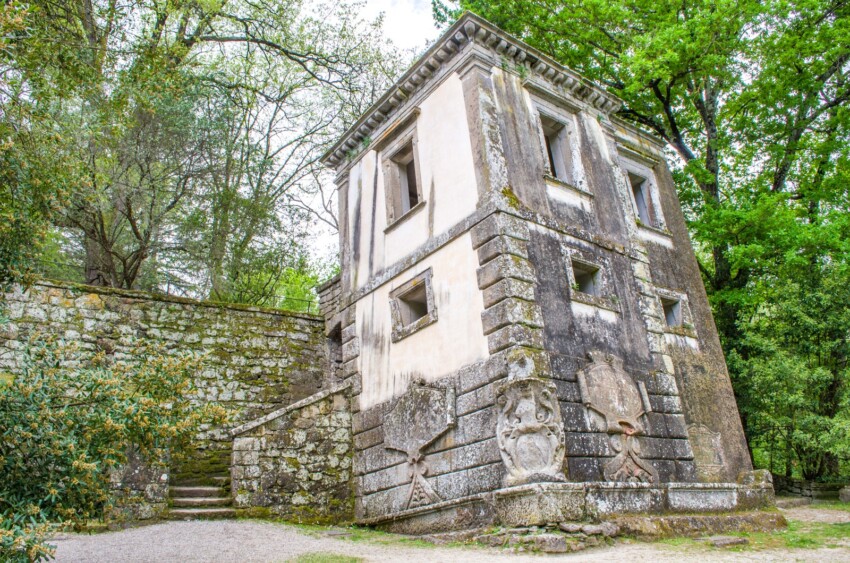
One of the most disconcerting architectural elements of Sacro Bosco is the Crooked House, a small building deliberately constructed at an angle to the horizontal plane. Entering it immediately creates a sense of disorientation: floors and ceilings follow a slope that defies balance and provokes a physical sensation of instability.
This is an intentional optical and architectural game, in line with the playful and provocative spirit of the entire garden. The building is perfectly solid, but its deliberately asymmetrical construction produces sensory effects that are difficult to explain rationally. It’s worth spending a few minutes inside to experience the strange sensation. From outside, the tilt is barely perceptible; only on entering do you fully understand the design.
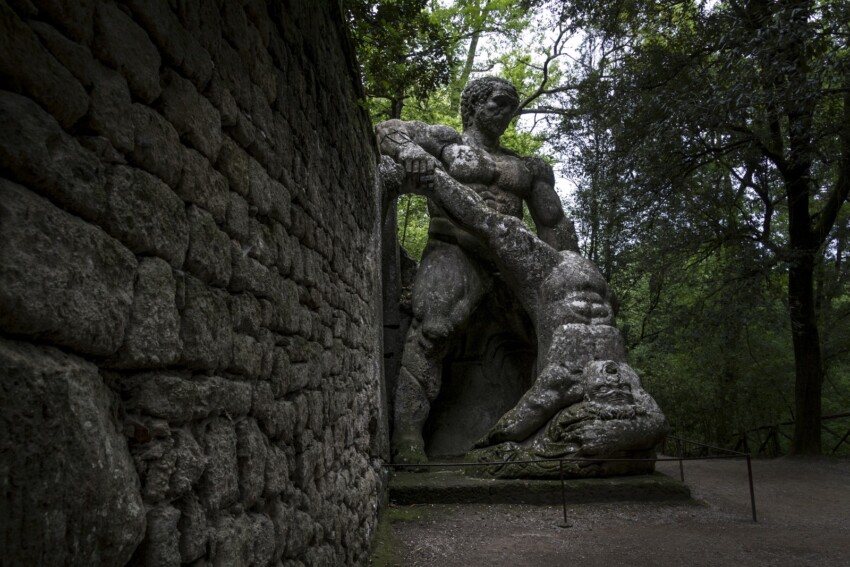
Among the park’s most impressive sculptures stands the Giant Tearing Apart, a depiction of two colossal figures locked in struggle: a warrior about to rip his opponent in two, seizing him by the legs with a gesture of brute and decisive force. The work is carved from a single block of peperino and reaches several metres in height, with a surprising level of anatomical detail for the volcanic stone-working technique.
The iconography recalls Hercules killing Cacus, but also other mythological episodes linked to strength and revenge. Some scholars have interpreted the sculpture as an autobiographical reference to Pier Francesco Orsini, who may have wanted to represent his revenge against political enemies. The sense of frozen violence and the gigantism of the figure make this sculpture one of the most powerful along the entire route.
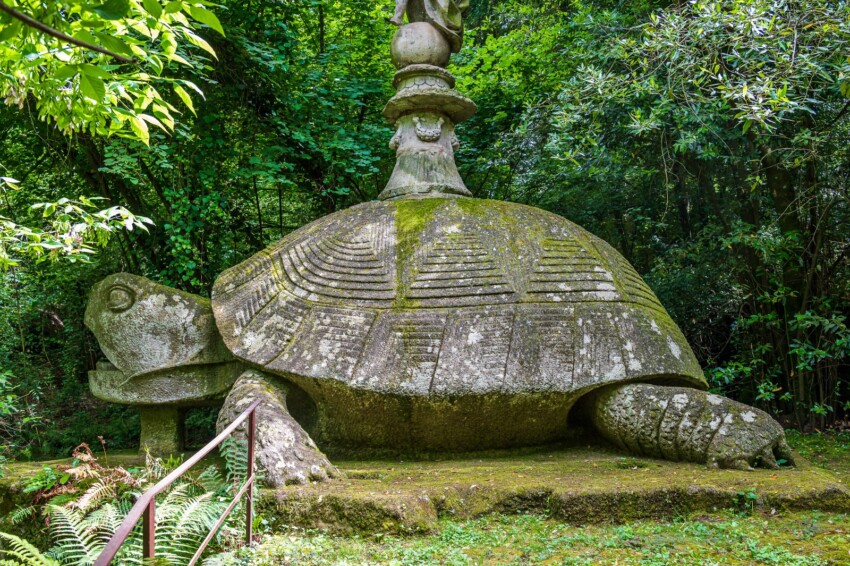
One of the park’s most elegant compositions is that of the Tortoise with Fame: a colossal tortoise on whose back stands the winged figure of Fame, the goddess of glory in Renaissance iconography. The tortoise symbolises slowness, whilst Fame represents the speed at which reputation spreads: the contrast between the two elements is deliberately paradoxical.
The work sits on a slight rise and offers a scenographic perspective that changes noticeably as you approach it. From a distance you first read the tortoise, then gradually the winged figure emerges. The symbolic combination echoes Renaissance noble emblems and could be a reference to the achievements of the Orsinis. The carving of the tortoise’s scales is particularly careful and demonstrates the technical quality of the stonemasons working in the 16th century.
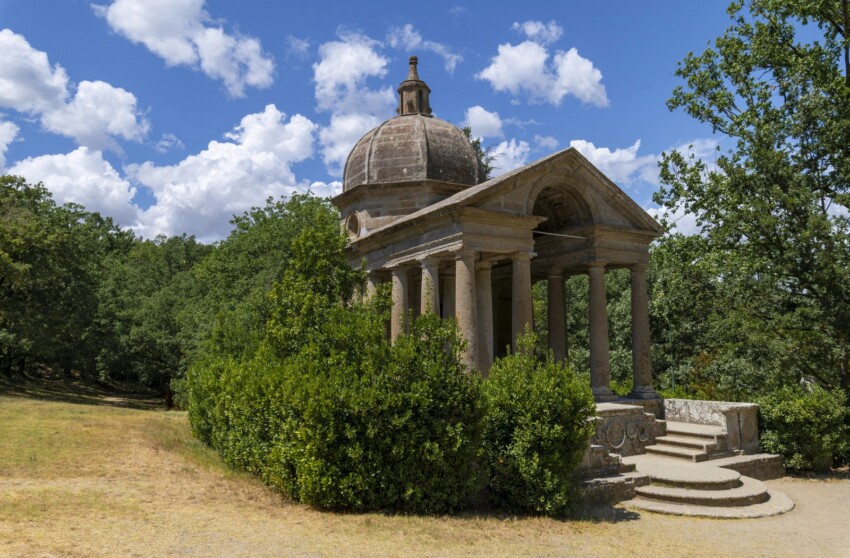
The only regularly planned building in Sacro Bosco is the Orsini Temple, a mausoleum in the form of a classical temple that Pier Francesco Orsini had built in memory of his wife Giulia Farnese, who died in 1560. The structure is relatively austere compared to the sculptural excesses of the rest of the park, and it is precisely this contrast that gives it particular emotional power.
The interior of the temple is accessible to visitors and retains some original decorations. The dedicatory inscription to his wife is one of the few elements in the park that openly reveals the patron’s personal intentions, suggesting that Sacro Bosco was not merely a garden of wonders, but also a space for processing grief and memory. This place, more than any other along the route, helps one understand the human dimension of the project.
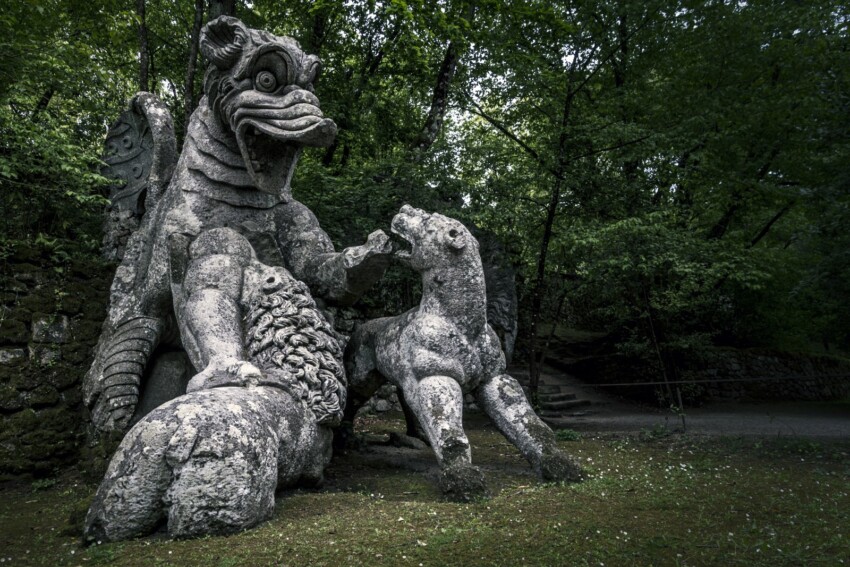
Rising from a depression in the ground, the Dragon Fighting Lions is a triumphant sculpture: a winged dragon with outstretched wings battles two lions attacking it from the sides. The composition is dynamic and full of tension, with open jaws and well-defined claws.
The dragon is a recurring symbol in Orsini heraldry and appears in other works throughout the park as an identifying element of the family. The sculpture is positioned at a point where the woodland becomes denser, and the effect of sudden discovery is greatest: you find yourself face to face with the creature almost without warning, which heightens the visual impact. From a technical standpoint, the dragon’s wings are among the most complex parts of the entire sculptural corpus.
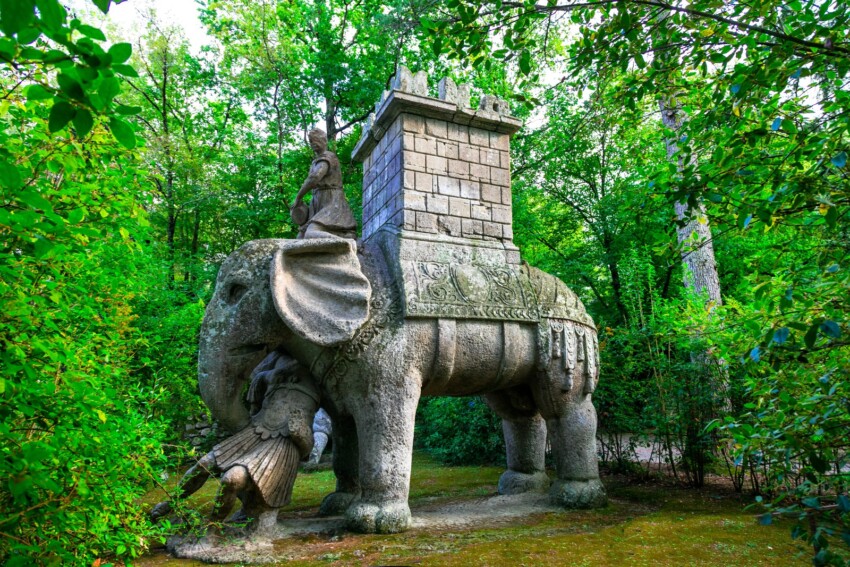
One of the most narrative sculptures in Sacro Bosco is that of the Elephant with Tower: a colossal pachyderm with a tower in the saddle carrying a Roman soldier in its coiled trunk, likely an allusion to the military exploits of the Romans who used war elephants. The work is often connected to episodes from the Punic Wars and the figure of Hannibal.
The elephant is represented with remarkable realism for the era, with skin wrinkles and proportions relatively faithful to the real animal, despite the inevitable stylisation in stone. The tower on its back is an architectural element that references medieval iconographic traditions of the elephant as a war animal. This sculpture is among the most appreciated by younger visitors for its immediate narrative character.
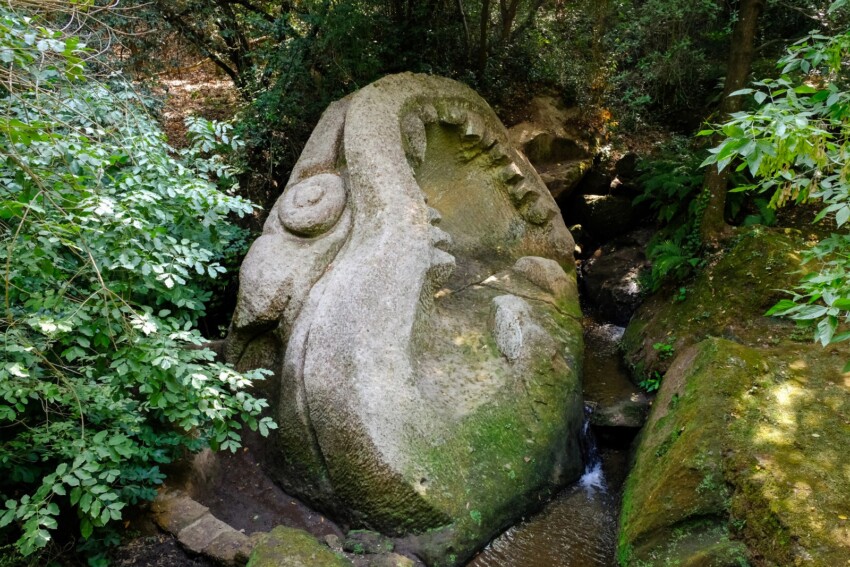
In one of the lower, damper areas of the park lie the aquatic sculptures, among which stands the figure of a whale or sea monster with gaping mouth, flanked by figures of sirens and hybrid creatures. This section of the park is most affected by soil moisture and often appears covered in moss, which adds a patina of antiquity that is particularly evocative.
The marine sculptures are connected to the imagery of medieval and Renaissance bestiaries, where sea monsters represented the dangers of the unknown and the uncontrollable. The presence of these figures in an earthly garden is a further element of the complex iconography of Sacro Bosco, which freely blends classical mythology, esoteric symbolism and the patron’s personal imagination.
The creation of Sacro Bosco di Bomarzo begins around 1552, at the behest of Pier Francesco Orsini, known as Vicino, a descendant of one of the most powerful families of medieval and Renaissance Lazio. Orsini was a cultured man, a lover of letters and the arts, connected to the intellectual circles of 16th-century Rome. He had fought as a soldier in the wars of his time and, according to some sources, had spent years in captivity after the Battle of Ceresole in 1544: an experience that would profoundly mark his vision of the world.
The park’s design is attributed to Pirro Ligorio, the Roman architect and antiquary who would later work on Villa d’Este in Tivoli. Ligorio was one of the greatest experts in classical antiquity of his time and possessed an encyclopedic knowledge of ancient mythology and iconography. His contribution to Sacro Bosco would have been primarily of a design and iconographic nature, whilst the actual realisation of the sculptures was entrusted to local stonemasons specialising in peperino stone-work.
The park was realised over approximately thirty years, until Pier Francesco Orsini’s death around 1583. During this long period, the garden underwent continuous changes and additions, reflecting the evolution of the patron’s thinking and personal experiences. The death of his wife Giulia Farnese in 1560 marked a particular turning point in the project, with the addition of more melancholic and introspective elements such as the funerary Temple.
After Orsini’s death, the park gradually fell into abandonment. Vegetation reclaimed the land, sculptures became covered in moss and earth, and for over three centuries Sacro Bosco remained known only locally as “the little grove of monsters”. It was the surrealist Salvador Dalí who “rediscovered” it in 1938, photographing it and helping to spread it through international artistic circles. Dalí considered it one of the world’s most fascinating places, comparing it to his own dream visions.
The park’s definitive restoration began in the 1950s, when the Bettini family purchased the property and undertook lengthy work to restore and clean the sculptures. Today the park is managed by the descendants of the Bettini family, who have transformed it into a tourist site open to the public whilst maintaining the wild and mysterious atmosphere that characterises it.
The interpretation of Sacro Bosco’s iconographic programme remains the subject of debate among scholars. The theories proposed over the decades include Neoplatonic, alchemical, esoteric, proto-Masonic, autobiographical and even political critique readings. The inscription at the park’s entrance — “You who wander through the world seeking, then tell if so many marvels were made by deception or truly by art” — seems to deliberately invite interpretative ambiguity, suggesting that the creator himself did not wish to provide a single key to understanding.
Admission to Bomarzo Monster Park is paid and tickets can be purchased online. The park is not included in the main city cards in the area or in the Roma Pass, as it is a privately-run family-managed facility. Official audio guides are not available within the park, but you can find local tour guides who organise accompanied visits departing from Viterbo or Rome.
The Parco dei Mostri di Bomarzo is open year-round, seven days a week, with opening times varying seasonally. Generally speaking, the park opens at 9:00 am and closes at sunset (with last entry approximately one hour before closing). During summer, opening hours extend until 7:00 pm–8:00 pm, whilst in winter closing times may be brought forward to 5:00 pm. It’s essential to check the updated opening hours on the official website before your visit, particularly around public holidays or in the event of adverse weather conditions.
A complete visit to the Sacro Bosco typically requires around approximately 2 hours. The route covers uneven terrain with inclines, descents and uneven surfaces. We recommend wearing comfortable, sturdy walking shoes suitable for unpaved ground. Following recent rain, some sections may become muddy.
The ideal time to visit the Parco dei Mostri is spring (April–May) and autumn (September–October), when the vegetation is lush without being overwhelming and temperatures are mild. Summer can be very hot and, whilst the route is largely shaded, there are sunny stretches. Winter offers a more bare but enchanting view of the park, with Tuscia’s mist enveloping the sculptures in an almost supernatural atmosphere. Weekday mornings are when the park is least crowded and the sculptures are most enjoyable.
A car is the most convenient way to reach Bomarzo. From Rome, take the A1 Motorway (Milan–Naples) heading north to the Attigliano exit, then follow signs for Bomarzo. The journey is approximately 80 km and takes 60–75 minutes. Alternatively, you can exit at Orte and continue on the SS205. The park has a free car park adjacent to the entrance.
From Viterbo, the distance is approximately 20 km, taking 25–30 minutes via the SP5.
The nearest railway station is Orte, with connections to Roma Termini via regional trains in approximately 50–60 minutes. From Orte, you’ll need to continue by taxi or private transfer to Bomarzo (approximately 15 km). There is no direct public bus connection between Orte station and the park.
Alternatively, you can reach Viterbo on Cotral buses from Rome’s Saxa Rubra station (connected by the Metro A at Flaminio stop), with frequent departures and a journey time of approximately 75–90 minutes. From Viterbo, however, getting to Bomarzo remains difficult without a private vehicle.
The most practical solution for those without a car is to book an organised tour departing from Rome. Several agencies offer day trips combining the Parco dei Mostri with Viterbo or other Tuscia sites. These tours include transport, park admission and often a specialist guide.
Travellers arriving at Rome Fiumicino Airport wishing to visit Bomarzo the same day can hire a car directly at the airport: all major car rental companies are located in Terminal 3. The route from the airport to Bomarzo is approximately 110 km, with a driving time of approximately 90 minutes.
City Card allow you to save on public transport and / or on the entrances to the main tourist attractions.
 Hotel
Hotel  Budget accommodations
  Apartments
  Family Hotel
  Luxury Hotel
  Resorts