There are numerous tourist passes and city cards available to purchase in Rome. Here are the best ones, based on the attractions they include and their costs.
Once you’ve decided that Rome will be your next destination for a weekend getaway or a proper holiday, it’s time to start saving money. You’ll certainly want to see as many museums and monuments as possible, many of which charge admission. But as with many European cities, Rome offers passes and tourist cards that grant entry to the city’s main attractions, unlimited access to public transport and more. For a single payment, these can work out cheaper than buying individual tickets.
Rome doesn’t have a single official city card like some other cities do. Instead, there are several passes to choose from. It’s easy to get confused, especially as some offer fairly similar benefits, but the golden rule remains the same: the more you visit, the better the value.
With our guide, we’ll help you make sense of the various cards so you can navigate Rome’s different passes with ease.
Choose the one that suits you based on your travel needs and habits, carefully considering how many museums you plan to visit, how many paying monuments you’ll enter, and how much you’ll use public transport.
Roma Pass
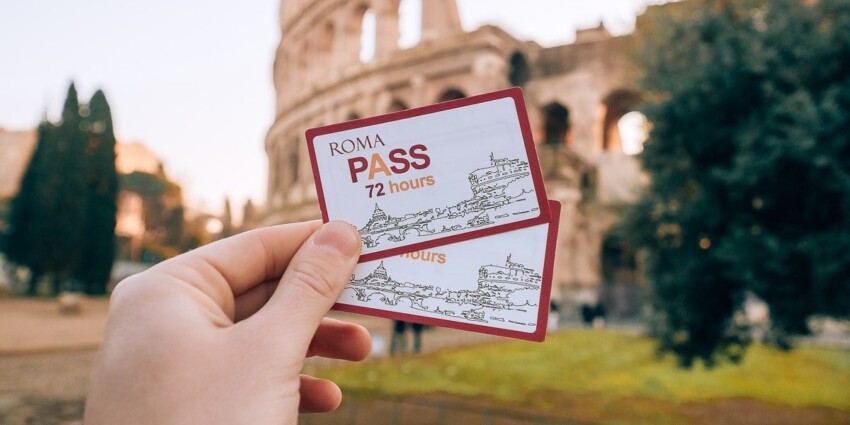
The Roma Pass is one of the most popular tourist cards among visitors to Rome. It’s available in two versions: one valid for 48 hours and one for 72 hours. It’s promoted by Roma Capitale and the Ministry of Cultural Heritage and Activities, in collaboration with ATAC.
The 72-hour Roma Pass is valid for 3 days from first activation and offers free entry to two museums from a selection of 45 participating venues, including archaeological sites and experiences, with reduced rates from the third entry onwards. The 48-hour version is valid for 2 days from first activation and offers free entry to just one museum, with reduced rates from the second entry onwards.
The differences between the two cards end there, as they both provide the same additional benefits: unlimited free access to Rome’s urban public transport network operated by ATAC, discounts and special prices for exhibitions, attractions and tourist services, dedicated museum booking options, and free access to monitored P.Stop toilet facilities.
Additionally, when you buy a Roma Pass, you’ll receive a Rome map highlighting tourist information points, underground stations and all the main attractions in the city that can be accessed with the Roma Pass.
Transport
As mentioned, the Roma Pass includes Rome’s public transport managed by ATAC for 48 or 72 hours depending on which version you’ve purchased. In particular, you have access to all local transport including buses, trams, underground lines A, B, B1 and C, and trains on the Roma-Lido, Roma Flaminio Piazza del Popolo-Viterbo (as far as Sacrofano) and Roma-Giardinetti routes.
Transport to and from Ciampino airport is also included: specifically, the Roma Pass covers ATAC bus line 720 to and from Ciampino Airport, with departures and arrivals at Laurentina Metro B station, and line 520 to and from Ciampino, with departures and arrivals at Subaugusta and Cinecittà Metro A stations.
Fiumicino airport, unfortunately, is not covered by the Roma Pass (Leonardo Express train, FL1 train, local urban services), nor are special ATAC connections and Trenitalia regional FL trains.
Museums
There are over 45 museums, monuments, archaeological areas and experiences in the Roma Pass network. You can visit two of them free of charge with a 72-hour card, or one with a 48-hour card. Remember that once you’ve used up your free entries, you can visit all the other museums and attractions at reduced rates.
Among the most interesting museums included in the scheme and therefore accessible free with the Roma Pass are the Capitoline Museums, the Ara Pacis, Centrale Montemartini, and marvels such as the Colosseum, Circus Maximus, Borghese Gallery, the Via Appia monumental complex and Castel Sant’Angelo.
The selection of contemporary and scientific museums is also worth noting, including the MAXXI – National Museum of 21st Century Arts and the Rome Zoology Museum.
Discounts
By purchasing a Roma Pass, you’ll be entitled to a range of discounts at various city attractions. For example, you can benefit from a 15% reduction on Augustus Welcome to Rome, the most fascinating and striking show dedicated to Rome, or a €2 discount on entry to the Bioparco, Rome’s zoo. There’s also a €5 discount on full-price tickets for Cinecittà World, the film and TV theme park, and €2 off entry to the Leonardo Da Vinci Experience.
How to use it
To use the Roma Pass, you need to fill in the back with your name, surname and activation date after purchase. The card becomes active for 48 or 72 hours when you first access a site/museum/experience, or when you first travel on public transport. Remember that you must validate the card on your first use of public transport, even if you’ve already visited a museum beforehand.
The card should be presented on request in case of inspections, along with a valid form of identification.
The Omnia Card, officially OMNIA Vatican & Rome, is a card developed through collaboration between Roma Capitale, Zètema Progetto Cultura and the Opera Romana Pellegrinaggi (ORP). It’s an integrated tourist pass that allows you to visit a range of attractions linked to the Vatican and Christian religion without queuing and with preferential entry.
The card comes in two versions: 24 hours or 72 hours. Be aware that the duration isn’t the only difference – the services included also vary. For example, only the 72-hour version includes transport.
With either card, you can purchase add-ons to visit an additional selection of Rome’s museums, monuments and attractions, including a guided tour of Palazzo Lateranense and the Lateran complex with audioguide, Rome’s catacombs, the papal gardens at Castel Gandolfo, a guided visit to the Basilica of Santa Pudenziana and its underground areas, the Colosseum archaeological park which also includes the Roman Forum and Palatine, and much more.
Alternatively, instead of buying the full Omnia Card, you can purchase hybrid solutions combining the Roma Pass with a single attraction, such as Roma Pass + Carcer Tullianum, Roma Pass + Lateran complex with audioguide, or Roma Pass + a catacomb of your choice.
Omnia Card 24 hours
The 24-hour Omnia Card gives access to the Vatican Museums and Sistine Chapel, one ride on a hop-on hop-off open bus, entry to the Carcer Tullianum, Rome’s oldest prison, entry to the Basilica of San Giovanni in Laterano and cloister with audioguide, entry to the Treasury Museum, a guided tour of the Catacombs of San Callisto and the Vox City Guide app, a helpful digital city guide.
In contrast, the 72-hour Omnia Card, in addition to being valid for 3 days rather than 1, includes the 72-hour Roma Pass, thus providing unlimited access to Rome’s public transport and free entry to 2 museums from the Roma Pass network. It also grants access to the exclusive audioguide app for St. Peter’s Basilica.
On the Tiqets platform, you can purchase two digital cards: the Roma Tourist Card and the Vatican City Pass.
Roma Tourist Card
The Roma Tourist Card is a digital pass that provides access to Rome’s main attractions. It includes:
Priority last-minute entry to the Colosseum, Roman Forum and Palatine with digital audioguide of the Colosseum.
Guided entry to the Vatican Museums and Sistine Chapel with unlimited time to spend inside.
Audioguide app featuring over 130 points of interest throughout the city, with images, descriptions and expert audio commentary, plus digital maps and offline interactive navigation.
Audioguide app for the Pantheon, with 9 points of interest, plus images, descriptions and interactive digital maps.
Exclusive 10% discount on other Rome attractions purchased via the Tiqets platform thanks to a personal discount code you’ll receive by email after purchase.
To use the Roma Tourist Card, simply select your visit date and number of tickets, then make a secure online payment. Your tickets will be sent by email, so you just need to follow the instructions and head to the attractions’ entrances.
The Vatican City Pass allows you to visit St. Peter’s Basilica, the Sistine Chapel and the Vatican Museums. By purchasing this digital card, you’ll be able to enter the Vatican Museums with skip-the-line entry, accessing all the rooms and galleries open for you to explore at your own pace. The pass also allows entry to St. Peter’s Basilica with a guided tour in English or French.
Finally, the Vatican City Pass includes entry to Castel Sant’Angelo with a guided tour and access to hop-on hop-off buses.
As with the Roma Tourist Card, to book the Vatican City Pass you’ll need to select your visit date and number of tickets on the website, then proceed to payment. You’ll receive email tickets, so you can head to the attractions’ entrances.
GoCity, previously known as Leisure Pass Group, is a leading American private company in the tourist pass sector. It operates in over 30 cities across all continents, including Rome, the only Italian city in its network.
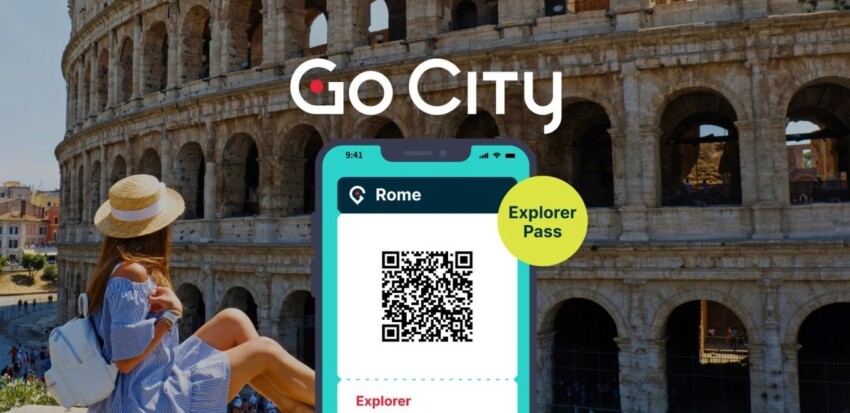
GoCity’s product for Rome is called the Explorer Pass, which gives access to over 35 attractions including the Colosseum, Vatican Museums, cooking classes and much more. It works slightly differently because the choice of pass isn’t based on the number of days’ validity, but rather on the number of attractions or activities you can visit, called options.
Passes are available with 2, 3, 4, 5, 6 or 7 options, and discounts are available for children aged 5 to 15.
Examples of activities/options include the Colosseum, Roman Forum and Palatine tour, Vatican Museums and Sistine Chapel with reserved entry, Italian cooking classes, Rome sunset tours, Italian craft beer and gourmet pizza tastings, Rome catacombs tours, Italian breakfast in the city centre, papal audience, Hard Rock Café entry with skip-the-line access, virtual reality experiences of all kinds, guided tours of St. Peter’s Basilica or the Pantheon and much more.
As an American company, it’s natural that the GoCity Explorer Pass includes many activities aimed at showcasing Italian culture, particularly culinary, with activities involving breakfasts, aperitivos or tastings. For this reason, this pass may be less suited to Italians, but still evaluate the cultural activities it offers and make a decision.
Touristation is a Rome tour operator that has launched two types of pass, namely the Roma Super Pass with public transport and the Experience Pass Roma and Vatican.
Roma Super Pass with public transport
The Roma Super Pass with public transport includes entry to numerous attractions with audio guide, including the Vatican, the Colosseum, St Peter’s and much more, plus unlimited local public transport travel.
The Roma Super Pass is valid for 3 consecutive calendar days from activation, which coincides with your first museum entry.
Specifically, the pass includes skip-the-line entry to the Vatican Museums and the Sistine Chapel, the official audio guide for St Peter’s Basilica (without queue-jumping), entry to the Colosseum archaeological park, which includes the Colosseum itself, the Roman Forum and Palatine Hill, as well as unlimited journeys on Rome’s public transport (metro, bus, tram), and a range of additional benefits including free Wi-Fi at the meeting point, the Tourism Office at Viale Vaticano 95 and a 25-minute multimedia presentation on Ancient Rome at the Touristation Vatican at Viale Vaticano 95.
Please note that purchasing this special pass does not include access to the dome of St Peter’s Basilica, nor does it include guided tours of the sites where access is permitted.
To receive the paper public transport ticket, you’ll need to show your pass purchase receipt at the Touristation office at Viale Vaticano 95.
The Experience Pass Roma and Vatican is available in three denominations: 3, 5 or 7 attractions to visit. You’ll have a choice of over 30 in total, including the Vatican itself.
The pass is collected by presenting the voucher from your smartphone, which you’ll receive after purchase, at the Touristation office located at Piazza Ara Coeli 16, near Piazza Venezia. The office is open from 09:00 to 16:30. Upon activation, the Experience Pass will be activated when scanned at your first attraction and will then be valid for 90 days.
The pass purchase also includes a tourist map to help you plan your itinerary and navigate your way around Rome.
Among the attractions included in the pass (remember: you’ll need to choose 3, 5 or 7 depending on which pass you’ve purchased) are the Vatican Museums and the Sistine Chapel with skip-the-line entry, the open bus for the Vatican Gardens, the Colosseum archaeological park with skip-the-line entry, a guided tour of the Catacombs, a guided tour of St Peter’s Basilica, one day of Hop-on Hop-off bus, a 2-hour bike rental, breakfast or aperitif on a panoramic terrace, a guided tour of the Pantheon and much more.
It’s also worth noting the option to choose some activities outside Rome, including visits to the gardens of the Papal Villa or the Papal Palace at Castel Gandolfo and the Villas of Tivoli, Villa Adriana or Villa D’Este.
Vatican + Colosseum Pass
The last Rome pass we’d like to suggest is the Vatican + Colosseum pass, useful if you want to visit just these two attractions. Essentially, it’s a combined ticket that offers a discount on the total cost.
It’s worth noting that the Vatican visit includes the Vatican Museums with the Sistine Chapel, as well as St Peter’s Basilica, whose entry is always free, whilst the Colosseum visit includes the entire archaeological park, which also covers the Roman Forum and Palatine Hill.
There are other small advantages to purchasing the Vatican + Colosseum pass: firstly, it offers priority entry, allowing you to skip the crowds thanks to a ticket valid for early morning, plus it lasts 2 days, which allows you to visit the two attractions on two different days; the first day is dedicated to the Vatican, the second to the Colosseum.
As you’ve been able to read, Rome’s tourist cards are truly numerous and choosing which one to buy can prove to be a difficult decision. Let’s recap.
The 72-hour Omnia Card is the one that includes the most attractions, and its purchase also includes the Roma Pass, so by buying it you’ll be entitled to both all public transport and the benefits included in both cards. It’s certainly an excellent all-inclusive choice if you want to do the classic Rome weekend without any worries. Alternatively, if you’re staying in Rome for 3 days, there’s the solution offered by Ticketstation, the Roma SuperPass, which also includes transport.
If, however, you’re staying in Rome for 2 or 3 days but prefer to spend your time enjoying the city in the open air rather than rushing from one monument to another, then the best choice is the Roma Pass which is also the most economical, including only transport and 1 or 2 attractions.
Finally, if your time in Rome is limited, perhaps just 1 or 2 days, but you still want to visit the main points of interest, you could consider the Roma Tourist Card or the Go City Explorer Pass in the 2-3 attractions version. However, transport is not included in these cases.
Is it worth buying a Rome city card?
Obviously it depends on how much the characteristics of the individual pass match your needs. As a general rule, we always recommend purchasing a pass that covers most of the experiences you’ve decided you want to have in Rome, so you can be sure of the value for money (after all, that’s what they were created for!).
Clearly, if a pass includes 5 attractions and you only visit 3, it won’t be worth it for you… Don’t underestimate the convenience of having a card that includes transport either. Unfortunately, Rome isn’t renowned for being an “easy” city for a tourist, so having a pass that allows you to hop on and off any vehicle is certainly a great time-saver and will certainly give you greater peace of mind during your stay.
Finally, we’d also like to suggest that you consider the value of passes if your group includes many children or young people. In fact, entry to museums, monuments, galleries and archaeological sites in Rome is free for under-18s, whilst those aged 18 to 25 pay a reduced entry fee. Lastly, remember that Rome’s public transport is free for children under 10 years old, when accompanied by a paying adult.

 Hotel
Hotel  Budget accommodations
  Apartments
  Family Hotel
  Luxury Hotel
  Resorts